
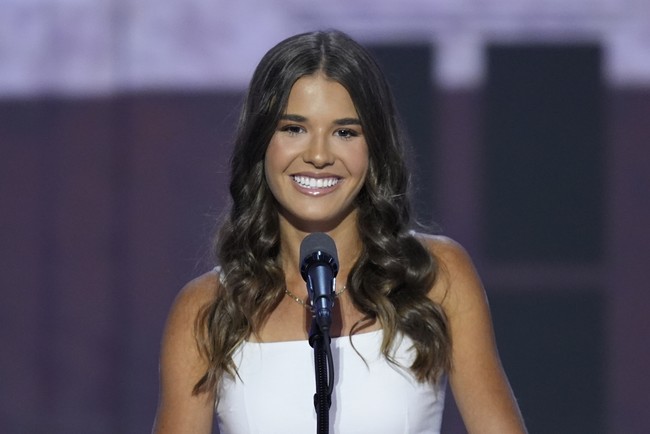
‘He’s Not Running’: President Trump’s Granddaughter Kai Talks Politics and Her Future
Kai Trump, age 18, spoke frankly about staying out of politics, the strain of social media, and the oddities of dating with Secret Service protection during a recent podcast appearance. Her remarks touched on family loyalty and the unpredictability of future elections, including a blunt observation about President Trump not running again. She also reflected on how extremes on both sides and the filter of social feeds shape public opinion and personal choices.
On a popular podcast episode, Kai Trump made it plain that she plans to avoid a political life. She described politics as “such a dangerous thing” and said she would “never run” for office, framing her stance as a conscious choice to keep distance from the public fray. That choice comes from watching how social media and polarized voices push people toward extremes rather than middle ground.
She argued the current online environment amplifies radical positions, saying, “I think if both sides met in the middle, everyone would be so much more happier and I think there’s a lot of this radical left and there’s a radical right, and there’s a lot of people that are getting too extreme.” Kai went on to point out how social platforms reinforce those swings, making feeds feel one-sided and intensifying division. Her view was that the echo chambers crafted by algorithms contribute to heightened emotions and distorted public debates.
Kai added nuance to her position by describing herself as centered, noting there is “no bad blood” in her personal outlook despite the larger political battles. She stated, “I’m very much in the middle. I’m kind of like ‘It is what it is.’” Even as she affirmed familial support—”Obviously, I’m going to support my grandpa, my family member”—she made clear that active political engagement is not on her agenda. That balance underscores a generational perspective on loyalty versus public ambition.
The conversation briefly dipped into odds and speculation when the host mentioned Polymarket projections about a potential 2028 run. Kai estimated the probability at roughly four percent and agreed with the host’s reference to a 4.1 percent figure, treating it as a remote possibility. When directly asked whether she thinks President Trump could run again, she replied, “I don’t…he’s not running for a third term.” The comment was delivered plainly, closing off that line of conjecture from her point of view.
Still, Kai acknowledged uncertainty in politics and conceded that much can change between now and 2028. She accepted that events, motives, and public sentiment are fluid, so absolute predictions are risky. That realism sits alongside her firm personal decision to avoid pursuing elected office herself. It also shows how public figures and their families navigate both certainty about personal choices and humility about political futures.
Kai also spoke about the practical impact of protection details on daily life, especially in the realm of dating. She described the awkwardness of Secret Service agents positioned nearby during private moments, saying, “To be honest, it’s really awkward trying when you’re going on a date with a guy and [Secret Service agents] are like two tables behind you.” The presence of agents changes how she experiences ordinary social interactions and forces a constant awareness of security realities that most peers do not face.
She explained that the discomfort eased over time as she learned to focus and “pretend like they’re not there,” but admitted the early months were tough. That adaptation reflects a coping strategy many public figures’ families must develop, balancing privacy with necessary safeguards. Kai’s candidness about the awkwardness humanizes the often-anonymous side of security details and shows how intimacy and protection can clash in everyday settings.
Throughout the interview, Kai maintained a tone of pragmatic detachment, preferring not to engage in headline-making political activity while still recognizing family ties. Her stance is straightforward: support relatives personally without stepping into the arena herself. That position provides a window into how younger members of prominent political families negotiate identity, loyalty, and the pull of public life.
Her remarks also highlighted broader cultural dynamics: a generation shaped by social platforms, skeptical of extremes, and wary of the personal costs of visibility. Kai’s observations about social media feeds and ideological silos reflect a common critique among young people who grew up online. By voicing a desire for moderation and private normalcy, she tapped into a wider conversation about how to live in a polarized media landscape without becoming consumed by it.


Add comment