
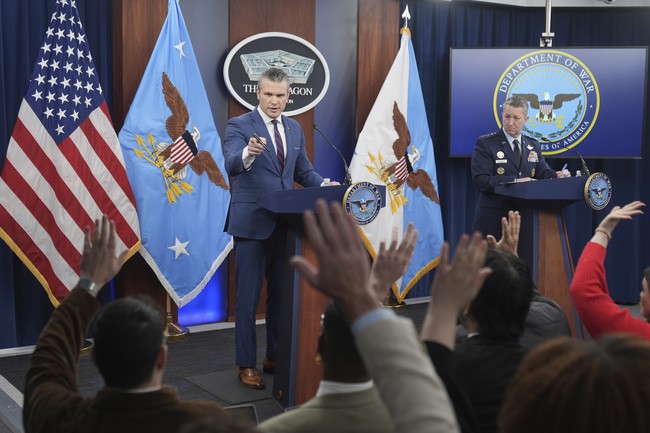
Secretary of Defense Pete Hegseth and Joint Chiefs Chair Gen. Dan Caine gave a briefing on Operation Epic Fury that painted a picture of mounting U.S. pressure on Iran, claimed shrinking Iranian capabilities, and hinted that the next days could determine the campaign’s direction.
Hegseth opened by saying the “upcoming days will be decisive,” a line he repeated to make clear the administration believes momentum is on its side. He portrayed a campaign that is tightening its grip, stressing increases in American firepower and a shrinking window for Iran to respond effectively. That tone set expectations that more intense operations could come if Iran does not change course. Officials framed the effort as precise and escalating rather than aimless or indefinite.
“Iran knows that, and there’s almost nothing they can militarily do about it,” Hegseth claimed.
The Defense Secretary said that “American firepower is only increasing,” while saying Iran’s is “decreasing.”
“Just one month in — only one month — we set the terms,” Hegseth said.
Hegseth highlighted immediate tactical indicators, noting that the past 24 hours showed the “lowest number of enemy missiles and drones fired by Iran.” He said U.S. forces had recently destroyed a command bunker and carried out “200 dynamic strikes alone” in a single night. Those specifics were offered to show operational tempo and to underline the message that the United States is applying sustained, varied pressure. The implication was that such attrition will compound over time and stress Iran’s ability to respond.
President Donald Trump shared video material of a major strike near Isfahan, signaling an effort to make the campaign’s effects visible to both domestic and international audiences. Officials used the footage and strike tallies to reinforce the narrative of decisive action and to demonstrate results. Making such operations public also serves a strategic purpose: to shape perceptions among Iran’s leadership and allies. Transparency about capability and resolve is being used as leverage in this phase.
Hegseth told reporters that there had already been elements of “regime change,” and urged Iran to accept negotiated terms if it was “wise.” He stressed that the United States expects the new decision-makers to behave differently if they seek de-escalation. The message was blunt: accept known terms or face continued, possibly escalatory, pressure from U.S. forces. Officials framed that as both a warning and an open door.
“President Trump doesn’t bluff, and he doesn’t back down — You can ask Khamenei about that,” he declared.
“This new regime, because regime change has occurred, should be wiser than the last…The terms of the deal are known to them. If Iran is not willing, then the U.S. war department will continue with even more intensity.“
On the subject of ground forces, Hegseth was careful but clear that lessons from past wars shape current thinking. He said, “You can’t win a war if you tell your adversary what you’re going to do,” and emphasized keeping options available rather than telegraphing intentions. That stance preserves strategic flexibility and denies Iran the chance to adapt to predictable moves. It also signals to partners and rivals that the United States is weighing options without committing publicly to specific paths.
Hegseth added that maritime commerce in the Strait of Hormuz is increasing as more ships transit the area, though he urged other nations to contribute more to shared security. That comment pointed to a broader diplomatic and logistical effort to normalize trade routes and reduce the risk of regional escalation. It also speaks to the economic stakes tied to military operations and how stability in shipping lanes is a practical goal of the campaign. Allies are being reminded they have roles to play beyond rhetoric.
Gen. Dan Caine summarized operational achievements, saying the campaign had struck more than 11,000 targets and that U.S. forces had achieved air superiority sufficient to employ B-52s overland. That shift expands reach and payload options for precision strikes, especially against dispersed or mobile targets. The capacity to deploy long-range assets like B-52s over land changes the dynamics of targeting and attrition. It also means the campaign can press advantages against fleeting threats such as mobile missile launchers.
Caine explained that air superiority has improved the ability to take out mobile and hardened systems, addressing one of the bigger operational concerns. He described sustained efforts to degrade missile and drone networks and to neutralize naval threats that have plagued the region. On the maritime side, Caine said U.S. forces have “taken out more than 150 ships” tied to Iran’s capabilities, alongside work against mine-laying and depot networks. That multi-domain pressure targets movement, supply, and the industrial base that supports future attacks.
He also detailed a focused campaign against Iran’s defense industrial base, listing factories, warehouses, and nuclear research facilities among legitimate military targets. “This includes factories, warehouses, nuclear weapons R&D labs, and the associated infrastructure required for Iran to reconstitute its combat capability.” The goal, officials said, is to shrink Iran’s ability to rebuild offensive forces and to force decision-making back to political leaders. That approach aims to keep pressure on centers of production and planning rather than only hitting tactical units.
The line from Hegseth and Caine was consistent: pressure is increasing, Iranian capacity is being reduced, and key decisions lie ahead. Officials framed these operations as carefully measured but ready to escalate if diplomacy fails. The scene they painted was one of controlled intensity intended to compel a change in behavior while protecting U.S. forces and strategic interests.



Add comment