
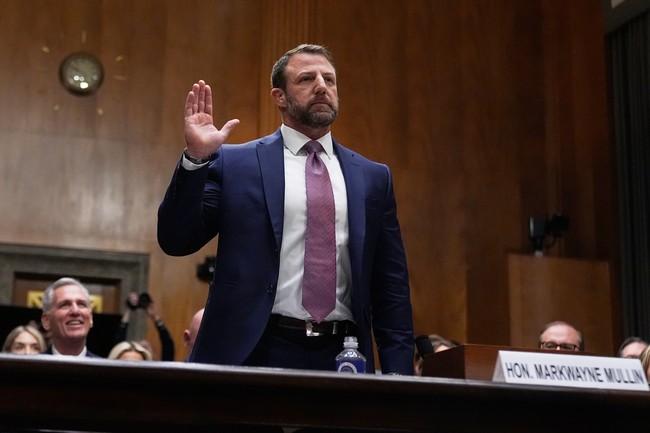
I recap the clash between Sen. Markwayne Mullin and Democrats at his DHS confirmation hearing, focusing on Elissa Slotkin’s grilling about ICE, election security, and the role of the department, while preserving the exact quotes from the exchange and embedding the original video tokens.
The hearing was tense but not a conflagration, and it showed two competing views about the role of DHS in law enforcement and elections. Democrats, led by Sen. Elissa Slotkin, pushed a narrative that DHS must remake itself and answer for perceived abuses, while Mullin insisted the secretary enforces laws passed by Congress and will protect election integrity. The hearing highlighted the usual partisan theater, but it also exposed real differences about how DHS should partner with local law enforcement and the limits of its authority.
Slotkin opened with an emotional appeal about the Jewish community and security grants, arguing the grant program needs reform so synagogues and other institutions are safer. She framed her case as bipartisan concern and asked Mullin to commit to working with her on grant reform, a request he accepted, saying he would “absolutely welcome an opportunity” to collaborate. That exchange set the stage for sharper questioning about ICE and election administration.
SLOTKIN: I think, you know, in general, your position — or your future position as Secretary of Homeland Security, sits at like, the fulcrum of these big issues that we’re having in this country. Just big cultural issues. The use of law enforcement in our streets, and where our rights begin and end. And then, our elections. Our democracy. And given the importance of that, I think it’s important that we state really clearly where you are on these two issues. First and foremost, on the use of ICE.
Slotkin painted immigration enforcement in stark, accusatory terms, invoking images of overreach and warrantless entries. She even suggested DHS officers had acted like a foreign occupying force, tying that claim to broader cultural anxieties. Her tone was clearly designed to put Mullin on the defensive and to produce a viral soundbite about ICE reform.
That was exactly the moment Senators like Slotkin expected to corner Mullin, asking him to promise to put reforms into law—an odd demand because the secretary enforces statutes, not writes them. Mullin refused the trap politely and plainly, pushing back that the legislative branch makes the laws. He said, “Ma’am, as you know, I can’t make the law, you guys make that.”
SLOTKIN: So, you say you don’t want ICE in the news, you say you want to rebuild trust. Your predecessor was fired because she couldn’t manage that, and people had to go in and bring the temperature down. Can you, without other words, just state clearly what you’d be willing to do to fundamentally reform ICE and put into law to do so, since that trust is gone.
Mullin avoided the bait and emphasized working within legal limits and stronger partnerships with local law enforcement. He proposed practical adjustments, like shifting ICE toward transport and support rather than frontline community-facing operations when possible. That approach reflects a conservative view: enforce the law while avoiding unnecessary federal overreach into daily community policing.
Slotkin pivoted to election security with the explicit goal of forcing Mullin to relitigate 2020 and to say whether he accepted established outcomes. She raised the familiar Democratic fear that future federal involvement in elections could be abused. Her line of questioning tried to conflate rhetoric about 2020 with potential DHS actions in 2026 and 2028, pressing for guarantees that federal officers would not be sent to polling places.
SLOTKIN: Let me turn to elections. The Department of Homeland Security has the mandate since the Obama era for securing our elections infrastructure. That’s an important job, and you’ll be secretary. The president has continued to say that he won the 2020 election even though there’s been 60 court cases saying the opposite. He has said he wants to federalize the elections, he has said, name-checked cities, including Detroit. He has said voting machines are inaccurate, he has said in the State of the Union, I was on the Senate floor, paraphrase, that if his side doesn’t win in November then the elections were rigged, which is the exactly what he said eight months before the 2020 elections. You have your own history, you did not certify the 2020 election. There are people at the Department of Homeland Security, three people significantly, who are well-known election deniers now running election security functions.
Who won the 2020 election?
Mullin answered by reiterating that the president was sworn in and by redirecting to his duty to ensure elections are fair and secure. He then pointed to the Save America Act and framed citizen verification as a reasonable federal standard to protect election integrity. That answer aimed to reassure conservatives who worry about eligibility while also deflecting Democratic attempts to paint DHS as a tool for political interference.
Slotkin doubled down, asking whether uniformed officers would be placed at polling places, evoking images she hoped would alarm viewers and push a narrative of intimidation. Mullin was careful: federal presence would only follow specific, credible threats and always in coordination with local authorities. He rejected the idea of arbitrary deployments and emphasized the department’s mission to support, not to intimidate voters.
MULLIN: Ma’am we know that President Joe Biden was sworn into office, he was the president for the last four years, but I do believe…
SLOTKIN: [Flustered] That’s not, — who do you believe won the election?
MULLIN: I believe my job as Department of Homeland Security secretary will be to make sure that we assure that the elections are fair and people can trust them.
SLOTKIN: Does the federal government run the elections process or do states?
MULLIN: It’s very clear in the Constitution that the states control state elections and then there is some federal oversight that’s on it, but the federal government can set some standards. So, if you’re talking about the Save America Act, requiring you, which is within the Constitution by the way, requiring individuals to be citizens of the United States, I don’t think it’s too much to ask somebody to prove they’re a citizen of the United States.
Other Democrats tried similar lines, asking Mullin to re-litigate past disputes and suggesting DHS resources were being misapplied. He repeatedly returned to the same conservative message: DHS enforces laws, partners with state and local officials, and must protect both national security and civil liberties. The hearing made one thing clear—policy fights over DHS will be fought hard, and Republicans will press for clarity that the department will enforce law, not invent it.
WATCH:
WATCH:
WATCH:
WATCH:


Add comment