
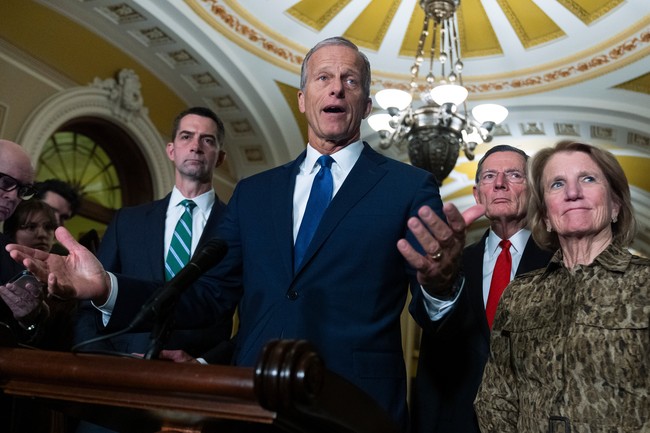
The Senate Leadership Fund has announced a major $342 million ad buy aimed at protecting Republican control of the Senate, and this article walks through the eight battleground states SLF named, the competitive dynamics in each race, and why Republicans can still hold the chamber in 2026.
“The top Senate GOP super PAC is laying down a massive $342 million ad buy in an aggressive push to help Republicans maintain control of the Senate, reserving airtime in eight battleground states in this year’s midterm elections. The Senate Leadership Fund, a group with close ties to Majority Leader John Thune, announced the plan Monday.”
The SLF is focusing on a mix of Republican-held and Democrat-held seats with the largest allocations to Ohio ($79 million) and North Carolina ($71 million). Other big allocations include Maine ($42 million), Iowa ($29 million), Georgia ($44 million), Michigan ($45 million), and New Hampshire ($17 million). That spending pattern shows the GOP strategy: defend relatively safe turf while investing where pickup chances exist.
Republicans currently hold a 53-47 Senate majority, and 35 seats are up in 2026, so Democrats need a net gain of four to take control. The national narrative pushes a Democratic takeover, but the map math favors Republicans because many GOP seats sit in states that voted for Trump by double digits. Those kinds of margins usually stick in Senate cycles, especially when incumbents are strong and well-funded.
https://x.com/IAPolls2022/status/2041159892568875010?s=20
Alaska pits Sen. Dan Sullivan against former Rep. Mary Peltola, who is the Democrats’ best recruit in that race but still faces an uphill climb in a state where Republicans have structural advantages. Sullivan is broadly popular and holds a substantial war chest, while the only public polls appear to come from left-leaning sources that show a tight race. Alaska will be watched, but the underlying dynamics favor the incumbent Republican.
Georgia is expensive and brutal, and Sen. Jon Ossoff benefits from enormous fundraising advantage and incumbency. The GOP primary produced Rep. Mike Collins as the leading challenger, and Collins keeps pace in some surveys, but Ossoff’s massive campaign resources give him a cushion. Expect heavy advertising and voter-targeting there, which is exactly why SLF poured money into the state.
Iowa becomes an open-seat fight with Sen. Joni Ernst retiring and Democrats carrying a contentious primary between Zach Wahls and Josh Turek. The GOP likely nominee, Rep. Ashley Hinson, brings a large campaign fund and a favorable statewide profile. Iowa’s electorate has moved right in recent cycles and the Republican nominee should be competitive in the general election.
Ohio features appointed Sen. Jon Husted defending against former Sen. Sherrod Brown, who is attempting a comeback. Brown has shown he can mount strong campaigns and has momentum in fundraising, but Husted benefits from incumbency and the state’s recent Republican tilt. This matchup will be one of the most expensive and closely watched, with turnout and messaging determining the winner.
Maine presents a unique challenge for Democrats because Sen. Susan Collins has a long incumbency advantage, a powerful Senate role, and deep fundraising reserves. Her opponent is a controversial figure who has drawn negative attention and insurgent rhetoric, and polls have shown mixed results. Collins has a track record of outperforming polls on Election Day, which makes Maine a defensive priority for Republicans.
Michigan is an open seat with retiring Sen. Gary Peters and a competitive field. Former Rep. Mike Rogers looks like the strongest Republican contender in general election matchups, and outside groups are already committing significant resources to his effort. The Democratic primary is fractious, and that internal division could hand a tactical advantage to Rogers if Republicans unify early.
New Hampshire leans Democratic federally but former Sen. John Sununu is mounting a serious comeback and leads comfortably in the Republican primary polls. Rep. Chris Pappas is the likely Democratic nominee and holds a modest polling edge in some averages, but Sununu’s name recognition and fundraising make him a credible threat. New Hampshire will be tight and requires targeted ground game work to tilt the outcome.
North Carolina is one of the most consequential toss-ups, with retiring Sen. Thom Tillis leaving an open seat and former Gov. Roy Cooper leading in many surveys. The Republican nominee, former RNC chair Michael Whatley, trails in name recognition and has deferred major ad buys, which gives Democrats a short-term advantage. Historically, the GOP has had strong Senate success in North Carolina, so the race could swing back if Republicans organize and spend efficiently.
Across these contests, the GOP strategy is clear: defend vulnerable incumbents, shore up winnable open seats, and invest where outside groups can move the needle. With SLF’s record ad plan, Republicans aim to blunt Democratic momentum and preserve the narrow majority that protects conservative priorities in the Senate.

Add comment