
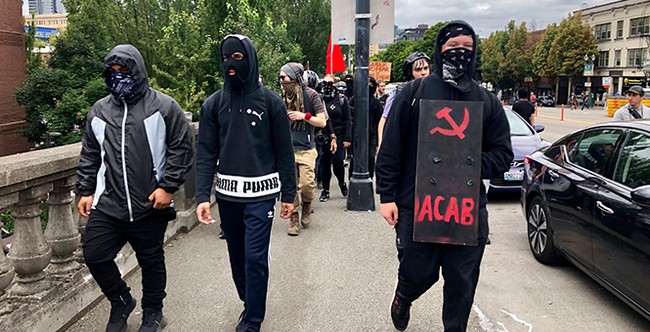
The Department of Homeland Security has accelerated a rule to curb masked demonstrations at federal facilities, aiming to stop agitators who hide behind costumes and face coverings to evade identification while disrupting operations and threatening personnel.
One of the most common tactics used by left-wing agitators at demonstrations is concealing their identities with bandanas, scarves, ski masks, or full character masks that leave only the eyes visible. These coverings make it harder for law enforcement to hold individuals accountable after violent or destructive acts near federal property. Masking tactics have evolved in several cities into theatrical distractions, where costuming serves both to confuse authorities and to draw media attention away from the confrontation.
In Portland, nightly demonstrators near the ICE facility have increasingly adopted full costumes to distract and deceive federal officers, a trend mirrored at other recent protests. These theatrical approaches can hide not only faces but weapons or tools used to damage property, complicating lawful responses. When protest activity crosses into intimidation, threats, or physical harm to federal employees or property, it moves from protected speech into criminal conduct.
Here are a couple of examples:
To address that behavior, DHS moved up the effective date of new conduct rules around federal sites, with the intent of denying cover to those who exploit masks or disguises to avoid identification. The rules cover not only masks but a range of actions that threaten federal property or the people who work there. They are designed to give federal protection officers clearer authority to act when protests turn violent or destructive.
Federal policy language makes the intentional avoidance of detection while violating laws a specific offense. The prohibited conduct section outlines disorderly or violent actions, the use of disguises to evade identification, and creating nuisances like loud noises or noxious odors. That language aims to distinguish lawful expressive activity from deliberate schemes to endanger people or disrupt government functions.
All persons are prohibited from engaging in the following conduct, on federal property or in areas outside federal property, that affects, threatens, or endangers federal property or persons on the federal property —
(a) Disorderly conduct, which includes, but is not limited to, assaulting, fighting, harassing, intimidating, threatening or other violent behavior, lewd acts, or the inappropriate disposal of feces, urine, and other bodily fluids.
(b) Wearing a mask, hood, disguise, or device that conceals the identity of the wearer when attempting to avoid detection or identification while violating any federal, state, or local law, ordinance, or regulation.
(c) Creating a loud or unusual noise, noxious odor, or other nuisance.
Beyond the mask language, DHS emphasized practical changes to how federal facilities are protected. The department expanded charging authority so federal protective services can pursue violations that affect federal property even when the conduct occurs off-site. That broader reach is meant to close loopholes where hostile actors coordinate away from a facility but then act on or against it.
The changes also modernize prohibited conduct to include threats posed by modern technology and tactics, such as unauthorized drone use and tampering with digital networks. Placing standardized notices at federal buildings clarifies expectations for behavior and makes enforcement less arbitrary. The rule also stresses coordination among federal tenants, security teams, and local law enforcement so responses aren’t fragmented during fast-moving incidents.
Journalists and commentators who track protest dynamics argue the policy shift could change how agitators operate. Katie Daviscourt called the update a “game changer” for confronting militants, their media allies, and officials who have downplayed the risks. That phrase captures the argument that more decisive enforcement tools could deter repeat offenders and reduce escalation around federal sites.
Expect legal challenges; policy changes like this often end up before the courts as questions about free speech and public safety collide. Meanwhile, federal officers, including ICE personnel, now have clearer authority to address masked and disruptive behavior that threatens their safety and the operation of detention centers. The policy aims to rebalance protection of federal property with constitutional rights, leaning toward preventing identifiable threats from hiding behind anonymity.
Editor’s Note: The Schumer Shutdown is here. Rather than put the American people first, Chuck Schumer and the radical Democrats forced a government shutdown for healthcare for illegals. They own this.
Help us continue to report the truth about the Schumer Shutdown. Use promo code POTUS47 to get 74% off your VIP membership.
Start locking up these anarchist enemies within!
In their private prison cells they can wear the masks all they want!