
The Democratic fight over Virginia redistricting blew up in their faces, costing them tens of millions and highlighting a hunger for power that tramples process and principle; Republicans see this as proof the other side prioritizes advantage over rules and it’s a political gift heading into 2026.
The Virginia redistricting episode was loud, costly, and ultimately pointless for Democrats. They pushed a plan to gain four congressional seats, spent heavily to make it happen, and watched the state Supreme Court toss the effort for procedural constitutional violations. That outcome underlined a pattern: when the law gets in the way of ambition, some Democrats treat the law like an obstacle to be pushed aside.
Money matters in politics, and Democrats burned a mountain of it chasing a map they could not legally secure. Reports say Democratic-aligned groups poured more than $64 million into the drive, with roughly $40 million traced to a single 501(c)(4) tied to House Majority PAC. Throwing that kind of cash at a flawed gambit not only failed to flip districts, it diverted resources that could have been used for competitive midterm races across the country.
The spending spree wasn’t just wasteful, it was reckless. Republicans had already been out-raising Democrats heading into the midterms, and then national Democrats made it worse by sinking huge sums into a state fight with obvious legal exposure. That reckless allocation of scarce resources plays right into the narrative that Democrats govern by press release and spectacle, not sober political strategy.
Before voters cast their ballots in Virginia’s April redistricting referendum, the 10 wealthiest Republican-aligned political committees had close to twice as much cash on hand as their Democratic counterparts, according to Federal Election Commission records.
Despite this, Democratic-aligned groups poured more than $64 million into their attempt to net four congressional seats by redrawing Virginia’s congressional map, a bet that ultimately failed to pay off after the Virginia Supreme Court invalidated the redistricting process due to a procedural constitutional violation.
That legal defeat wasn’t a secret risk; many observers warned the plan had weak constitutional footing. Yet high-profile Democrats rallied behind it and poured in cash as if a promising headline could overcome a judicial ruling. The result is embarrassment and a reminder that good intentions don’t erase legal realities.
There’s a cost beyond money: credibility. Leaders who champion constitutional tweaks to get an edge end up looking like opportunists. When national figures push for radical fixes—court-packing, changing the Electoral College, or statehood maneuvers—the public sees ambition in search of a mechanism, not democratic reform in search of justice.
Political opponents were quick to pounce, and it’s not hard to see why. One Republican spokesman framed the episode as a cautionary tale about the difference between media hype and effective leadership, calling out the massive expenditures that fizzled. Those attacks will stick because voters remember wasted funds and failed schemes, especially when those funds are meant to defend or expand political power.
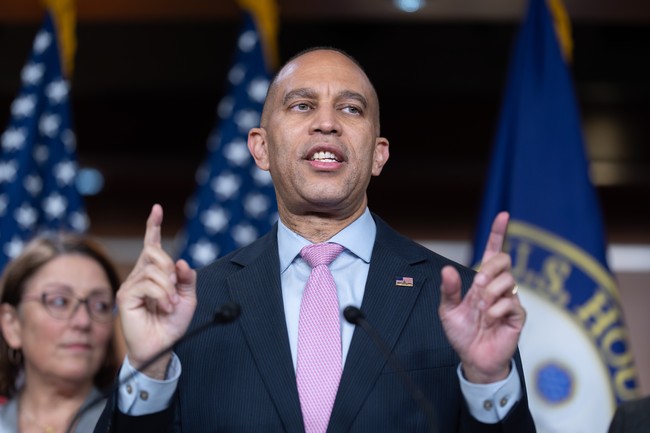
“So-called ‘Leader’ Hakeem Jeffries lit well north of $55 million on fire chasing illegal redistricting fantasies, only to fall flat on his face in spectacular fashion,” National Republican Congressional Committee spokesman Mike Marinella told Fox News Digital. “National Democrats are already drowning in a massive cash deficit against Republicans while the NRCC and our battle-tested candidates continue shattering fundraising records and building momentum for 2026.” [….]
“Jeffries is proving he’s no Nancy Pelosi, and Democrats are getting an expensive lesson in the difference between media hype and actual leadership,” Marinella continued.
Beyond the theater, the practical fallout matters. Funds squandered on failed redistricting can’t be redirected to winning governors’ races, protecting House seats, or bolstering Senate bids. For Republicans, the misstep is an opportunity: it sharpens the contrast between parties on fiscal discipline and political judgment at a time when voters care about competence and results.
Virginia isn’t the only place where voters notice when elites chase power at the expense of process, and that perception shapes turnout and persuasion. The takeaway is simple for the GOP: spotlight the waste, emphasize the rule-of-law angle, and tie Democratic leadership to poor choices that cost real resources. That strategy will likely echo into the midterms and shape how independent and swing voters view both parties.
The Democrats managed to hoodwink themselves, and the aftermath will be watched closely as campaigns recalibrate. For Republicans and voters who favor restrained government and respect for institutions, the episode reinforces long-held arguments about priorities and competence in public life.



Add comment