
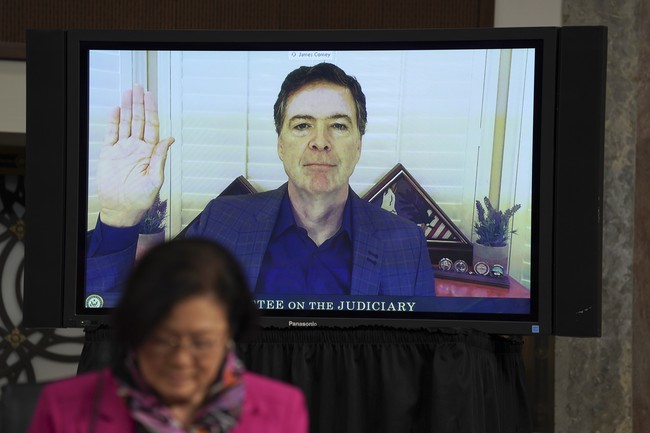
Former FBI Director James Comey surrendered at a federal courthouse after being indicted over a social media post alleged to threaten the president, setting off a politically charged legal showdown that tests free speech, prosecutorial judgment, and the limits of acceptable public commentary by former officials.
James Comey turned himself in at the federal courthouse in the Eastern District of Virginia following a grand jury indictment over his “86 47” seashell post, which prosecutors say amounted to a threat against President Trump. The case will be tried in the Eastern District of North Carolina, but the surrender marked the first public legal step in what supporters of the rule of law describe as a necessary response to a disturbing message. Court proceedings on Wednesday ended without a plea from Comey, and a judge informed him of the charges, which carry serious potential penalties.
The charges include making a threat against the President of the United States and interstate transmission of such a threat, each count carrying up to five years in prison if convicted. Judge William Fitzpatrick did not set conditions for Comey’s release beyond requiring the removal of firearms from his household. That restraint seemed routine, but the broader political context makes this more than a routine arrest: it is an accountability moment for one of the most consequential law enforcement leaders of the past two decades.
Acting Attorney General Todd Blanche publicly rejected the idea that the indictment was ordered by President Trump, emphasizing that the case followed a lengthy investigation and a grand jury decision. Blanche made his comments on CBS News, stressing that the indictment reflected the results of nearly a year of work by prosecutors. His direct denial aims to separate this prosecution from partisan politics, even as critics and supporters line up on opposite sides of the courthouse steps.
Former FBI Director James Comey’s first court appearance for his latest federal indictment ended on Wednesday without him making a plea.
Judge William Fitzpatrick informed Comey of the charges against him, saying the two counts both carry up to five years in prison.
The first count is making a threat against the President of the United States, the second is interstate transmission of a threat against the President of the United States.
There was no arraignment, and Fitzpatrick did not set any conditions for Comey’s release, aside from removing any firearms from Comey’s household.
Comey insists he did nothing wrong and says he had no intention of threatening anyone, claiming he did not understand the alleged meaning behind “86 47.” That defense strains credulity for many who recall Comey’s political instincts and public statements over the years, but his high-profile status complicates public reaction. With both legal and reputational stakes on the line, the courtroom became the only place to resolve the factual dispute without media theatrics dominating the narrative.
Blanche gave repeated statements defending the indictment process and rejecting suggestions this was an audition for a political appointment, asserting, “I don’t audition for this job.” He doubled down in an interview: “Of course not,” Blanche said when asked whether Trump had asked for the indictment. The acting attorney general emphasized that the grand jury’s return of an indictment is the core factual basis for moving forward, framing the step as the work of justice rather than political theater.
Acting Attorney Todd Blanche stated that the indictment against former FBI Director James Comey is “not an audition” for the top job at the Justice Department on Wednesday.
Blanche made the statement during an interview with CBS News, going on to say he was “absolutely, positively not” directed or asked by President Donald Trump to pursue the indictment.
“I don’t audition for this job,” Blanche told Garrett. “I’ve been the deputy attorney general for over a year, OK? This is not an audition.”
“Of course not,” Blanche added when asked whether Trump asked for the indictment. “Absolutely, positively not, and there’s no suggestion that that’s the case that happened, and the fact that we’re doing our work –– this is not something that just happened in the past couple weeks. This is something that has been investigated for nearly a year now, and the results of that investigation is that a grand jury returned an indictment.”
Video of Blanche’s comments and portions of the indictment have circulated, and prosecutors point to the grand jury decision as evidence the case has substance. Critics argue the post was ambiguous, and some legal scholars have already raised First Amendment questions that will be litigated aggressively. Still, supporters of the indictment say no former high-ranking official should be above criminal scrutiny when speech crosses into threats against a sitting president.
Legal experts will now weigh in on whether the charges survive constitutional challenge, but the political implications are unavoidable. This is a test of whether the justice system can treat powerful figures equally and whether prosecutors can withstand claims of political motive. As the case moves toward trial in North Carolina, the country will be watching how the law handles a high-profile clash between speech and alleged threats, all while the partisan temperature remains high.
Some of the most pointed public commentary has focused on the optics of a former FBI director facing criminal charges tied to a social media post, and whether standards applied to others are the same here. The courtroom will sort the legal facts, but the political fallout will echo across the institutions Comey once led and those now enforcing the law. With the next legal moves expected soon, observers on both sides are preparing for a lengthy, consequential fight.
Those comments appear at the 4:18 minute mark:
A grand jury has indicted former FBI director James Comey, after the Justice Department claimed a photo Comey posted online of seashells appearing to spell out “86 47” threatened President Trump. Comey denied the accusation.
Acting U.S. Attorney General Todd Blanche told CBS Mornings that the proof of the threat lies in “the fact that a grand jury returned an indictment.”
“That is not the Department of Justice charging James Comey with a crime,” he added.
Comey maintains his innocence and says he never meant “86” to mean kill and “47” to identify President Trump, though many find that explanation unconvincing given the context. The prosecution will have to demonstrate intent or a credible threat, while defense lawyers will press First Amendment protections. The public will get to see whether grand jury findings translate into proof beyond a reasonable doubt at trial.


Add comment