
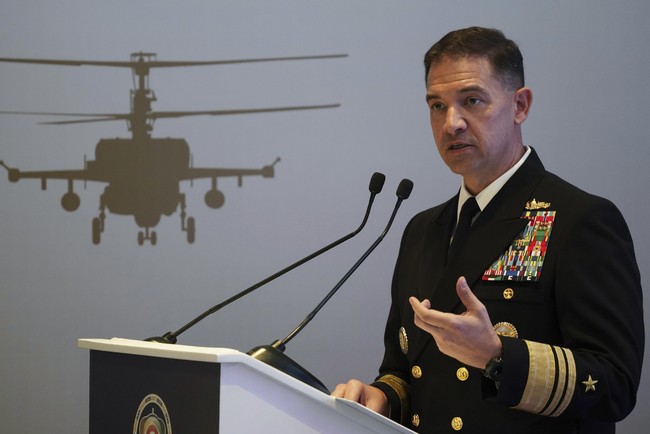
CENTCOM commander Admiral Brad Cooper warns that social media and cellphone footage are giving Iran actionable intelligence on U.S. forces, letting the Iranian side assess strike results in near real time and potentially putting service members at risk.
Admiral Brad Cooper, head of U.S. Central Command, has pointed to a quiet but dangerous vulnerability: open-source material posted online that can reveal unit locations, reactions, and damage assessments. He argues that posts by journalists, bystanders, and even service members themselves are being scanned and used to measure the effectiveness of Iranian strikes. The risk is that seemingly harmless clips and reports amount to free battlefield intelligence for an adversary that wants to learn whether its weapons hit targets or missed by wide margins.
Admiral Brad Cooper, in a previously unreported letter, said Iran was benefiting from being able to see the success or failure of its strikes in near real-time by searching news reports or online posts by journalists referencing “reactions, photos, and footage from the cellphones of our troops.”
“The direct, unavoidable cost of this open-source intelligence could be measured in the lives of American service members and civilian residents in targeted Gulf countries,” Cooper, head of U.S. Central Command, wrote in his July 28 letter, a copy of which was obtained by Reuters.
He called on troops to “redouble our focus on operational security,” without prescribing specific steps in the memo.
The memo highlights a conflict between rapid, real-time reporting and operational security needs. When news outlets and social feeds publish location details, reaction shots, or videos from the scene, they can inadvertently perform what Cooper calls Iran’s Battle Damage Assessment for them. Modern conflict is no longer waged only by ammunition and maneuver; information shared instantly can be weaponized by a watchful opponent.
https://x.com/phildstewart/status/2082425883822801199
That concern has led to discussions about tighter controls on communications for deployed forces. Some reports suggest that certain personnel could be asked to surrender phones or otherwise limit the digital trail they leave behind. That kind of step would be disruptive and painful for troops who depend on periodic contact with family, but commanders say the trade-off may be necessary to reduce intelligence leakage to hostile actors.
Real-world examples drove Cooper’s warning. He cited incidents in which social posts and footage showed how troops behaved during strikes and gave the attackers an immediate read on the outcome. Those images are more valuable than a delayed after-action report because they let an adversary adapt tactics, confirm hits, and refine targeting. The instant nature of social media removes the fog of war for those who are watching closely with hostile intent.
Cooper’s memo underscores the mounting tensions between real-time news reporting on the war, often aided by satellite imagery and first-person accounts, and the desire by the U.S. military to restrict any information that could aid Iran as it tries to kill and wound U.S. troops.
Open-source intelligence has become a staple of modern militaries and irregular forces alike, and Iran’s Revolutionary Guard Corps has shown it can harvest publicly available imagery and posts to judge strike success. Journalists, analysts, and social users can all contribute to a mosaic of evidence that clarifies what happened on the ground. Cooper’s memo warns that this very public flow of information can translate directly into harm if adversaries exploit it to plan follow-on attacks or refine weapons employment.
Commanders worry not only about the content of photos and video, but about metadata and contextual clues embedded in posts. Visuals can reveal compass bearings, shadows that establish time of day, identifiable terrain or structures, and even troop movements. When these pieces are stitched together online, they form a more precise picture than any single post would suggest, and that picture can be used to aim the next strike.
Cooper spelled out that the enemy may know weapons were fired but not whether they missed by a wide margin or scored a direct hit. He explained that “detailed lists, descriptions, and analyzes of what was hit, openly published by news outlets are essentially performing Iran’s Battle Damage Assessment (BDA) for them, free of charge.” The blunt message is that public reporting and unguarded sharing can do the adversary’s reconnaissance for it.
MORE –
Cooper says Iran benefits from being able to see the success or failure of its strikes in near real-time by searching news reports or online posts by journalists referencing “reactions, photos, and footage from the cellphones of our troops.”“The direct, unavoidable cost of this open-source intelligence could be measured in the lives of American service members and civilian residents in targeted Gulf countries”
One example mentioned in the memo involved a clip from an attack on an air base in Jordan where footage of soldiers running to safety was posted online. That kind of imagery did more than tell a story; it showed the enemy how troops reacted, how they evacuated, and which routes offered cover. Those operational details matter to planners on the other side of the fight.
Admiral Cooper’s appeal is straightforward: tighten operational security and be mindful of what is posted or shared from the field. The military must balance morale and connectivity against the very real intelligence value that innocent-seeming content can provide. In a time when anyone with a phone is a potential sensor, old rules about secrecy and discipline are being tested by a new digital reality.



Add comment