
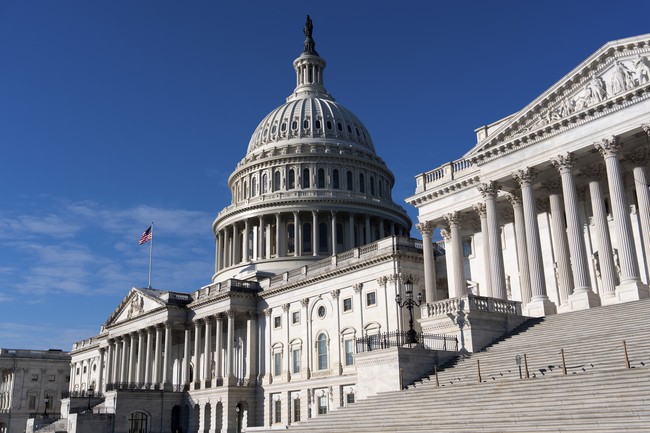
The Air Force major who donned his uniform to call for President Trump’s impeachment on the Capitol steps has been formally charged under the Uniform Code of Military Justice, detained, and is now facing multiple counts that could end his career and serve as a warning about active-duty political activism.
Maj. Jason Watson’s July 1 appearance at the Capitol, where he stood with Rep. Al Green and held a sign reading “Impeach Convict Remove,” crossed lines that military law takes seriously. His public denunciation of the commander in chief while in uniform prompted an immediate Air Force probe and wide political blowback. The sequence of events shows how military rules and civilian politics collide when service members step into partisan fights.
Watson did not limit his statements to the Capitol steps; he later appeared on national television and doubled down on his claims against President Trump. On CNN he accused the president of “flagrantly violating the Constitution,” “breaking the law,” engaging in “rampant corruption,” and “killing Americans.” Those are blistering accusations for any citizen, and they’re especially charged coming from an active-duty officer in uniform.
Following the Capitol stunt and the TV interview, the Air Force moved to take decisive action. Service leadership determined there was probable cause to allege continued misconduct, which led to Watson’s pretrial confinement and a formal set of charges under the UCMJ. Being detained by your own service is a rare and severe step that underlines how the military enforces standards of political neutrality and respect for civilian authority.
“When the President of the United States orders military action against foreign countries, absent an emergency scenario, where American interests are under imminent, dire threat — as was done with Cuba, Venezuela, and Iran — that’s an unconstitutional usurpation of Congress’ authority, and a violation of the War Powers Clause,” Watson foamed at the mouth. “These violations resulted in the deaths of 13 service members, and injuries of hundreds more.”
“For this, the president and vice president must be impeached, convicted, and removed.”
The record now shows Watson faces a list of charges tied directly to his public conduct. According to the official allegations, he faces multiple counts including contempt toward officials and failure to obey regulations, along with accusations of conduct unbecoming an officer. Those specific articles of the UCMJ carry significant potential penalties and reflect the ways the military codifies limits on political speech by service members.
https://x.com/Osint613/status/2072657374049874150
Another public post repeated the military’s view that the situation had escalated to criminal military charges, noting: “BREAKING: US Airman Jason Watson has been hit with MULTIPLE criminal military charges after he called for President Trump to be impeached while in uniform at the US Capitol” and “He is now IN CUSTODY. FAFO!” The list of alleged violations included three counts of Article 88, five counts of Article 92, and two counts of Article 133. Those numbers make clear the seriousness with which the service is treating the matter.
BREAKING: US Airman Jason Watson has been hit with MULTIPLE criminal military charges after he called for President Trump to be impeached while in uniform at the US Capitol
He is now IN CUSTODY. FAFO!
The charges are:
– 3 violations of Article 88: Contempt Toward Officials
– 5 violations of Article 92: Failure to Obey Regulations
– 2 violations of Article 133: Conduct Unbecoming of an Officer
Make an example out of him!
Watson remains in military custody at a Maryland facility as the legal process moves forward and his chain of command finishes its case. The Air Force’s actions were tied to findings of probable cause and concerns about continued misconduct after his televised comments. For servicemembers, being in uniform imposes limits that civilians do not face, and those limits are enforced through the UCMJ.
The episode has stirred debate among civilians and veterans about free speech, duty, and the proper role of officers in political discourse. Critics argue that an officer publicly calling for the removal of the nation’s commander undermines civilian control of the military and erodes discipline. Supporters of strict enforcement say this is a necessary defense of the chain of command and military professionalism.
Public reactions have been sharp and partisan, reflecting broader tensions over politics and the armed forces. Some see the charges as inevitable and appropriate, while others call the response heavy-handed. Whatever one believes about Watson’s politics, the legal reality for active-duty personnel is clear: there are rules, and violating them can carry serious consequences for career and liberty.
This case will likely proceed through courts-martial or other military judicial processes, where the specific allegations and evidence will be examined. The outcome could set a useful precedent about where the line is drawn for political speech by uniformed officers. For now, Watson’s detention and the string of UCMJ charges stand as a stark reminder that the military treats political action from within its ranks differently than from civilians.
The footage of the Capitol event circulated widely and factored into how the Air Force framed its response. Video gives context to the public spectacle and demonstrates why service leadership felt compelled to act. Media exposure turned a single act of protest into a formal disciplinary matter with real legal weight for the officer involved.

Add comment