
President Donald Trump has publicly signaled that Iran’s leadership looks fractured, and Tehran’s rapid, identical responses from multiple officials suggest something deeper: either rigid top-down control or a vacuum that breeds confusion. This article examines Trump’s message, the uniform replies from Iranian officials, the question of who can actually negotiate, and why that uncertainty raises the odds of further U.S. military moves.
Trump has combined offers to negotiate with pressure: sanctions, a naval blockade around the Strait of Hormuz, and visible deployments of U.S. forces. He posted a blunt social media message meant to expose divisions inside Iran’s ruling circles and to warn that the window for a deal is closing. That tweet argued the United States controls the strait and will keep it sealed until Iran makes a deal, a public hardline posture meant to force clarity.
He wrote, “Iran is having a very hard time figuring out who their leader is! They just don’t know! The infighting is between the “Hardliners,” who have been losing BADLY on the battlefield, and the “Moderates,” who are not very moderate at all (but gaining respect!), is CRAZY! We have total control over the Strait of Hormuz. No ship can enter or leave without the approval of the United States Navy. It is “Sealed up Tight,” until such time as Iran is able to make a DEAL!!! Thank you for your attention to this matter.”
That post was designed to do two things at once: warn Tehran publicly and embolden anyone inside Iran who favors negotiation. If key Iranian ministers and officials really are not moderates, publicly calling that out weakens their credibility. At the same time, the tweet pushes Iran into choosing a visible, unified answer—or revealing that unity is superficial.
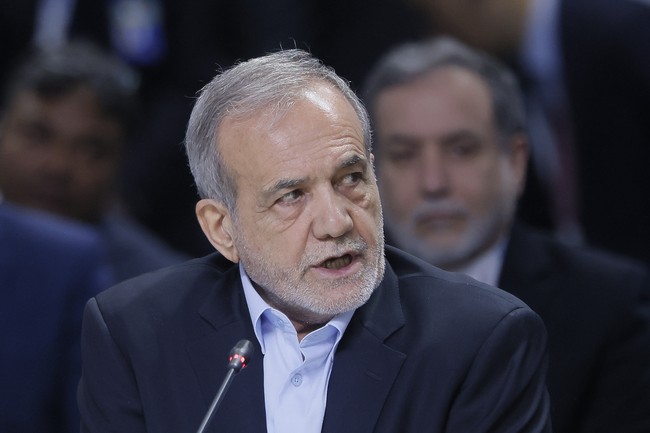
Within minutes of each other, several Iranian figures commonly labeled in the West as “moderates” reposted the same line, a rare coordinated response in tone and content. The President, , the Foreign Minister, Abbas Araghchi, and the Parliament Speaker, all issued identical statements on X, asserting unity and obedience to the Supreme Leader. Those mirrored posts claimed there are no radicals or moderates, only “Iranian” and “revolutionary” people acting together.
The identical wording read: “In Iran, there are no radicals or moderates; we are all “Iranian” and “revolutionary,” and with the iron unity of the nation and government, with complete obedience to the Supreme Leader of the Revolution, we will make the aggressor criminal regret his actions. One God, one leader, one nation, and one path; that path being the path to victory for Iran, dearer than life.” That sentence was posted verbatim by multiple officials, which itself is revealing.
When separate offices publish the same text at once, it can mean tight control from the top, or it can mean a scripted defensive posture designed to hide fractures. Either way, it undermines the notion that any of those officials could independently broker a credible deal with the United States. A scripted reply signals that real decision-making power may lie elsewhere.
Complicating the picture were unconfirmed reports that one of those involved in negotiations, Mohammad Bagher Ghalibaf, had stepped down from the negotiating team. N12 News reported the claim, which Tehran did not publicly confirm. If true, it would add another layer of instability to a leadership already showing signs of internal tension.
That instability matters because diplomacy requires someone who can sign and deliver on commitments. If there are no moderates with real authority, there is no reliable counterpart to make and execute agreements. In practice, that means options narrow: either accept a deal with limited guarantees, or prepare for continued pressure and possible military steps.
U.S. officials appear to be leaning on pressure precisely because a clear negotiating partner is missing on the Iranian side. The public narrative from Washington is simple: make a deal or face containment. When adversaries show disarray and a tendency to answer in unison, it often signals that coercive measures still have to play a role in producing any tangible change.
The identical responses from Iran’s leadership shift the calculus. They remove the façade of reliable moderates and increase the likelihood that Washington will continue to press its advantage—militarily and economically—until Iran either negotiates on terms acceptable to the U.S. or its leadership visibly consolidates authority in a way that allows meaningful talks.


Add comment