
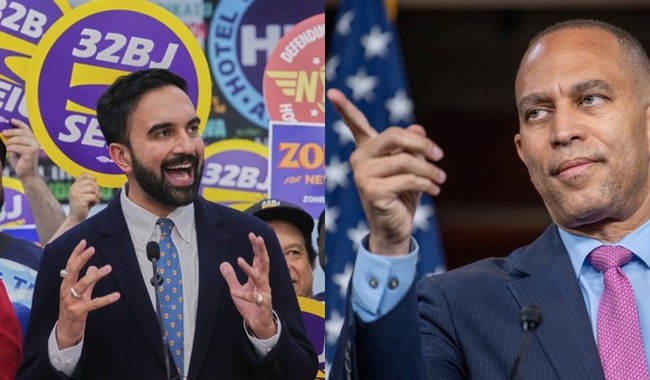
House Minority Leader Hakeem Jeffries faced a pointed question about Zohran Mamdani becoming the future face of the Democratic Party, and his answer — or avoidance of a clear answer — tells you a lot about where Democrats are headed and how Republicans are already preparing to use this moment politically.
Jeffries stood with other party leaders after a high-turnout New York City election and was asked directly, “You had record turnout in New York City for this election. Would you say that Mamdani is the future of the Democratic Party?” The question landed because Mamdani’s win puts the party’s direction on display: a shift toward unapologetic socialist rhetoric that conservatives can and will highlight.
Instead of addressing Mamdani head-on, Jeffries tried to reframe the conversation to a national message about turnout and affordability. “I would say we had record turnout across the country because Democrats in New York City, in Virginia, in New Jersey—and we’re so proud of our two colleagues, Mikie Sherrill and Abigail Spanberger, they ran amazing campaigns,” he said, steering attention away from the real issue.
The pivot was quick and obvious, and it revealed what Republicans have been saying: the party is scrambling to manage optics after a victory for a candidate openly tied to Marxist ideas. Rather than confronting whether Mamdani represents the party’s future, Jeffries sought comfort in wins elsewhere and generic policy language about costs and affordability.
Jeffries went on at length about affordability and blamed economic stress on tariffs and other policies, while conservatives argue the recent economic data shows improvement and confidence rising. That counter-narrative is central to the Republican response — portray the Democrats as out of touch, elevating radicals while pretending to worry about working families.
The tone from GOP leaders has been blunt and direct. Republican House Speaker Mike Johnson weighed in strongly, writing that Mamdani is “an unapologetic Marxist — fully EMBRACED by the Democrat establishment,” and calling out the level of elite support the new face of the party received. That kind of language is meant to pin responsibility for this ideological turn squarely on Democratic leaders.
Jeffries did eventually offer what looked like an endorsement, but it was slow and tepid, the kind of qualified support that signals discomfort. Republicans see that hesitation as evidence the Democratic coalition is fracturing between establishment figures and rising socialist voices, and they plan to exploit the division in campaign messaging.
The broader political play is clear: Republicans will frame the choice for voters as between common-sense governance focused on economic strength and the radical policy shift being embraced by parts of the Democratic Party. Conservatives will emphasize accountability, economic gains, and the perceived disconnect between Democratic elites and everyday Americans.
Meanwhile, the Democratic leadership’s attempts to downplay Mamdani’s influence only make the issue stickier. When a party’s leader dodges a straightforward question about direction, it invites opponents to define the narrative. That’s exactly what happened: instead of calming worries, Jeffries’ answer handed Republicans a clearer path to argue that the Democrats have moved too far left.
The rhetoric now coming from Republicans will be pointed and persistent, centered on the idea that voters must choose between stability and radical change. Expect sustained messaging tying local wins like Mamdani’s to national consequences, with emphasis on values, national security, and economic competence as contrasts to democratic socialist agendas.
Editor’s Note: The Schumer Shutdown is here. Rather than put the American people first, Chuck Schumer and the radical Democrats forced a government shutdown for healthcare for illegals. They own this.
Help us continue to report the truth about the Schumer Shutdown. Use promo code POTUS47 to get 74% off your VIP membership.
Public reactions will drive the politics. As Republicans escalate their attacks, Democrats must decide whether to embrace their socialist flank or distance themselves to avoid alienating moderate voters. Jeffries’ performance shows that internal tensions are already playing out under the spotlight, and the coming months will reveal whether Democrats can control the narrative or if Republicans will define it for them.
“The Democrat Party has officially surrendered to socialists and the radicals who HATE America — they now control the movement.”

Add comment