
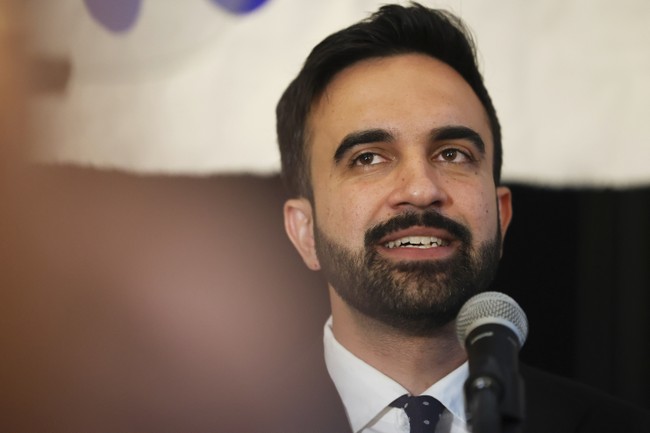
I’ll show why Mamdani’s promises ring hollow, explain the practical problems with free buses and rent freezes, point out the irony of soliciting small-dollar donations after campaigning on giving away benefits, note who else could be asked to fund a transition, and highlight who actually backed him at the ballot box.
The Incredibly Ironic Request Mamdani Has of His ‘Working People’ Supporters
Zohran Mamdani ran a campaign built on big promises: free buses, rent freezes, and a vision of affordability paid for by taxing the wealthy. Those lines resonated with voters who wanted relief from rising costs, and they helped him win a key election. Now the reality of governing and the logistics of policy are colliding with campaign rhetoric.
Free buses sound great as a slogan, but transit systems cost money to run and maintain every day. A sudden shift to free service without a clear revenue plan risks overcrowding, reduced maintenance, and an environment that could become unsafe if capacity and social services aren’t addressed. In short, rolling out free transit without parallel investments invites serious operational breakdowns.
Freeze rents is another appealing promise that masks harsh trade-offs. When landlords are blocked from adjusting rents, their ability to invest in upkeep vanishes, and buildings trend toward disrepair. That outcome undermines the stated goal of livable, affordable housing, because housing quality and supply are intimately tied to incentives for property investment.
Beyond policy faults, the political hypocrisy here is striking. After a campaign pitching free benefits funded by taxing the rich, Mamdani immediately asked his supporters—people he called the “working people”—to pony up money for his transition. The ask came right after victory, with a pitch that the transition needs staff, research, and infrastructure.
He claimed he had told people to stop donating months ago, but that didn’t last long. The message shifted: a transition team will need funding to operate, and that funding should come from the very base that voted for him. That pivot undercuts the image of delivering free stuff directly through taxation of the wealthy, because the grassroots base is now being tapped for cash.
He said it “would require staff, it will require research, it will require infrastructure.” Those are legitimate costs for any incoming office, but when those needs are funded by small-dollar contributions from working voters it exposes a mismatch between campaign promises and campaign fundraising habits. The optics are bad: asking the same voters promised free services to finance the mechanics of delivering those services reveals a dependence on donations that contradicts the rhetoric of funding via the rich.
“Those are things we will have to provide. I’m excited for the fact that it will be funded by the very people who brought us to this point, the working people who have been left behind by the politics of this city.”
The additional pitch, complete with polished smiles and campaign cadence, was that he needs staff and resources to even plan how to provide these benefits. That raises a fair question: if wealthy donors, progressive foundations, and allied nonprofits backed his candidacy, why are working-class donors being singled out to fund the transition? Asking regular voters to bankroll the apparatus of governance creates a dependency that is both politically and operationally awkward.
There is also a discrepancy between who supported Mamdani and who the campaign now targets for money. Post-election analysis showed stronger support among college-educated voters in certain neighborhoods, rather than the broader non-college electorate the message claimed to uplift. That coalition dynamic matters when determining who should shoulder the costs of an incoming office’s operations.
Governance requires clear revenue sources, pragmatic policy design, and realistic expectations. Promises that hinge on simple narratives—tax the rich, get everything free—ignore the complexity of public services and municipal finance. The moment to reconcile slogans with spreadsheets comes quickly, and early fundraising asks for transition work make that reconciliation more urgent.
When a new official leans on grassroots donors immediately after promising free benefits, it sends two messages: one about need and one about priorities. The first is practical—the staff and research must be paid for—while the second is political—who really funds the political movement and who is expected to carry the financial burden. For voters who expected cost-free benefits, that distinction will be uncomfortable.
New York residents should watch how campaign promises translate into policy and budgets, and question why some funding asks land on everyday supporters rather than institutional backers or large donors. The test of any administration is whether it balances idealism with the fiscal and logistical realities of running a city, and early fundraising choices help reveal those priorities.

Add comment