
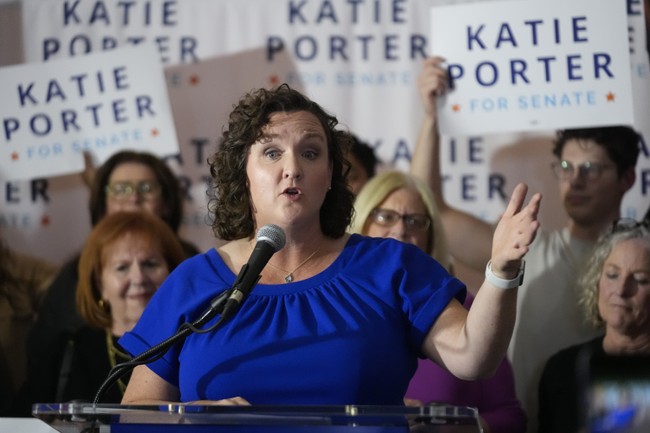
I’ll explain why Katie Porter’s campaign is collapsing, how Eric Swalwell’s entry reshuffled the field, what internal Democratic dynamics are at play, and what the current polling and opposition research reveal about California’s 2026 governor’s race.
Katie Porter has seen her standing nosedive since Rep. Eric Swalwell entered the California governor’s primary, and the damage tracks to multiple vulnerabilities within her campaign. Recent polling shows her support drifting into the low double digits, a steep fall for someone once mentioned as a top Democratic prospect. What follows is a blunt look at the forces causing her decline and why Democrats may be headed for a real contest in a state they long assumed was safe.
Porter’s image problems began long before this primary cycle, and a stream of opposition material amplified doubts about her temperament and judgment. Video clips and former associates’ accounts have painted a picture of a candidate who can be abrasive under pressure. Those episodes have undercut her message and handed Republicans concrete ammunition to use during the campaign season.
The arrival of Eric Swalwell has intensified those problems by fracturing the Democratic vote and introducing fresh negative attention. Swalwell is now a magnet for controversy of his own, but his presence in the race makes the primary more chaotic and less predictable. Rather than consolidating around a single progressive alternative to Gov. Gavin Newsom, Democratic voters now face a crowded, splintered field that helps Republicans by default.
Former Rep. Katie Porter is sinking in the polls as the race to replace Gov. Gavin Newsom gets downright claustrophobic.
Support for Porter, the former Orange County congresswoman who’s been labeled a tyrant by a former staffer and her ex-husband, has slipped to 11% of voters surveyed by Emerson College in a new poll released Thursday.
The poll suggests splintering support for Porter and others in the crowded primary field after the entry of East Bay Rep. Eric Swalwell and Tom Steyer, the billionaire climate activist.
Democratic insiders and established figures in California politics have not rallied behind Porter, and that isolation matters. Party elders who control donor networks and endorsements are wary of candidates who upset internal hierarchies. Porter’s decision-making and public disputes with colleagues convinced many that she is not the unity candidate the party needs for a statewide fight.
Critics inside the party frame the problem as both procedural and personal: she challenged senior figures and refused to play the waiting game many expected from a junior member of Congress. That perception of being a rule-breaker damaged her standing among influencers who would normally help build a statewide campaign infrastructure. In California politics, loyalty to the machine still counts for a lot.
Former Democratic colleagues have been openly critical about Porter’s style and impact on the party’s map, claiming her rise cost Democrats winnable seats. Those critiques combined with reports about her interpersonal conduct created a narrative Republicans have exploited aggressively. When leadership distances itself, fundraising, endorsements, and strategic support all dry up, which is exactly what appears to be happening.
Enter Eric Swalwell, whose candidacy introduced a new set of problems for Democrats while also serving as a crude form of opposition research in motion. Swalwell brings baggage that opponents will happily exploit, but his presence siphons attention and donors from Porter. In a crowded primary, the party’s progressive lane is now split, which lowers the chance any single anti-establishment candidate gains the momentum to beat a well-funded Republican.
I guess Swalwell can enjoy today, but folks know he slept with many of his interns while married, sexually harassed others while engaged, has a ton of weird texts late at night saved on former interns phones still, he gets he will have to answer for his later on during the campaign, right? Endorse at your own peril people. Yo [sic] have been fully warned, just doing my public service today.
Swalwell’s controversies give Republicans a clear path for attack ads and messaging that emphasize Democrat chaos and poor judgment. That plays well with voters tired of reckless behavior and insider infighting, and it helps Republican contenders define themselves as stable alternatives. In this environment, a unified GOP message could gain traction in a state otherwise considered safely blue.
All of this leaves Republicans with a strategic opening in California’s governor’s race that they should not waste. If Democrats continue to fight among themselves and fail to rally behind a credible, disciplined nominee, the November general election becomes competitive. For now, Porter’s tumble and Swalwell’s entry tell a familiar story: divided parties lose, and California’s Democratic establishment may be discovering that lesson the hard way.
Add comment