
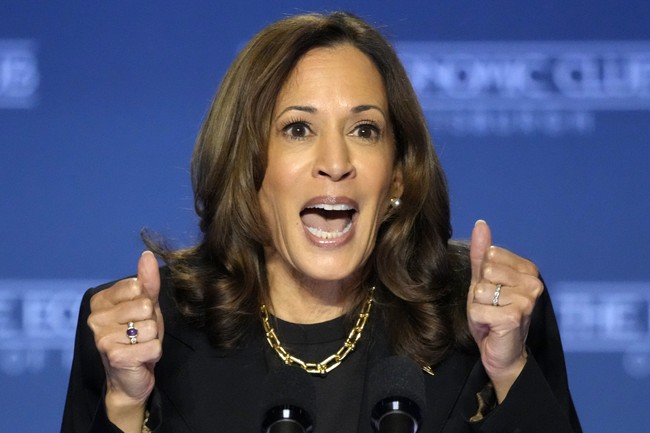
The piece examines Kamala Harris’s recent explanations defending Joe Biden’s fitness for office, highlights a revealing exchange with Jon Stewart, and argues that her framing — claiming a difference between running for president and governing — fails normal scrutiny and underestimates how demanding the presidency truly is.
Kamala Harris has been giving a string of interviews while promoting her book, and some moments have been notable for their awkwardness. She described a loss as being both “inarticulate” and “very articulate,” a contradiction that undercuts credibility when precision matters. Those slips matter because they shape how voters and observers judge the people around President Biden.
When foreign journalists pressed her on Joe Biden’s cognitive state, her responses often sounded evasive, prompting sharper questions than she faced from many U.S. outlets. An Australian reporter labeled one answer a “world-class pivot,” and that biting description stuck because it captured the slippery, rehearsed feel of her replies. People expect clarity on the fitness of the commander in chief, not rhetorical gymnastics.
The moment that captured the internet was her conversation with Jon Stewart on The Weekly Show, where a short exchange exposed how unconvincing some of her lines appeared. Stewart is an entertainer, not a credentialed political reporter, but his reactions often mirror what many Americans are thinking. Watch his expression when she insists, “I believe he [Joe Biden] was fully competent to serve,” and you see the suspicion that pollsters and pundits have been reporting for months.
“I believe he [Joe Biden] was fully competent to serve,” Harris said.
Stewart’s skeptical follow-up, “Do you really?” cut through the practiced cadence and put the claim on the spot. Harris doubled down: “Yeah, I do.” Later she tried to draw a line between campaigning and governing, repeating a talking point she has used elsewhere. That distinction is supposed to shield a sitting president from critiques about stamina and sharpness, but it left the host and viewers unconvinced.
Stewart asked, “What’s the distinction?” and Harris answered by painting campaigning as a punishing sprint under public attack. “Well, being a candidate for president of the United States is about being in a marathon at a sprinter’s pace, having tomatoes thrown at you every step you take,” she said. The image is colorful but it does not address the substance of concerns about daily executive functioning.
The argument that campaigning tests different skills than governing is not absurd on its face, but Harris’s version flips reality in a way that doesn’t withstand scrutiny. Governing demands sustained decision-making, long stretches of briefings, complex negotiations, and stamina for unpredictable crises. Claiming that one can lack the capacity to campaign and still possess the sharper faculties required to run the federal government is a hard sell to anyone who expects accountability.
From a Republican vantage point, the contrast with President Donald Trump’s active schedule is an obvious talking point: travel, summits, and deal-making are tangible proof of energy and engagement. That comparison is political, yes, but voters use it to evaluate real-world results. If a vice presidential candidate or former officeholder downplays the workload or pretends the public can’t see the daily demands, it only fuels doubts.
Harris’s defense reads like a strategy memo more than a straight answer. Labeling campaigning as a chaotic sprint with tomatoes is theatrical and designed to redirect the conversation. But redirection does not answer whether the president has the cognitive clarity to manage classified briefings, diplomatic crises, and legislative battles. Americans want clear-eyed leadership, and rhetorical flourishes fall short.
Stewart’s facial expressions are not the story in themselves, yet they matter because they reveal what a neutral observer might feel when confronted with evasive logic. The exchange underscores a larger problem: when close allies offer strained explanations, the public fills the gap with doubt. That gap is political airspace where opponents will operate, and it risks eroding trust among swing voters.
Beyond the Stewart segment, Harris’s broader pattern of loose phrasing and puzzling turns of phrase has been a recurring theme during her media appearances. Whether describing past defeats or defending a president’s fitness, precision and accountability are the key standards most citizens expect. Without them, explanations come off as spin rather than serious answers.
Finally, the political consequences are straightforward. If voters conclude that defenders of the administration cannot clearly justify its leader’s competence, that perception can shape elections and policy debates. Arguments about distinction between campaigning and governing might play well within partisan circles, but they do little to reassure the broader electorate that the country is in steady hands.



She is truly Demonic and so Jon Stewart was staring down the Devil!
And her continued rants since her totally failed crack at the administrative level as VP of the federal government followed by her $Billions campaign to grab the presidency in which she hands down was a complete and utter failure and nutjob is added proof that she is directly influenced by Satanic Demons!
She must be shown for what she is to all so that there can never again be a Kameltoe in our political system!