
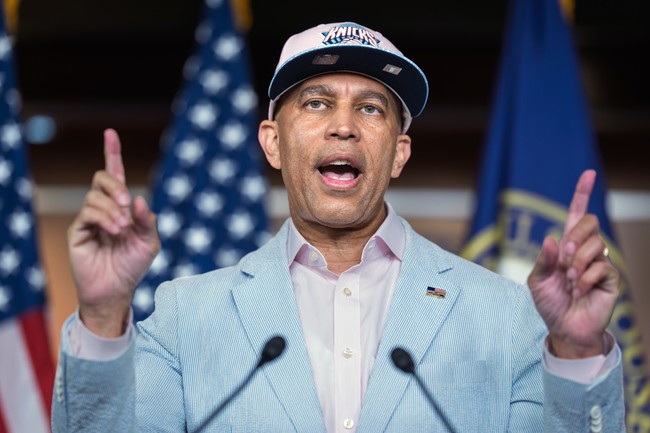
I’ll explain how Democrats react when celebrities and sports collide with politics, recap Hakeem Jeffries’ public complaint about President Trump attending a Knicks game, show the context around the invitation and the canceled watch party, and note how this episode highlights the double standard in elite treatment of political figures at public events.
For years Democrats have leaned on celebrity connections and pro sports to signal cultural relevance, using access to Hollywood and athletes as badges of being in touch. That approach often looks like a one-way street: favors and flattery for friends, sharp criticism for opponents. When Republicans begin to show up in those same spaces, it rattles the usual script.
The New York Knicks and Madison Square Garden have long been woven into local and national culture, and President Trump is a well-known Knicks fan with decades of ties to Manhattan. So his appearance at Game Three of the NBA Finals was never just about basketball for some people. Critics in the media and on the Hill treated his attendance as an intrusion instead of recognizing it for what it was: a long-time fan going to a game.
House Minority Leader Hakeem Jeffries staged a press moment earlier that day, wearing Knicks gear and questioning whether Trump even knew the team well enough to call himself a fan. He pushed the idea that Trump’s presence would carry a partisan energy that could distract from the event. That line of attack made clear Jeffries saw the president as a political problem more than a spectator.
Within seconds Jeffries moved from faux concern about fandom to his real gripe: the MAGA factor. Saying the president would bring “MAGA energy” framed the visit as a political stunt rather than an ordinary outing by a longtime supporter. It was an easy pivot from neutral commentary to partisan alarm, and it revealed the underlying discomfort with Republican visibility in traditionally elite social arenas.
There’s an obvious double standard here. If a popular Democrat or a Hollywood A-lister had shown up, you can imagine a very different reaction from the same crowd—red carpets, smiles, and praise. When the familiar privileges of the cultural class are reserved for one side, genuine public events become political litmus tests instead of shared civic moments.
Critics also tried to blame the appearance for operational problems around the game, but that narrative doesn’t hold up. The Knicks say the visit came at the invitation of the team owner, which makes it a straightforward engagement rather than a spontaneous provocation. Invitations from team leadership are part of the sports world; they happen all the time and should not be weaponized into excuses to diminish a fan’s presence.
Reports also circulated about a canceled watch party outside the Garden, and the team clarified that the cancellation was not the president’s fault. Large public gatherings involve permits, logistics, and security decisions that are made by multiple parties, and singling out a single attendee as the cause is misleading. Facts matter when the story is being used to score political points.
https://x.com/greg_price11/status/2064057475863544005
Beyond the specifics of one game, this episode shows how cultural institutions can be turned into battlegrounds for partisan theater. When one side treats stars and venues as simply extensions of their political brand, pushback looks performative and entitled. That is why many observers see Jeffries’ remarks as less about the president and more about protecting a monopoly on cultural influence.
The Knicks led the series 2-0 at the time, with Game Three scheduled for the evening. Fans expecting an ordinary playoff atmosphere found themselves in the middle of a manufactured controversy, with media and politicians debating optics instead of the on-court product. For many Americans who follow both politics and sports, it’s a reminder that culture wars now reach into arenas where fans should just enjoy the game.


Add comment