
The following piece examines a new flashpoint in higher education and politics: the American Association of University Professors breaking its long-held neutrality to endorse a Michigan Senate candidate, and what that decision signals about ideological capture in universities and its political consequences.
For years critics on the right have warned that parts of academia prioritize political advocacy over teaching, and recent events offer fresh evidence for that concern. Faculty and administrators reacted in ways after the October 7 attacks that many observers saw as defensive of radical campus demonstrations rather than as a clear condemnation of violence and antisemitism. Those reactions hardened the impression that certain corners of higher education are not merely biased but actively siding with one political worldview.
The Michigan Senate contest has become a focal point for this debate, with former Wayne County health director Abdul El-Sayed emerging as a likely Democratic nominee after the August primary. El-Sayed is a left-wing figure who draws support from progressive groups and influential online commentators, and his campaign has leaned into positions that make many conservatives and moderates uneasy. His profile as a union member and his ties to activists add fuel to the narrative that organized campus and labor networks are coordinating political support in ways they never did publicly before.
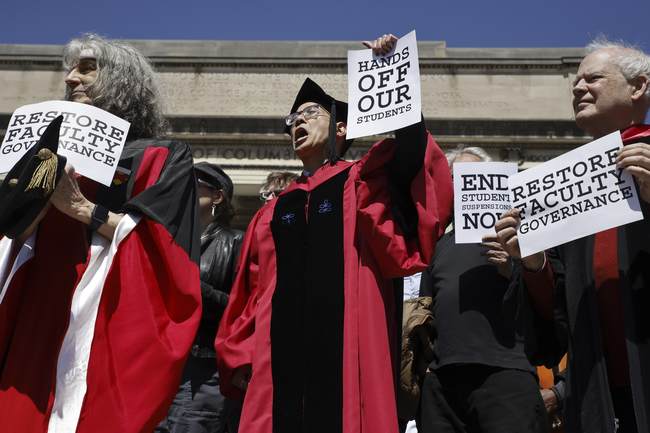
That context makes the American Association of University Professors’ first official political endorsement in its 110-year history especially notable. The AAUP, traditionally an association focused on faculty governance and academic freedom, announced its backing for El-Sayed, a move observers say marks a dramatic departure from institutional neutrality. Todd Wolfson, the AAUP president, released the endorsement publicly and framed it in activist terms, signaling a deliberate shift toward open political intervention by an organization once seen as a professional body.
Wolfson, who is an Associate Professor and has served in union leadership roles, has spoken of making the AAUP a “fighting organization” for progressive causes, a phrase that critics point to as proof of ideological intent. His dual role with the American Federation of Teachers and public activism have led some legal scholars and commentators to say the endorsement was predictable. Those critics suggest the organization’s institutional change mirrors broader transformations on campus, where advocacy, fundraising, and politics increasingly intertwine with academic work.
The endorsement also shines a light on El-Sayed’s own connections to unions and academic circles. He lists membership in multiple labor organizations, and his family background includes ties to higher education leadership. Those details reinforce the sense among opponents that his candidacy is tightly linked to networks that include faculty groups and union leaders who are now willing to exert their influence directly in electoral contests.
Not everyone is surprised by the AAUP’s political move; some commentators cite Wolfson’s prior commitments and the association’s recent actions as evidence that neutral stances were being replaced by explicit political campaigns. A notable legal scholar and frequent critic of campus partisanship has documented a series of policy shifts and public campaigns by the AAUP that, in his view, align the group with progressive political agendas. That record includes advocacy positions and initiatives that critics say target conservative programs and viewpoints on campuses nationwide.
I previously criticized the selection of Wolfson who promised to make the AAUP more of a “fighting organization” for liberal causes. A Rutgers University anthropologist and former union leader, Wolfson is a political activist who doubled down on the ideological intolerance that now defines higher education.
https://x.com/ProfTWolf/status/2082880374125084919
As promised, the AAUP quickly became a more radical and activist organization. It adopted an anti-Israel boycott policy and unleashed attacks on Trump supporters as “fascists.” It has targeted civics centers as conservative breeding grounds. Trinity College Professor Isaac Kamola, the director of the AAUP’s Center for the Defense of Academic Freedom (CDAF), explains that they want to unleash “naming and shaming and discrediting and undermining the legitimacy” of such programs.
[…]
The group has also sponsored anti-ICE programs. The AAUP Journal has adopted the same ideological bias.
Observers point to social media commentary from professors during high-profile campus incidents as further proof that many academics have embraced a partisan posture. For instance, one professor described law-enforcement action around a campus protest as “nypd is doing a tiananmen style crackdown in uptown and midtown while an NBA playoff game is happening like 500 meters away.” Another scholar reacted to a campus clearing by calling it “WORSE” than Tiananmen Square, language critics say shows how far rhetoric has drifted from measured academic discourse.
The AAUP’s endorsement of a Senate candidate is now part of a broader pattern that conservatives argue proves their long-standing warnings about politicized education. Critics say organizations that once defended intellectual diversity have too often become platforms for partisan advocacy, and that this shift changes the relationship between universities and civic life in ways that deserve scrutiny. The choice to intervene in a high-stakes Senate race will likely amplify those debates in Michigan and beyond.
For many on the right, the AAUP move confirms what they’ve pointed out for years: academic associations and some faculty have moved from scholarly engagement to active political campaigning, and that transition has real consequences for public trust in higher education institutions.


Add comment