
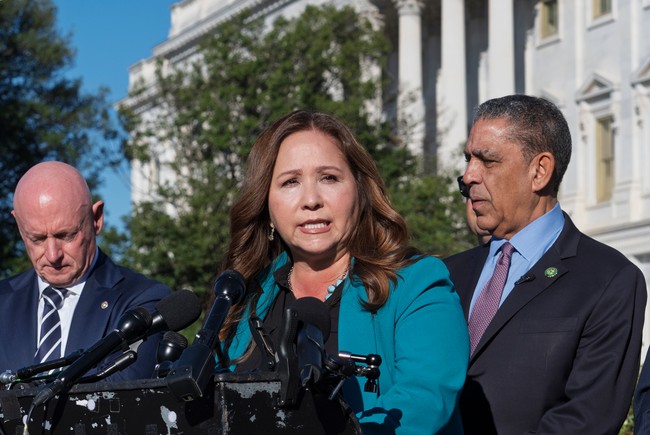
This piece examines the flare-up over the delayed swearing-in of Arizona Rep.-elect Adelita Grijalva, how Democrats staged protests and framed the moment, the Speaker’s explanation and historical context, the guests Grijalva invited, and how the episode fits into the broader partisan fight over the recent shutdown.
The fight over Adelita Grijalva’s swearing-in became a media moment for Democrats, who accused the Republican Speaker of blocking her oath while the government was partly closed. The controversy arrived amid the so-called Schumer Shutdown and a flurry of theatrical protests outside the Speaker’s office. Those demonstrations were captured on phones and pushed to cameras, turning procedural timing into a headline story.
Arizona’s attorney general filed suit over the delay in late October, and Democrats staged a loud demonstration the same week that aimed to create pressure and optics. The protesters gathered in front of the Speaker’s office, tore down a sign, and confronted a Capitol Police officer while recording the scene. What started as a timing dispute quickly became a spectacle designed for legacy media consumption.
Conservative commentators noted the contrast between this outcry and past practice, pointing out that timing disputes have precedent going back to when Democrats controlled the gavel. Speaker Mike Johnson addressed the situation in an interview and said the delay followed established legislative calendar practices. He compared the timing of Grijalva’s oath to a previous special election case under Nancy Pelosi and suggested the response from Democrats was a staged outrage.
In short, the Dems are ticked off that Rep.-elect Adelita Grijalva, who recently won a special election in Arizona, is not being seated while the Schumer Shutdown rumbles on.
…[T]hey decided to storm Johnson’s office, knowing full well he wasn’t there, the Presidential Medal of Freedom award ceremony for slain conservative icon Charlie Kirk.
They marched their little clown shoes on over to Johnson’s office with cell phones in hand to record the stunt, tore down a sign, and proceeded to go full Karen on the Capitol Police officer standing outside.
Johnson noted that similar timing had occurred in 2020, when another member elected in a special election waited several weeks to be sworn in under Speaker Pelosi. He emphasized the routine nature of handling oaths around the legislative calendar and dismissed claims that the delay was unprecedented. The comparisons underline that timing disputes can be weaponized into political theater when one side needs a narrative.
Pressed by the host about Grijalva’s accusation, claiming it was unprecedented not being sworn, Johnson reminded everyone that something similar happened in 2020 when the Speaker of the House then was Nancy Pelosi (D-CA), and no one cried a single teardrop.
“My colleague Julia Letlow from Louisiana was elected in a special election under very certain circumstances, and Nancy Pelosi, who was speaker at the time, took 25 days to administer the oath to Julia Letlow. Nobody threw a fit. Nobody engaged in a publicity stunt because Nancy Pelosi was doing that on the legislative calendar.”
“I’m doing the same thing,” he added. “It has nothing to do with Epstein. That’s absurd. It’s a moot point. The House Oversight Committee is digging into the Epstein file and putting out the documents almost in real time.
The broader context here is the recent shutdown fight, which left both sides accusing the other of political gamesmanship. Conservatives argued the shutdown was driven by Democratic tactics and that the swearing-in drama was another attempt to score points. Democrats said delays harmed constituents and used emotional appeals to highlight the story.
In public posts, Grijalva framed the delay as obstruction and promised travel to Washington to resolve it, noting disappointment about the legislative agenda she would face. She highlighted concerns about healthcare costs and premiums while pledging to be sworn in and get to work. Those posts became part of the public record and fed the media narrative she and her allies promoted.
Grijalva also published a statement laying out her view on the delay and her intention to travel to D.C., an excerpt of which emphasized frustration after weeks of obstruction. The excerpt reinforced the political framing—portraying the delay as a deliberate blockade that affected her ability to serve constituents. That messaging helped set the stage for the ceremonial elements that followed.
After 7 weeks of obstruction, I am planning to travel to D.C. to hopefully get sworn in. While I am eager to get to work, I am disappointed that one of my first votes will be on a bill that does nothing to protect working people from skyrocketing premiums.
When the swearing-in finally happened, Grijalva invited two survivors of Jeffrey Epstein’s crimes as guests, a choice that intensified media attention and framed the moment as a moral stand. The invitation linked the oath ceremony to the ongoing fight over releasing Epstein-related documents and pushed the proceedings into a politically charged spotlight. That move was predictable and fit the larger pattern of tying symbolic gestures to policy aims.
Minutes after being sworn in, Grijalva signed a discharge petition pushing for a vote on the full release of the Jeffrey Epstein files, an action noted by observers across the spectrum. That procedural step immediately tied her new congressional status to a high-profile oversight demand. For critics, the sequence underscored how symbolic moments are often timed to advance partisan objectives.
At a later presentation, Grijalva used strong language to describe the occasion for her supporters and constituents, declaring it historic for Southern Arizona and communities of color. She characterized the delay as the longest in modern history and framed it in terms of gender and racial double standards. The remarks echoed themes used widely in contemporary political theater to build solidarity and outrage.
“Today is a historic day for Southern Arizona, for women, for Chicanos and Chicanas everywhere,” Adelita Grijalva said. “We shattered the glass ceiling together…But this historic moment comes with a sober reality: my swearing-in was delayed by 50 days, the longest in modern history.”
“And let’s understand very clearly, that if I were a Republican I would not have waited this long; If I were a man, I would not have waited this long. We all know that the rules are always different for women of color and people of color–and we have to fight against that,” she added.
“There is no way that this can ever happen again to anyone at all,” the congresswoman stated, even though similar delays have occurred under prior speakers. The episode closes a chapter of performative outrage while opening another over how such moments are used for political leverage.
Editor’s Note: After more than 40 days of screwing Americans, a few Senate Dems have finally caved. The Schumer Shutdown was never about principle—just inflicting pain for political points.

Add comment