
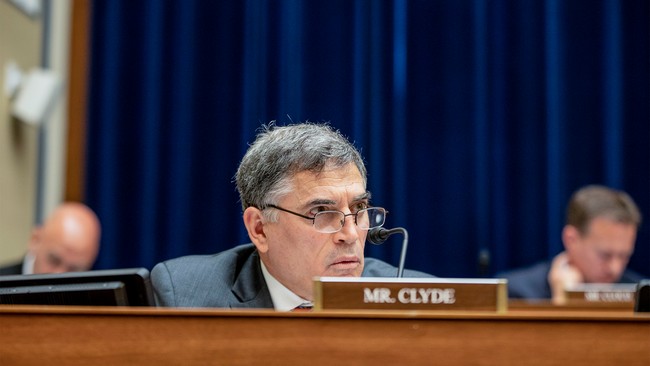
This piece looks at Rep. Andrew Clyde’s new bill to repeal Temporary Protected Status, the GOP defections that helped spark it, how TPS has been applied to Haiti over the years, recent court battles, and the political debate over whether TPS is a compassionate bandage or a backdoor amnesty that sidelines American workers.
Americans are fed up with an immigration system that too often rewards lawbreaking and creates incentives for mass migration. Rep. Andrew Clyde of Georgia is pushing back with the Territorial Protection and Sovereignty Act, a bill that would repeal Temporary Protected Status and terminate current designations. Under his proposal, people now under TPS would be required to depart the United States within 60 days of enactment or face removal proceedings. That sharp timeline is meant to restore the rule of law and make immigration policy reflect American priorities.
Clyde frames TPS as a program that started with goodwill but has morphed into something else. He says the label temporary has been stretched into permanent residency by successive administrations and that Congress has let it persist without a meaningful plan to return beneficiaries to their home countries. In his words, “Unfortunately, there has never been anything temporary about Temporary Protected Status. TPS has been weaponized and abused for decades, turning a so-called ‘temporary’ protection into permanent amnesty. It’s time for Congress to close this amnesty loophole once and for all by fully repealing TPS and sending all TPS holders out of the country.”
What pushed Clyde to act, he says, was not liberal plotting but movement inside his own party. Ten House Republicans voted with Democrats to extend TPS for Haitian nationals, a move that convinced him the program’s expansion was bipartisan and entrenched. Those defections highlight an internal GOP fight: some lawmakers see narrow extensions as humane responses to crises, while others view them as dangerous precedents that encourage more unlawful migration.
Haiti’s relationship with TPS illustrates the point. The first designation arrived after the catastrophic 2010 earthquake and was extended repeatedly for years before being terminated in 2019. The status was later reinstated and broadened amid political violence, another quake, and pandemic-era instability. Numbers spiked at the border: roughly 54,000 Haitian entries were recorded in fiscal 2022 and more than 76,000 in fiscal 2023, figures that shaped the policy debate in Washington.
The Biden administration reopened and extended TPS for Haiti through 2026, which opponents say rewards chaotic governance abroad and signals to migrants that the U.S. will tolerate large inflows. Supporters counter that sending people back to unstable conditions would be cruel and could cause humanitarian harm. Republicans who prioritize robust borders argue that temporary relief must not become open-ended sanctuary that displaces American workers and strains communities.
Legal fights have complicated the matter. A Trump-era attempt to end TPS protections for hundreds of thousands of people was blocked by a federal judge, and an appeals court kept that block in place while a Supreme Court decision looms. That litigation means many TPS holders remain in the United States for now, and it raises the question of whether Congress or the courts will settle the long-term fate of the program. For lawmakers like Clyde, waiting for the courts is not acceptable; legislative repeal would be a clear political statement.
Beyond the legal niceties, the dispute is political. Some Republicans who supported narrow extensions argue practical politics and humanitarian concerns justified their votes. Others see those votes as betrayals that cement an expansionary approach to immigration policy. Clyde’s bill is meant to force a choice: either defend an open-ended TPS model or restore strict enforcement and immigration rules that put American citizens first.
Policy details matter: ending TPS would create immediate challenges for those currently protected and logistical questions about deportation and diplomatic coordination. But the broader point from Clyde and allies is straightforward and forceful: temporary programs must stay temporary, and Congress needs to stop turning emergency measures into permanent immigration pathways. That argument sits at the core of the renewed push to end TPS and reassert federal control over who may stay in the country.


Add comment