
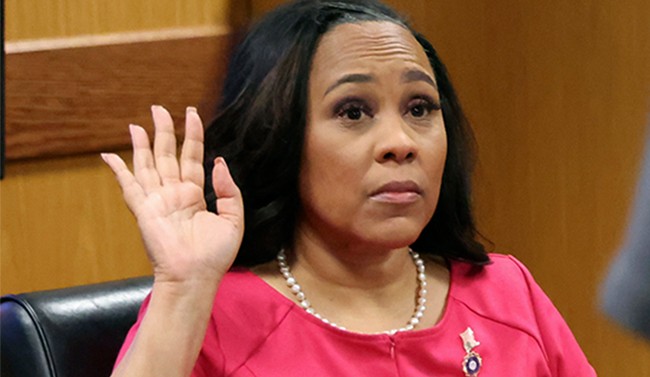
Fulton County District Attorney Fani Willis faced a tough day before a Georgia state Senate committee, answering sharp questions about her handling of the Trump election case, her relationship with special prosecutor Nathan Wade, and invoicing that raised serious concerns about oversight and judgment.
The questioning came after the election case against President Donald Trump was dismissed and Willis had previously been disqualified from the prosecution. Republicans and others have pressed for accountability, saying the process surrounding the case was chaotic and riddled with conflicts. This hearing gave committee members a chance to publicly challenge Willis on key decisions that shaped the prosecution.
Committee members zeroed in on payments to Nathan Wade, whom Willis appointed as a special prosecutor and with whom she had a personal relationship. Willis at first said she “allowed him to bill 160 hours a week,” a claim that drew immediate skepticism given the implausibility of that workload. She later corrected the figure to 160 hours a month, but the episode underscored how poorly prepared she appeared under scrutiny and why concerns about billing oversight persist.
Willis tried to justify Wade’s role by saying he would be the first in the office every day and that he enforced workplace standards. That explanation did little to explain the lack of invoice oversight or who actually reviewed the billing statements. Reports indicate Wade was paid a substantial sum for his time on the case, which fuels criticism that taxpayer funds were spent without proper supervision.
When pressed about who reviewed invoices and who authorized payments, Willis stumbled and offered evasive answers. At one point she shifted blame and implied others in her office handled those details, but she could not name them or describe the review process. That uncertainty highlights a systemic problem when prosecutors cannot establish clear, documented controls over outside contractors and fees.
Under questioning about Wade’s involvement in meetings and investigative strategy, Willis insisted she would need to see records and transcripts to confirm details. Her response, “I don’t really trust you,” to the committee was blunt and confrontational, and it did not play well for someone supposed to be accountable to the public. For many watching, her posture fed the narrative that she was more defensive than transparent.
Willis also reacted emotionally to questions that touched on personal attacks and threats she alleged she had endured over several years. She raised race-related incidents and said the hostility had forced her from her home at times, which invoked sympathy even from critics who still demand full answers on professional conduct. But those claims did not address the practical issues about invoice oversight, staffing choices, or the cascade of legal problems that led to disqualification.
At one point Willis directly accused the committee of intimidation, saying, “You think that you’re going to intimidate me! You all have been trying to intimidate me for five years, which is why I have not been able to live in my house for five years, because the n word has been written on my house!” That exact quote captured the charged tone of parts of the hearing and revealed how personal the exchange became amid procedural questioning. It also diverted focus from the financial and ethical questions surrounding the prosecution team.
The hearing touched on additional topics, including contact with the Jan. 6 committee and a DC trip taken by Wade and others that Willis described only vaguely. She acknowledged a letter seeking documents from the Jan. 6 committee but said she recalled no nonpublic materials being provided and that she had never met the committee chair. Her vague answers on travel and meetings only deepened the impression of sloppiness and poor recordkeeping.
Republicans have framed Willis’ conduct as part of a broader pattern of politically charged prosecutions that lack basic transparency. Her defensive tone and inconsistent details during questioning gave that narrative fresh ammunition. For conservative observers, the hearing reinforced long-standing concerns about prosecutorial discretion being used in ways that look partisan and poorly managed.
Beyond the political spin, the facts presented raise straightforward governance questions: who approved and reviewed invoices, what oversight mechanisms existed for outside counsel, and how did communications with federal committees or other entities shape prosecutorial strategy. These are the kinds of basic controls taxpayers expect when public money and high-stakes charges are involved, and the hearing did little to reassure them.


Add comment