
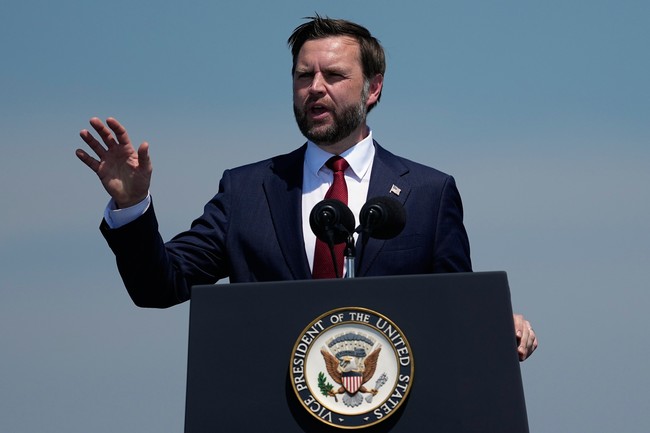
The piece examines recent reporting that Vice President JD Vance has alienated some pro-Israel Republican donors, traces comparisons to past vice presidential campaigns, and considers how his rhetorical style and factional ties might shape the 2028 Republican nomination fight.
Politico says Vice President “JD Vance has an Israel problem,” a claim that has prompted pushback and debate inside GOP circles. Reporting like this lands with extra weight because it touches the donor class that funds campaigns, and fundraising often determines who can compete in a long nomination season.
It is fair to treat any single outlet’s piece with a grain of salt, and to remember outlets come with editorial slants. Still, stories that connect a candidate’s rhetoric to donor unease deserve attention, because once donors wobble they can quickly shift the shape of a race. Vance’s candidacy is not hypothetical: he looks very likely to run and to be the early frontrunner if he does.
The polling picture looks familiar to Republicans who have watched vice presidents move toward the top of the ticket before. Today’s early averages put Vance near or around the forty percent mark in national Republican-primary snapshots, with other figures trailing at much lower levels. Early momentum matters, but it never guarantees a coronation, and history shows surprises happen.
Comparisons to Vice President George H. W. Bush’s 1988 path are tempting but imperfect. Bush arrived with decades of public service, name recognition, and the clear blessing of President Reagan after two terms as vice president. Vance, by contrast, is a one-term vice president who was relatively unknown before his selection and who represents a different factional balance within the party.
Factional tables in the GOP have shifted. Vance sits inside what some call the restrainer wing, which leans toward cautious foreign-policy positions and often clashes with hawks on Ukraine and other international commitments. That faction is smaller than the establishment and core conservative blocs, making coalition-building a tricky task for any candidate who starts there.
Rhetoric plays a huge role in these intra-party contests. Vance is a polished speaker with charisma, an advantage over many modern vice presidents. But the same verbal skill can be a liability when off-the-cuff comments inflame donors or activist groups who care deeply about issues like Israel and religious solidarity.
The vice president’s pugnacious defense of a ceasefire agreement with Iran that rattled Israeli diplomats — and his tough talk on Prime Minister Benjamin Netanyahu’s government — has damaged his standing with some pro-Israel GOP donors who have backed the party under President Donald Trump… “There’s angst among a significant majority of pro-Israel Republicans, Christians and Jews alike,” said the donor. “Overwhelmingly, I’m seeing unease, and it could be even worse than that.”
The Politico report points to moments that pro-Israel Republicans mention repeatedly, including an exchange at a campus event where Vance responded to a question framed in stark terms. The report quotes the student and surrounding reaction, and that moment now appears to be a recurring talking point among critics. Those flashpoints are what donors and operatives remember when deciding whether to back a candidate.
asked why the U.S. supports Israel when “not only does their religion not agree with ours but also openly supports the prosecution [sic] of ours.” Vance made no effort to correct the student’s characterization of the Jewish religion as being hostile to Christianity. “When I talk to people in the pro-Israel space about Vance, the Turning Point event comes up in almost every conversation,” said one longtime GOP strategist and activist in the pro-Israel camp, granted anonymity to speak openly.
Beyond Israel, Vance has clashed rhetorically with hawks on Ukraine and with other Republican internationalists, and those disagreements cut across fundraising networks. Close ties to media figures who have become lightning rods add another complication, because donors often factor in associations as well as policy positions.
Money follows perceived electability and coalition breadth. The GOP’s biggest check-writers tend to come from establishment and economic-conservative circles; pro-Israel fundraisers are frequently nested inside those groups. If Vance wants to avoid a costly primary fight, he must keep President Trump’s support while softening concerns among influential donors without alienating his base.
My wife’s favorite philosopher, Sun Tzu, once wrote, “To win one hundred victories in one hundred battles is not the acme of skill. To subdue the enemy without fighting is the acme of skill.” Vance’s strategic aim should be to avoid an intra-party war he can lose on the money and messaging fronts, and that means careful rhetoric and deliberate outreach to factions he has irritated.
Politics is unpredictable. “We’ll (Just Have to) See What Happens”.


Add comment