
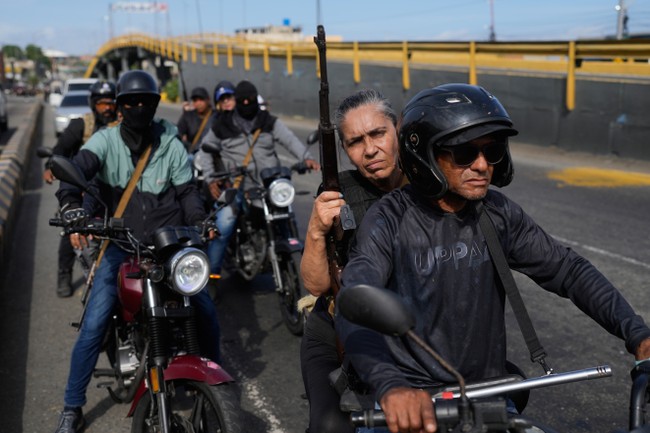
The U.S. Embassy in Caracas has issued a red alert urging Americans to leave Venezuela immediately, citing armed pro-Maduro militias setting up roadblocks and searching vehicles for signs of U.S. citizenship or support, and warning that the State Department cannot provide emergency services inside the country.
The message from U.S. officials is blunt: get out now. The alert follows the recent military action that removed Nicolás Maduro and the chaotic security conditions that followed. For Americans still in Venezuela, the risks are being described as immediate and serious.
Officials warn that bands of armed groups, often referred to as colectivos, are roaming highways and creating checkpoints. These groups reportedly stop and search vehicles looking for passports or anything suggesting a person is connected to the United States. The embassy emphasizes that these actions are not isolated incidents but part of a broader pattern affecting travel and personal safety.
The Embassy’s language is stark and unqualified. “U.S. citizens in Venezuela should leave the country immediately,” the embassy said in a Jan. 10 security alert. That line is repeated to cut through any uncertainty about the severity of the situation and the urgency of the advice given to American citizens.
“U.S. citizens in Venezuela should leave the country immediately,” the embassy said in a Jan. 10 security alert.
The warning cited reports of armed groups operating on Venezuelan roads.
“There are reports of groups of armed militias, known as ‘colectivos,’ setting up roadblocks and searching vehicles for evidence of U.S. citizenship or support for the United States,” the U.S. Embassy Caracas said.
The embassy also noted that international flights have resumed, advising travelers to use those options to depart. At the same time the advisory reminds Americans that the State Department has no personnel on the ground in Caracas to provide emergency services. That absence means the U.S. government cannot directly assist citizens who run into trouble inside Venezuela.
That matters in concrete ways: the State Department previously withdrew all diplomatic staff from the embassy in March 2019 and suspended operations, a fact the alert restates to underline the lack of in-country consular support. The embassy’s message makes clear there is no routine emergency backup for Americans facing wrongful detention, kidnapping, or other dangers. The basic infrastructure for helping U.S. citizens is not present.
“In March 2019, the U.S. Department of State withdrew all diplomatic personnel from U.S. Embassy Caracas and suspended operations. The U.S. government continues to be unable to provide emergency services to U.S. citizens in Venezuela.”
The State Department has already advised Americans not to travel to Venezuela at all, listing risks such as wrongful detention, torture, terrorism, kidnapping, arbitrary enforcement of local laws, crime, civil unrest, and poor health infrastructure. Those are not abstract concerns when militias are reportedly stopping cars and demanding proof of identity. For many, the prudent choice is departure while commercial routes remain available.
Beyond the immediate peril to individuals, the situation raises broader points about security and U.S. interests in the region. The instability following Maduro’s removal shows how quickly a security gap can form and how non-state actors exploit that gap. From a Republican perspective, the priority should be clear rules of engagement, robust contingency planning for citizens abroad, and firm measures to counter militias that threaten innocent people.
The white-knuckle reality is that no one is immune to travel disruptions caused by violent conflict, whether a regular traveler or a public figure. The recent ripple effects included canceled appearances and restricted airspace that inconvenienced various travelers. That illustrates how even temporary chaos can have broad consequences, from personal safety to international travel logistics.
Americans in Venezuela now face real choices and immediate danger, and the embassy’s red alert is meant to take the guesswork out of what to do next. Leaving while flights operate is the straightforward path the U.S. government is urging, because there simply is no in-country U.S. emergency apparatus. People should treat the alert as the highest level of warning it is.


Add comment