
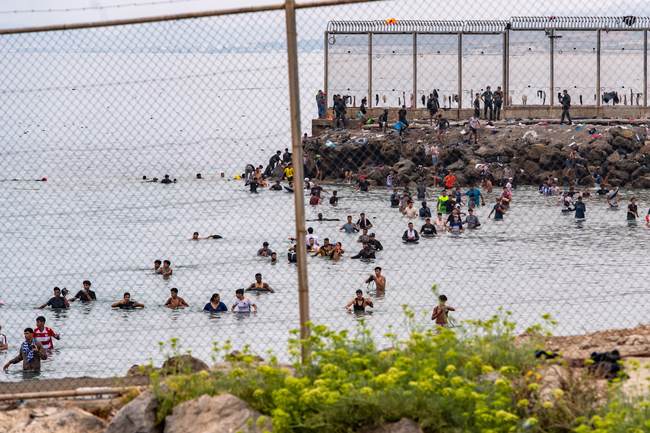
Spain faced a sudden mass crossing into its North African enclaves when roughly 60,000 people, mainly young men, surged into Ceuta and Melilla, with 67 reported dead, and the episode set off a row in the EU over who is enforcing borders and who is offering incentives for illegal entry.
The immediate crisis saw Spanish authorities claiming most of those involved were returned to Morocco, while European leaders scrambled to respond to the scale of the movement and the humanitarian toll. Italian Prime Minister Giorgia Meloni warned she would take measures to protect Italy from spillover, saying “The images arriving from Ceuta have once again demonstrated how urgent it was for Europe to respond to illegal immigration.” Her stance reflected concern that open arrangements could shift the burden unevenly across the bloc.
https://x.com/DHSgov/status/2082998116584677441
Madrid reacted angrily to that Italian stance, and the Spanish prime minister framed the pushback as an attack on Spain and a breach of European solidarity. “In the current international context, the European Union cannot afford this kind of selfish, polarising and unlawful reaction,” Sánchez said in a letter obtained by the Agence France-Presse (AFP) newswire. That language struck many as defensive given decisions Madrid has made this year.
Spain had implemented broad regularization measures earlier in the year that allowed many foreign nationals to obtain legal residency under certain conditions. Those policy moves were widely criticized for sending a signal that illegal entry could eventually be rewarded with legal status, creating a pull factor for migrants seeking a path to residence in Europe.
Observers point out the disconnect between lecturing others about legality and the practical effects of policies that relax enforcement at external borders. Political leaders can denounce reactions they call polarizing, yet the incentives created by policy choices matter to those deciding whether to risk dangerous crossings. When the welcome mat goes out, you should not be surprised when people step onto it.
Dolors Montserrat and other voices in the European People’s Party warned that actions like regularization can encourage irregular migration and weaken deterrence at the frontier. Meanwhile, a group of 22 EU states backed the call for stronger external border control and joint action to stop illegal entries, highlighting a split inside the bloc on how to balance humanitarian concerns with collective security and rule of law.
The humanitarian tragedy of dozens dying during the chaotic movements cannot be ignored, yet the political rhetoric around it shows a clash between principle and practice. If nations want solidarity in enforcing a common border regime, they need consistent policies that do not undercut one another by offering mixed signals. Tough talk from Brussels or Madrid rings hollow if it’s paired with measures that effectively lower the bar for illegal arrival.
Critics argue that temporary suspension of Schengen measures or other defensive steps are predictable responses when member states feel exposed by neighboring policy choices. Those defensive steps are not about punishing Spain alone; they are about protecting other states from sudden, uncontrollable flows and the public backlash that follows. The law and the promises of cooperation only hold if countries all play by the same rules and do not create incentives for people to test borders.
There is also a political optics problem: leaders who prioritize open-door approaches domestically must accept responsibility when those approaches produce cross-border consequences. Claiming moral high ground while implementing policies that relax enforcement invites both domestic and international criticism. Europe faces a choice between harmonizing strict external controls or tolerating ad hoc measures that shift burdens onto willing neighbors.
The episode in Ceuta and Melilla will be a reference point in debates about migration policy, enforcement, and political accountability across Europe. It exposes how policy decisions at the national level can ripple into regional tensions and humanitarian crises. Any meaningful solution requires clarity on who enforces external borders, consistent application of law, and honest political leadership that aligns rhetoric with practice.



Add comment