
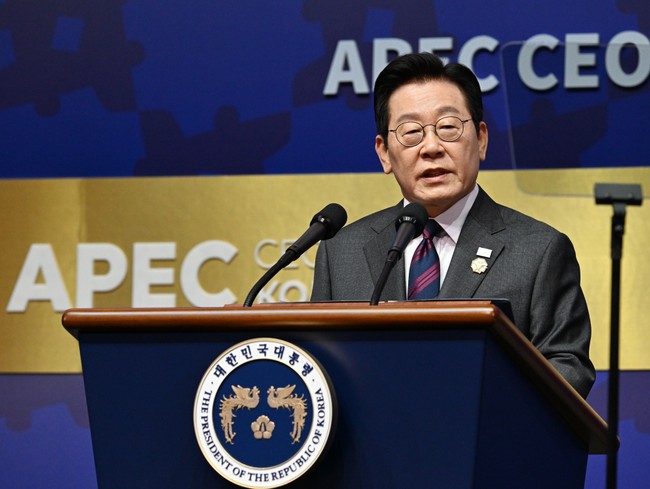
I outline how recent developments in Seoul under President Lee Jae Myung affect U.S. national security, why the Lee administration’s tilt toward China matters, the risks posed by new speech and immigration policies, how Chinese influence and espionage threaten U.S. forces in Korea, and why Washington must hold allies accountable while preserving strategic ties.
In late October, President Trump met South Korean President Lee Jae Myung during the APEC summit to discuss trade, security cooperation, and technology ahead of a meeting with China’s leader. That high-profile encounter underscored Seoul’s importance to American strategy in the Indo-Pacific and highlighted tensions between cooperation and emerging policy shifts in Seoul. These shifts merit scrutiny from a U.S. national security standpoint, because allies can’t be taken for granted when their domestic politics change the balance of strategic interests.
Secretary of War Pete Hegseth’s November stop in South Korea reinforced the Biden administration’s successor’s focus on the region, including a tour of the Demilitarized Zone and talks on adapting the ROK-U.S. alliance. Visits like these are critical to demonstrate U.S. commitment and to assess whether longstanding military and security arrangements remain fit for purpose. At the same time, domestic politics in Seoul are moving in a direction that could complicate practical cooperation on shared deterrence goals.
The Lee administration and the ruling Democratic Party of Korea have advanced measures that threaten free speech where it concerns criticism of China. A November bill would make what authorities call “anti-China hate speech” a criminal offense punishable by jail time or heavy fines. The government has also ordered police to crack down on groups and individuals accused of “anachronistic discrimination and hatred,” language that critics say will be used to silence patriots and protesters who oppose Chinese influence.
It is striking that Chinese state media have praised these moves, which invites obvious questions about why a South Korean government would follow a policy path aligned with Beijing’s preferences. China’s support for laws that curb criticism of the CCP is predictable, given the CCP’s own authoritarian approach, but Seoul’s embrace of similar restrictions shows political affinity that could undercut alliance trust. From a Republican viewpoint, an ally that limits pro-American dissent while cozying up to Beijing deserves firm scrutiny.
Seoul’s proposed speech restrictions mirror trends in parts of Europe that have tightened rules on public expression, with reported speech-related arrests numbering in the thousands in some countries. Given the presence of roughly 196,664 American citizens in South Korea, such laws are not merely abstract; they create real risks for U.S. residents and personnel. Any erosion of civil liberties that targets pro-U.S. voices raises red flags for how cooperative Seoul will be in crises that demand popular support for the alliance.
Compounding the political shift, Seoul implemented a visa-free travel policy for Chinese tourist groups on September 29, and since then several Chinese nationals who entered appear to have disappeared from official oversight. Authorities reportedly apprehended five of six individuals who vanished after arriving via Incheon; one remains at large. The incidents are alarming because South Korea’s National Intelligence Service previously reported multiple cases of Chinese nationals photographing and filming military sites since June 2024, with tourists and short-term visitors repeatedly implicated.
Those activities matter because the United States stations over 28,500 troops and operates numerous facilities on the peninsula. Any pattern of foreign nationals conducting surveillance of military installations threatens both ROK and U.S. security. Beijing’s 2017 National Intelligence Law also compels Chinese nationals and companies, at home and abroad, to assist Chinese intelligence, making seemingly innocuous tourist behavior potentially part of a broader collection effort against allied forces.
Seoul’s domestic politics have visible pro-China elements beyond immigration and speech policies. Leftist organizers have staged anti-U.S. protests with little repercussion, while labor groups with documented ties to pro-communist networks gain influence. That divergence between official rhetoric of partnership and permissive treatment of anti-U.S. activities increases the risk of South Korea becoming more receptive to Beijing’s influence operations, which aim to weaken allied cohesion in the Indo-Pacific.
Still, strategic realities constrain a harsh U.S. response. South Korea is a vital counterweight to China in the region and a major player in global shipbuilding. Seoul ranks as the world’s second-largest shipbuilder after China and is critical to efforts to revive the U.S. Navy’s industrial base. President Trump secured a $150 billion South Korean investment in U.S. shipbuilding as part of a broader deal, showing how economic and security interests remain intertwined despite political tensions.
Given these competing pressures, Washington must calibrate accountability with prudence. Holding the Lee administration responsible for policies that empower Beijing should not mean abandoning a key ally or betraying pro-U.S. South Korean patriots. The task is to apply clear pressure where necessary, safeguard American personnel and technology, and ensure that strategic cooperation endures even as Seoul’s politics shift.
The coming months will test whether diplomatic and economic levers can realign Seoul with shared security goals, or whether domestic political choices will widen the gap between Washington and a crucial partner. U.S. policymakers should prepare to act decisively to protect national security interests while keeping the alliance intact.


I’m getting 230 D0llars consistently to deal with net. Q I’ve never accepted like it tends to be reachable anyway one of my most noteworthy buddy got D0llars 15,000 D0llars in three weeks working this basic task and she impacted me to avail…Take A Look Here…..
.
More Details For ≻≻≻≻≻≻≻≻≻≻≻ EarnApp1.Com