
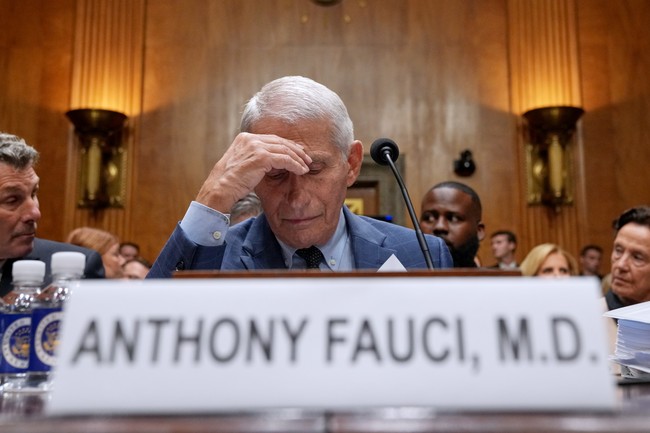
After a stormy Senate appearance where Dr. Anthony Fauci repeatedly invoked the Fifth Amendment, lawmakers left shaken and talk turned to contempt votes and possible legal action while observers and pundits savored the moment and mocked his post-hearing reaction.
Dr. Anthony Fauci faced a rough session before the Senate Homeland Security Committee, and it did not go well for him. He repeatedly declined to answer questions about his pandemic-era conduct and diary entries, leaning on the Fifth more than a hundred times. That refusal set off a chain reaction of anger and calls for accountability from several senators. The hearing left him visibly rattled and under fire from Republican members looking for consequences.
Sen. Rand Paul announced plans to force a contempt vote next week, which would push the matter toward the Department of Justice for a decision on prosecution. That move is part of a broader set of actions under discussion, including possible state-level responses, all aimed at forcing answers and consequences. Republicans say this is about restoring trust and getting a full accounting of decisions made during a national crisis. The stakes are both legal and political, and lawmakers clearly intended to keep pressure on him.
The visual of Fauci struggling under questioning was memorable, particularly during exchanges with senators like Josh Hawley, and it seemed to hit him where it hurts. Observers noted his demeanor, and pundits and hosts had a field day dissecting every facial expression and stumble. Being publicly rebuked by elected officials appears to have been intolerable for someone used to deference. For many on the right, the scene confirmed long-held doubts about his conduct and media relationships.
Later that same day he was reportedly overheard venting while walking with his wife, and that moment became a story in its own right. The New York Post described him muttering about being shouted at and dropping an F-bomb, a reaction that played into the narrative of someone unable to handle public scrutiny. That anecdote fed into an already simmering critique that he avoided accountability for too long. Critics framed the episode as a sort of public comeuppance.
Dr. Anthony Fauci was overheard blowing off steam after a brutal day on Capitol Hill — angrily venting to his wife, Christine Grady, about someone “shouting” at him.
The couple, married for 41 years, were spotted Wednesday evening power-walking near their $2.4 million home in a tony neighborhood in Washington, DC.
Fauci, fumbling with his phone and donning a Georgetown University “IronMed 5K” T-shirt, complained that someone “was shouting at me” and dropped an F-bomb as he got his steps in shortly after the tongue-lashing he received from Republican senators.
https://x.com/nypost/status/2082776230990897339
Media personalities and podcasters quickly weighed in, tying the hearing to revelations from Fauci’s diary and long-documented media contacts. The diary excerpts revealed a level of engagement with reporters that critics say undermines impartial public health messaging. Commentary focused on whether his private outreach distorted the public narrative. Critics argued those patterns demand serious review by lawmakers and the public.
Some commentators mocked his post-hearing behavior, while others used the moment to press for formal action. Laura Ingraham and others made jokes at his expense, and podcaster Katie Miller suggested he was likely conferring with reporters. That matches what the diary seemed to show: cozy relationships and frequent professional callbacks. For conservatives, the pattern confirmed long-held concerns about elite capture of public health messaging.
Sen. Rand Paul delivered a short, pointed line that captured the mood among many Republicans. “Walk it off,” he snarked, and the phrase quickly circulated as a pithy summary of the moment. It underscored a broader Republican attitude: accountability over comfort, and consequences over excuses. That sentiment is fueling the push to force a formal contempt vote and keep the spotlight on Fauci’s conduct.
Multiple paths remain on the table, from congressional contempt to state inquiries, and those options are being seriously considered by officials and allies. If the DOJ or state authorities choose to act, Fauci could face legal as well as reputational consequences. For now, the political fallout is ongoing and the debate over his role in the pandemic response shows no signs of fading. The story is shifting from private notebooks and testimony to formal mechanisms of oversight and potential discipline.



Add comment