
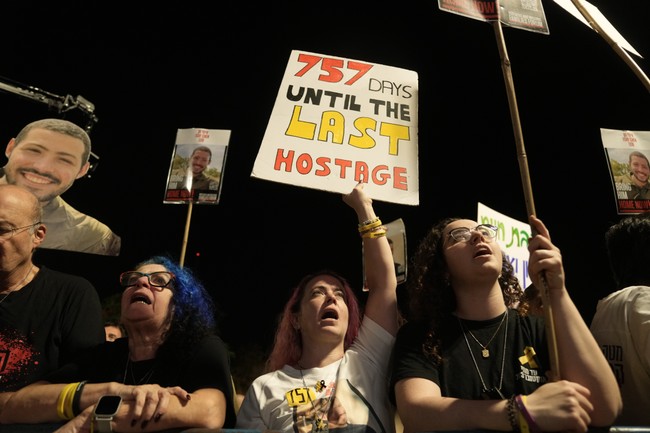
Romi Gonen, one of the first hostages freed after October 7, has finally spoken about the sexual violence and torture she says she suffered during 471 days in Hamas captivity. Her interview with Israel Channel 12’s “Uvda” delivers specific, disturbing details that challenge denials about the use of rape as a weapon. This piece summarizes her account, places it in a wider context of documented testimony, and criticizes those who downplay or defend the perpetrators. Embedded clips and original quoted passages are retained for direct context.
On Thursday, Romi Gonen broke her silence about what occurred during her captivity, describing repeated sexual assaults and physical abuse. She appeared on the “Uvda” program and recounted events with a bluntness that leaves little room for euphemism. Her testimony confronts claims that rape was not used by Hamas as a means of terror. An promoting the Uvda interview read:
“The whole point is that we’re here to open up all the things I haven’t opened up until now”: A year has passed since Romi Gonen was released from captivity, and until now – she hasn’t spoken. On Thursday, “Fact” in a special project with a brave and exceptional testimony that needs to be heard – precisely now
Gonen’s account is graphic and specific, and it makes clear that sexual violence was part of the campaign of terror. She told the interviewer that she had been raped multiple times while held, and that some attackers included individuals who were supposed to be treating or documenting her. The clarity and detail she offered undermine any narrative that minimizes the brutality inflicted on civilians that day.
Her video interview is available to watch and shows her speaking directly about the assaults she endured and how they were used to control and humiliate. WATCH:
Former hostage Romi Gonen is speaking out about the sexual abuse she endured while held by Palestinian terrorists in Gaza.
She was assaulted by 4 different men, including a doctor assigned to treat her injuries & a cameraman who filmed her for propaganda
Feminist & human rights orgs knew & were silent or backed Hamas
In the interview, Gonen said she had been raped four times before the incident shown in the clip where a gun was held to her head. She described circumstances that made resistance impossible: she was injured, powerless, and at the mercy of people who used their roles to exploit her. Those details point to a systematic pattern rather than isolated criminal acts.
Former hostage Romi Gonen tells Channel 12’s “Uvda” program about her harrowing ordeal in Gaza. Gonen says she was sexually assaulted by four different men during her time as a hostage.
She says the first assault happened on her fourth day in captivity, the abuser being a doctor who was tasked with caring for her injuries sustained during the Hamas-led October 7 attack and her abduction.
Gonen says she was allowed to take a shower, and the man followed her in “because he’s a nurse and he came to ‘help’ me in the shower.”
“I was injured, I had no power, and I was in a situation in which I couldn’t do anything,” she says.
“He took everything from me,” she says. “Afterward, I had to continue living with him in the house.”
Gonen says her next attacker was a cameraman who filmed clips of her for propaganda purposes. When she was moved homes, she was forced to stay alone with man, Muhammad, who then began touching her. Gonen says she told him to stop and went to another room, but that the next day Muhammad told her he would be beside her from then on out. “And that’s how my ordeal in that house began,” she says.
She says that for many days, Muhammad and a second man, Ibrahim, assaulted her.
“I’m sitting on the bed. Ibrahim comes and sits next to me, and harasses me. Everything happens in the room, in complete silence. I start crying insanely. Everything is quiet, and he says, ‘Be careful, if you don’t calm down, I’ll get angry.’ And that’s how the days pass: I go to the bathroom and Muhammad is with me, and he watches me. I pee, and with one hand I pull down my pants. I sit on the toilet so that God forbid he won’t see anything of me. Ibrahim keeps bothering me endlessly. They grab my leg and move up to my thigh. I kick. It went on for 16 days… Those were by far the worst 16 days of my captivity.”
Her testimony is not an isolated story; it sits alongside multiple accounts from released hostages and independent reports documenting the broader pattern of brutality on October 7. International organizations have gathered evidence of atrocities, and survivor testimonies like Gonen’s add human detail that is hard to refute. Those who insist otherwise are turning away from victims and enabling a dangerous narrative.
Some voices on campuses and in media circles have minimized these accounts or shifted blame in ways that protect perpetrators. This essay takes a clear position: denial or equivocation about documented sexual violence compounds the harm done to survivors. A free society should defend victims and hold accountable those who use rape as a tactic of war.
Gonen’s decision to speak out demands a response beyond sympathy; it calls for a firm rejection of ideologies and explanations that excuse or obscure brutality. Her courage in testifying is matched by the obligation of civic institutions to recognize and condemn these crimes. Silence and spin have consequences, and the facts in this case are chilling and direct.
Her voice joins others who have endured and survived, and it should shape how policymakers, media outlets, and civic leaders confront groups that commit wartime sexual violence. The moral clarity required is simple: recognize violence against civilians for what it is and refuse to normalize or defend it.
Those who continue to rationalize or defend such actions need to be challenged with evidence and survivor testimony, not slogans. This piece retains the original quoted material and embeds to ensure readers can see the accounts firsthand and judge for themselves.

Add comment