
This piece looks at early reporting around an attack on a girls’ school in southern Iran after the start of Operation Epic Fury, the quick rush by some media and politicians to assign blame without verification, CENTCOM’s cautious public posture, and a notable reaction from Rep. Rashida Tlaib that many saw as revealing. It examines how initial claims spread, why skepticism mattered, and why responsible commentary matters in a conflict zone where facts are still emerging.
Multiple outlets quickly ran with claims that Shajarah Tayyebeh, an elementary school for girls in southern Iran, had been hit, repeating unverified language that it was “bombed in broad daylight, when packed with young pupils” after the start of Operation Epic Fury. That kind of phrasing evokes outrage, and outlets leaned into it before independent confirmation could be established. When a story carries such immediate moral weight, good reporting should slow down, not accelerate.
Footage circulating of the strikes showed precise impacts on military targets, which raised questions about the initial narrative. As one write-up noted, “With footage coming out of the attacks showing the surgical precision of the strikes — with scalpel-specific hits on radar domes and kamikaze drones sliding between buildings to hit particular targets — the concept of a school being destroyed did not fit that blueprint.” Observers asked why allegations that clashed with the operational pattern were treated as settled fact so fast.
CENTCOM responded by saying they were “looking into them,” and emphasized that “the protection of civilians is of utmost importance, and we will continue to take all precautions available to minimize the risk of unintended harm.” That measured stance is appropriate when events are chaotic and information is incomplete. Republicans who favor strong, decisive action against hostile regimes still expect accuracy and caution before apportioning blame.
By the time of this writing, there was no confirmed attacker and casualty figures remained unverified. Iranian health officials raised an unconfirmed toll to 175, but outside confirmation was limited and murky. In a fast-moving information environment, uncorroborated numbers and emotional appeals can become tools in an influence campaign, intentional or not.
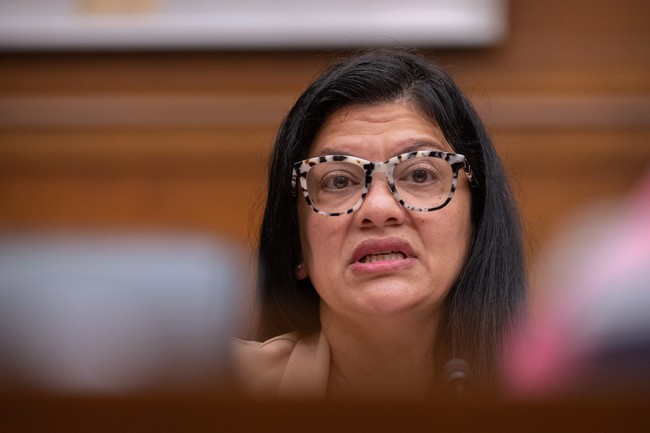
Michigan Rep. Rashida Tlaib was quick to amplify an assertion from Lebanese diplomat Mohamad Safa that the strike was carried out by the U.S. and Israel, calling it a “violation of Article 52 of Additional Protocol (I) Geneva Conventions”: That retweet-and-react pattern is common on social media, but it also shows how elected officials can lend credibility to unverified claims simply by repeating them. Many readers noted that Tlaib, born in Detroit, used the pronoun “they” for the United States, which some interpreted as a revealing rhetorical choice about whom she was representing.
Her phrasing prompted debate and critique among conservatives who see an elected official reflexively blaming American and allied forces as a betrayal of national loyalty. The moment was described by critics as a “mask slips off” instance, pointing to a tone-deafness about national service and a willingness to scapegoat the U.S. in the absence of facts:
When policymakers and media rush to conclusions, they risk amplifying propaganda and undermining public trust in legitimate military action. The questions here are straightforward and urgent: who struck the school, how did it happen, why was the school affected if it was, and what independent verification exists? Those questions deserve patient, forensic answers rather than instant certainty.
Part of the political response to this kind of event is inevitable—public officials must respond to constituents and to moral outrage—but responsible leadership requires restraint until facts are clear. The reflex to assign blame to the U.S. or its partners without confirmation plays into adversaries’ hands and distracts from holding the true perpetrators accountable, if indeed the school was struck by an outside force.
There is also a wider strategic context. Operation Epic Fury is an effort framed by supporters as necessary to degrade hostile capabilities and protect American interests and allies. That mission’s supporters want transparency and accurate reporting so the public can assess whether force is being used lawfully and effectively. Quick condemnations based on social posts do not help that cause.
For conservatives watching this unfold, the takeaway is a call for careful verification and a refusal to indulge kneejerk narratives that paint American action as criminal without proof. Raw emotion is understandable in response to images of children, but policy and media credibility depend on facts. In the absence of clear evidence, responsible citizens and leaders should insist on verification rather than amplification.
And when pundits or politicians try to force answers before investigators can provide them, remember the simple truth many of us keep repeating in these moments: “You can’t.”

Add comment