
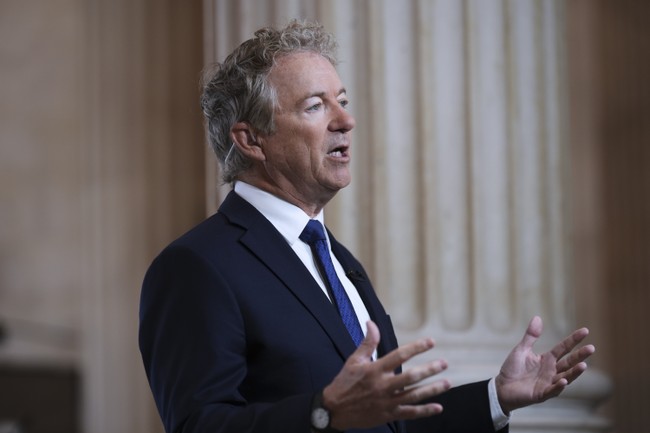
Senator Rand Paul’s annual Festivus Report landed again, cataloging what he calls trillions in wasteful federal spending — from bizarre animal experiments to overseas cultural projects — and sparking the familiar outrage over money that critics say should never have left private hands or state authority to begin with. The report lays out specific programs, dollar figures, and shocking examples that aim to show how taxpayer funds are being used in ways many Americans would find absurd or unconstitutional, and readers get a clear sense of why Paul and others keep sounding the alarm.
Every year the Festivus tally tries to do the same thing: put a price tag on Washington’s stranger expenditures and force a conversation about priorities. This edition claims $1.6 trillion in questionable spending, a sum framed to show scale and to make the point that those funds could have been deployed in private investment, business growth, or simply left in citizens’ pockets. The tone is equal parts incredulous and contemptuous, and the examples are chosen to provoke the sort of anger that drives calls for fiscal restraint.
Some of the line items read like satire, and that’s part of the report’s rhetorical power. It highlights projects that many would consider outside the federal government’s proper role, suggesting taxpayers are underwriting pursuits that neither the Constitution nor common sense justify. The implication is clear: when Washington stretches its reach that far, the result is waste at a massive scale and the dilution of individual liberty.
The report doesn’t limit itself to oddities; it also flags experiments that raise ethical and scientific concerns. One excerpt catalogs “brutal experiments on dogs, monkeys, and rats” with specific dollar amounts attached, aiming to make those expenditures emotionally and financially tangible. These descriptions are meant to shock and to make the ordinary voter ask whether these are legitimate national priorities or abuses of public trust.
We discovered cash going toward experiments teaching ferrets to binge drink alcohol and dosing dogs with cocaine (again). Then there were taxpayer dollars spent on safe spaces at a private university. It wouldn’t be a Festivus Waste celebration without mentioning the $2.1 million spent for researchers to collect saliva samples and survey partiers at EDM clubs and festivals in New York City about their drug use. White Coat Waste helped us uncover hundreds of millions of your hard-earned tax dollars funding labs, gain-of-function research, and brutal experiments on dogs, monkeys, and rats. That includes over $13.8 million on beagle experiments, $14,643,280 to make monkeys play a “Price Is Right”-inspired video game, and so much more.
Specifics in the report range from modest dollar amounts for cultural outreach to multimillion-dollar research projects with real-world implications. One example calls out roughly $244,252 directed to a cartoon series abroad aimed at climate education, a line item used to argue that federal funds are being siphoned into projects of limited domestic benefit. Critics say such spending reflects misaligned priorities and a bureaucracy that keeps finding new ways to allocate money beyond the federal remit.
Other entries aim straight for the gut: a $13.8 million figure tied to canine experiments, another $5.2 million for repeat dosing of dogs with controlled substances, and over $1 million linked to controversial collaborations that critics connect to risky viral research. The cumulative effect is to depict a federal machine funding pursuits that many taxpayers would find morally or practically indefensible.
Cartoon Climate Crusaders in Pakistan: The U.S. Department of State gave $244,252 to Stand for Peace in Islamabad to produce a television cartoon series that teaches kids in Pakistan how to fight climate change.
Fauci’s Beagle Labs Live On: NIH extended funding for Dr. Fauci’s beagle experiments, costing taxpayers $13.8 million.
Coked-Up Canines Redux: NIH spent $5,215,216 to dose dogs with cocaine. Again.
Ferrets on a Booze Binge: The Department of Veterans Affairs (VA) wasted over $1,079,360 teaching teenage ferrets to binge drink alcohol.
Bird-Brained Spending in China: The Biden U.S. Department of Agriculture (USDA) funded a $1 million collaboration to soup up bird flu viruses with the Wuhan Institute of Virology’s parent organization and a researcher affiliated with WIV.
For many readers, the report’s value is less in shifting policy immediately and more in naming what it considers unacceptable uses of public money. It’s a spotlight on the disconnect between voter priorities and what gets funded, and it frames the debate in stark financial and moral terms. Whether it changes spending habits in Washington is another matter, but it does keep the question of federal reach alive in public conversation.
Critics argue the Constitution and the Tenth Amendment offer a clear boundary for federal action, and they view these examples as evidence that boundary has been ignored for generations. The report plays to that legal and philosophical critique by repeatedly pointing out items that, to its authors, lack any clear constitutional basis. That legal framing is part of its appeal to those who favor limited government and local control.
The annual release has become a ritual: the report arrives, headlines flare, and the arguments over responsibility and oversight resume. It’s designed to provoke a political and cultural reaction, and for those who distrust an expansive federal state, it reaffirms long-standing complaints about how taxpayer dollars are spent. The facts and figures are meant to translate abstract concerns about bureaucracy into concrete, outraged response.


Add comment