
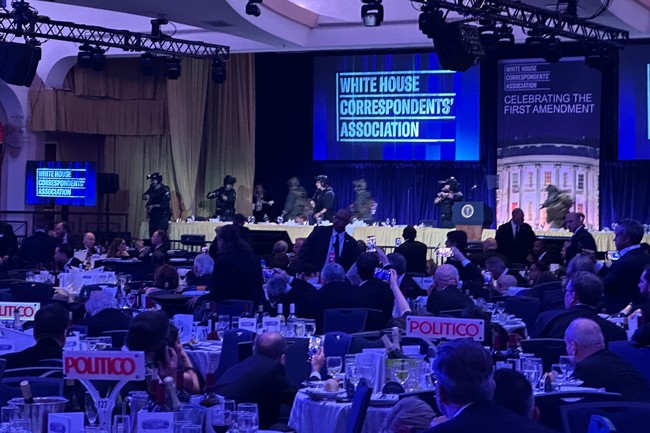
The federal court refused to disqualify Acting Attorney General Todd Blanche and U.S. Attorney Jeanine Pirro from the prosecution of Cole Tomas Allen, the man accused of the April 25 attack at the White House Correspondents’ Dinner; the judge ruled attendance and public comments did not create a legal conflict, and he found the actual victims to be President Trump and the wounded Secret Service officer, not department officials who happened to be present.
The judge’s 18-page order denied the defendant’s motion to remove Blanche and Pirro from the team prosecuting the case that grew out of the incident at the Washington Hilton. Prosecutors say Allen traveled there with the intent to kill President Trump, breached a Secret Service checkpoint with a shotgun, and injured an agent before he was stopped. The factual narrative in the filing frames the attack as a direct threat to the President and those protecting him, which the court treated as central to the disqualification analysis.
Allen argued that Blanche and Pirro should be recused because they attended the dinner, spoke publicly afterward, and in Pirro’s situation because of her long friendship with President Trump. The court rejected the idea that simply being at the scene of an alleged crime makes an official a legal victim. Judge McFadden emphasized that the statutory and legal concept of a victim is narrower than mere presence during a dangerous event.
The court laid out who qualifies as a victim in this case and pointed to the President and the wounded Secret Service officer as the individuals directly harmed by the alleged conduct. The judge wrote that attendance alone does not convert Department officials into victims when they were not targeted or injured. That legal distinction undercuts the defendant’s basis for asking for disqualification and helps explain why the motion failed.
Neither Blanche nor Pirro is a victim of Allen’s alleged crimes. Allen stands accused of attempting to assassinate the President, assaulting a United States officer with a deadly weapon, and committing two firearm offenses. See Indictment, ECFNo. 22. The only people “directly and proximately” harmed by those alleged crimes are the President and the wounded Secret Service officer. See Opp’n at 3. Add to that list, perhaps, the United States. Cf. Heldt, 668 F.2d at 1275. But the list stops short of Blanche and Pirro. Allen is not charged with attempting to harm either. Nor did he injure them. That they theoretically could have been injured or that they were present at the alleged crime scene does not make them “victims” of the charged crimes in a legal sense.
The court also rejected the premise that public comments by prosecutors create a disqualifying appearance of impropriety. McFadden reminded readers that prosecutors are charged to pursue cases vigorously and are not required to maintain personal detachment in public statements the way judges must remain neutral. His opinion made clear that impartial adjudication is the judge and jury’s task, while advocacy is the prosecutor’s job.
The written opinion addressed concerns that Blanche and Pirro would exert undue influence because of their senior roles, but the judge noted both are in remote supervisory positions and do not plan to serve as trial counsel. That practical reality undercuts claims of prejudice, since line prosecutors will handle the bulk of decisions and courtroom duties. If any biased conduct emerges, the court said defense counsel can and should raise it at the appropriate time.
Blanche’s and Pirro’s roles in this case assuage Allen’s specific concerns. Their remote supervisory status undermines the impropriety claim. See Opp’n at 8 n.3 (explaining that neither Blanche nor Pirro plan to act as trial attorneys here). It also undermines any claimed prejudice because line prosecutors will make most decisions. Allen’s fears that they will act inappropriately trade on his mistaken view that prosecutors must act completely impartially. That, the Court has explained, is a judge’s duty, not a prosecutor’s. See Wright, 732 F.2d at 1056. Should Allen develop concerns about biased treatment, the Court is confident that his attorneys will raise them.
The opinion turned as well to Pirro’s personal ties to the President, a point the defense emphasized in asking for recusal. McFadden reviewed historical practice showing presidents often appoint trusted allies and friends to senior Justice Department positions, and he cited precedent declining to require recusal by officials simply because of personal relationships. The court stressed that acting in an official capacity under the Constitution does not automatically trigger disqualification based on personal association.
The judge acknowledged the unusual nature of the facts here, given that senior Justice Department officials were present where the alleged assassination attempt happened. He nevertheless concluded that unusual circumstances do not equate to unconstitutional ones and found no actual conflict or legally sufficient appearance of one to justify removal. For now, the Justice Department will continue to prosecute the case with Blanche and Pirro remaining in supervisory roles.
The case has not been set for trial; a status conference is scheduled for June 29. The court’s ruling leaves in place the prosecution team handling one of the most significant active federal matters connected to the April 25 incident. The order clarifies how courts may treat attendance, comments, and personal relationships when evaluating motions to disqualify senior prosecutors.
Editor’s Note: This article was updated post-publication for clarity.
Add comment