
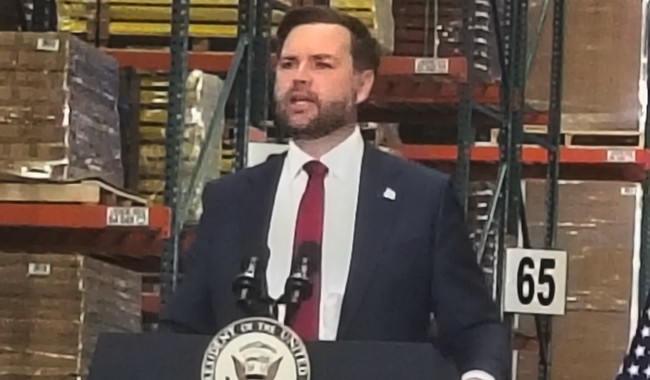
The 2028 Republican presidential primary is shaping up as a tense, factional fight with Vice President JD Vance at the center, facing structural limits, donor doubts, and rival ambitions that could turn a presumed frontrunner into a vulnerable incumbent. This piece lays out the party dynamics, the parallels and contrasts with 1988, the major hurdles Vance must clear, and the political maneuvers he’ll likely pursue to keep his path open.
Less than a day after the U.S. began bombing Iran, President Trump met with two dozen donors at his Mar-a-Lago club…Trump asked the crowd: What do you think of JD Vance and Marco Rubio? The guests applauded louder for Rubio, according to people in the room.
The 2028 field already includes obvious challengers and shadow campaigns, and the rivalry isn’t just ideological; it’s organizational. Marco Rubio’s name is floated in conversations and Sen. Ted Cruz has made clear he intends to be in the fight, signaling a traditional conservative challenge to Vance from the right. That combination—public interest, established senators, and donor movement—creates a realistic path for a contested primary.
The modern GOP coalition is fractured in ways that make a smooth vice-presidential succession unlikely. The party now includes the establishment, the Reagan conservatives, the MAGA base, and the restrainers, a mix that produces competing loyalties on both domestic policy and foreign affairs. Vance sits within the restrainer grouping, a segment that is ideologically diverse and currently the smallest and weakest component of the coalition.
Vice President Vance is part of the restrainer faction, the smallest and weakest faction of the coalition. Many GOP big donors still live in the establishment and conservative spheres, and those factions have clear differences with Vance on both strategy and style. That donor imbalance matters: campaign infrastructure, ad buys, and national travel maps are financed by donors who tend to favor candidates with long-established relationships.
History offers a useful comparison but not an exact map. In 1988, George H. W. Bush was the natural heir: a vice president who had spent decades building relationships, holding national posts, and courting donors, and he could carry Reagan conservatives and the establishment. Vance’s résumé is far leaner; by 2028 he will have served a single term as vice president and only two years in the U.S. Senate.
Vance’s shorter political record narrows his bank of favors and reduces his ready access to donors who value long service and proven national leadership. Bush in 1988 could rely on service as U.N. Ambassador, CIA Director, RNC Chair, and multiple congressional terms to reassure financiers and party powerbrokers. Vance lacks that depth of institutional ties, which makes him more vulnerable to challengers who have cultivated donor networks for years.
Another complicating factor is the party’s fading norm of deferring to the vice president when it’s “their turn.” That tradition held through many cycles until 2016, when an outsider disrupted expectations and reshaped the nomination process. The result is a modern GOP where ambition and momentum can defeat institutional seniority, and where a vice president’s claim to a clear succession is no longer guaranteed.
Vance also faces an image problem tied to close allies who have become lightning rods inside the conservative movement. Tucker Carlson’s recent controversies, including flirtations with extreme conspiratorial claims and criticism of President Trump’s foreign policy, have spilled over into Vance’s orbit. Carlson played a central role in elevating Vance and remains connected through family and staff ties, a fact opponents are already exploiting in the primary.
Sen. Cruz has targeted Carlson in his early positioning, which helps Cruz court establishment donors and voters who worry about toxic affiliations. That strategy gives Cruz a twofer: attack Vance’s associations while presenting himself as a steadier conservative alternative with deeper ties to the party’s donor class. In a tight primary, those narratives can matter as much as policy differences.
https://x.com/ScottWRasmussen/status/2029677586536710552
So what can Vance do? His short-term playbook will be to remain tightly aligned with President Trump to hold onto the MAGA base while simultaneously courting establishment and conservative donors who remain skeptical. He’ll need to neutralize the Carlson controversy or at least distance his campaign from the most extreme rhetoric, and he’ll have to persuade financial backers that his candidacy offers stability and electability.
All of this points to a primary that won’t be decided by lineage or tradition alone, but by who can stitch together a coalition across these fragmented GOP factions. Vance’s obstacles are structural, personal, and historical, and overcoming them requires rapid coalition-building against well-funded rivals and a party no longer bound to the old rule of succession.
“We’ll (Just Have to) See What Happens.”

Add comment