
I will explain the core of Iran’s president’s recent remarks, assess the claim Iran holds a “position of strength,” examine the domestic politics behind the message, consider economic pressure from U.S. sanctions, weigh the risks of any negotiated deal that leaves the regime intact, and lay out the likely consequences for American policy and energy markets.
Iran’s President Claims Position of Strength, Urges End to US Conflict
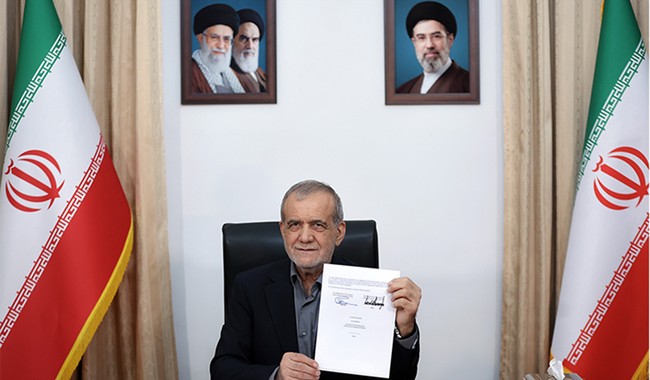
Iran’s new president told a domestic audience it’s time to end the conflict with the United States, claiming Tehran is in a “position of strength.” Saying this to a national medical association instead of an international forum changes the tone; it makes the pitch sound aimed more at internal politics than at convincing Washington. The messaging matters because leaders often tailor rhetoric to shore up domestic support while probing how far they can push externally.
The claim that Iran has been victimized by U.S. strikes on schools and hospitals was repeated in his remarks, and that line is included in the quoted material below exactly as delivered. From the American perspective, that allegation is false, and repeating it inside Iran serves to justify a push for respite while preserving regime prestige. On the ground, Tehran faces hard realities that seem to temper its public bravado.
Iranian President Masoud Pezeshkian says it is time to end the months-long Middle East war with the United States and Israel because Tehran is in a position of strength over Washington.
“It is better that we bring the war to an end now, as we are in a position of power and dignity, and the whole world acknowledges our victory and emphasizes that America has attacked our schools, hospitals and infrastructure in violation of all regulations and is hated around the world,” he says in a meeting with doctors.
The speech also took shots at hardliners at home, calling out critics who operate “outside the circle” and who comment without direct responsibility. That line signals a split between those pushing for continued confrontation and those who want to de-escalate to salvage what remains of Iran’s economy and stability. Internal debates often reveal more than the public platitudes, and this one shows a leadership wrestling with limits of its leverage.
Pezeshkian appeared to take a subtle jab at hardliners in his own country, criticizing people “sitting outside the circle.”
“In the meantime, some people are sitting outside the circle; because they do not know the state of the government, the state of the parliament, and the state of the commanders, they make comments and analysis, even though they have not experienced any suffering or hardship, and then they talk about the cost. They do not find a single clause in this agreement that indicates a commitment; all commitments are related to the other party,” he said.
On the U.S. side, economic pressure has been stepped up sharply, and that is likely a major reason Tehran is signaling openness to a pause. Sanctions and targeted financial campaigns can squeeze a regime in ways kinetic strikes cannot, and those pressures show up in domestic shortages and political unrest. When leaders publicly push peace while sanctions bite, it often reflects a calculation that the cost of continuing the fight is now higher than the benefit.
Any deal that merely freezes the current Iranian system without addressing the underlying drivers of aggression will probably only delay the next crisis. As long as the Islamic Republic remains in power, it is likely to keep supporting proxy groups, fostering instability, and pursuing nuclear options when international attention fades. A temporary pause that leaves the regime’s structure intact will not eliminate strategic threats in the region.
Energy markets are already sensitive to the rhetoric and the risk premium that accompanies conflict in the Gulf. Oil prices moved higher amid these developments, and that’s a real political problem as campaign season approaches. Higher fuel costs bite consumers immediately, and for an administration focused on winning voters, rising energy prices are the kind of headwind that shapes political fortunes.
Policymakers have a clear choice: treat Tehran’s current outreach as a genuine opening to negotiate meaningful, verifiable limits on malign behavior, or accept a surface-level pause that buys time for the regime to rearm and reorganize. A firm posture that ties any relief to concrete concessions and intrusive verification will limit the chances that a deal becomes merely a pause that benefits Iran’s ruling class.
From a Republican viewpoint, strength produces peace, and that posture should guide any response. Pressure that undermines the regime’s capacity to export chaos, combined with clear red lines and economic leverage, makes a negotiated pause credible only if it contains enforcement and verification. Otherwise, an appearance of weakness will tempt hardliners back into aggression once international attention drifts.

Add comment