
Tulsi Gabbard, now Director of National Intelligence, released declassified material that her office says reveals a coordinated intelligence community effort and congressional theatrics that led to the 2019 impeachment of President Trump. The documents allege procedural failures by the former Intelligence Community Inspector General and coordination between a whistleblower and Democratic staffers, and Gabbard points a finger at political motives driving the whole episode. This article lays out the central claims, the key players named, and the broader implications for how whistleblower processes and oversight can be misused. Embedded items from the original release are preserved inline for reference.
Gabbard’s declassification targets the heart of the impeachment storyline: the July 2019 phone call between President Trump and Ukrainian President Volodymyr Zelensky. Democrats at the time framed that call as a demand that Ukraine investigate Hunter Biden’s business ties, and argued the president abused his power. The new documents, Gabbard says, show the narrative was pieced together from secondhand material rather than solid, firsthand evidence.
The documents criticize former Intelligence Community Inspector General Michael Atkinson for deviating from standard inspector general procedures and effectively rushing a complaint into the public crucible. Gabbard’s statement accuses Atkinson of relying on just a handful of interviews and on witnesses who had no direct knowledge of the call, creating a shaky foundation used by others to build political momentum. That alleged shortcut, if true, undermines confidence in the objectivity of the oversight machinery so crucial to national security.
Gabbard’s release calls out how the whistleblower process was handled, saying the complaint was pushed to Congress, referred to the FBI, and leaked to media despite what she characterizes as a lack of first-hand evidence. She names associates of the original Russia assessment and figures connected to past political controversies as part of the chain that amplified the claims. The Office of the DNI’s press material, according to Gabbard, lays out how secondhand testimony became the spark that lit the impeachment fire.
During his preliminary investigation into President Trump’s July 2019 phone conversation with Ukrainian President Volodymyr Zelensky, former IC IG Michael Atkinson did not follow standard IG procedures and relied upon politicized, manufactured narratives – only conducting interviews with four individuals: the Whistleblower, the Whistleblower’s friend who was a co-author of the January 2017 Russia Hoax Intelligence Community Assessment (ICA) and close colleague of disgraced former FBI Agent Peter Strzok, and two character references who had zero firsthand knowledge of the July 2019 phone call.
The release mentions Peter Strzok by name, pointing to him as part of the broader context of political bias inside the intelligence community. That reference will ring familiar to many who followed earlier controversies about FBI conduct during the Russia probe. Gabbard’s narrative frames those past episodes as part of a recurring pattern where intelligence apparatus elements cross into political activity instead of staying neutral watchdogs.
Further passages in the declassified text accuse Atkinson of weaponizing the whistleblower process, ignoring Department of Justice guidance, and relying on secondhand testimony to ensure the complaint reached Congress and the press. The claim is that once the complaint was in play, then-House Intelligence Chairman Adam Schiff and then-Speaker Nancy Pelosi leveraged the story for political theater that culminated in impeachment. That sequence is presented as the result of a manufactured narrative rather than evidence-driven oversight.
Despite a lack of any firsthand evidence, IC IG Atkinson proceeded to take actions to weaponize the Whistleblower process and exceed his statutory jurisdiction by ignoring Department of Justice guidance and relying on only second-hand testimony to ensure the whistleblower complaint was released to Congress, referred to the FBI, and leaked to the propaganda media.
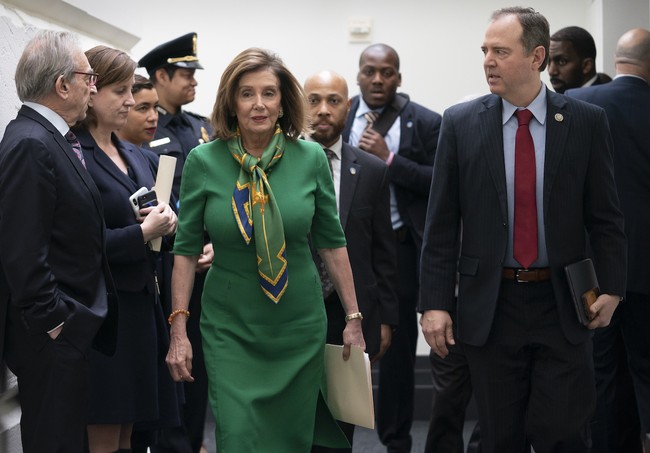
Then-House Permanent Select Committee on Intelligence (HPSCI) Chairman Adam Schiff and then-Speaker Nancy Pelosi used this false, second-hand narrative to create media intrigue and ultimately spark the basis to impeach President Trump in December of 2019.
Whistleblower met with Democrats on House Intelligence Committee (then led by Adam Schiff) BEFORE reporting his allegations to the Intelligence Community Inspector General.
The DNI release frames this as a textbook example of politicization: a whistleblower engaged with partisan committee members before filing through official inspector general channels, and the inspector general who reviewed the matter allegedly skipped standard safeguards. If accurate, those are serious procedural failures that feed public skepticism about both institutions and outcomes. Gabbard’s language stresses the idea that “deep state” players within the intelligence community helped manufacture a pretext for impeachment.
Other officials have echoed similar sentiments, calling the impeachment effort unfounded and politically motivated. That consensus among some current and former officials keeps the controversy alive, and it reshapes how watchdog institutions are viewed by the public. Beyond partisan headlines, the practical effect is clear: trust in intelligence oversight and whistleblower protections takes a hit whenever process and motive look murky.
The final practical concern raised by the documents is deterrence: if oversight offices can be shown to act with political bias, future honest whistleblowers may hesitate and the public will struggle to tell genuine accountability from political theater. The declassified material forces a conversation about fixing rules, reinforcing impartial procedures, and rebuilding the credibility of oversight roles so that they serve the Constitution rather than political ends.
“Deep state actors within the Intelligence Community concocted a false narrative that was used by Congress to usurp the will of the American people and impeach the duly-elected President of the United States,” said DNI Gabbard. “Inspector General Atkinson failed to uphold his responsibility to the American people, putting political motivations over the truth. And this, along with the politicization of the whistleblower process by a former CIA employee who was working hand in glove with Democrats in Congress, are egregious examples of the deep state playbook on how to weaponize the Intelligence Community. Exposing these tactics and showing how they undermine the fabric of our democratic republic furthers the critical cause of transparency and accountability and will help prevent future abuse of power.”


Add comment