
Checklists covered: spotlight the No Tax on Tips policy and its impact, tell DoorDash Grandma Sharon Simmons’ story, quote her and the White House exchange exactly, note the One Big Beautiful Law and Working Families Tax Cut context, and preserve the original embeds and quoted material.
This Tax Week brought attention to policy wins that matter in people’s wallets, and no single moment summed that up better than a DoorDash delivery to the Oval Office. Cabinet officials have been promoting the Working Families Tax Cut as part of the One Big Beautiful Law, but Sharon Simmons’ visit put a human face on the change. Her story shows how policy turns into real gains for everyday Americans who work for a living.
Sharon Simmons, a grandmother from Arkansas known online as “DoorDash Grandma,” made the first delivery of her career to 1600 Pennsylvania Avenue, and she used the opportunity to talk about how simplified tax reporting changed her life. She started dashing in 2022 to earn extra income while keeping her own schedule, and she has completed more than 14,000 deliveries since. For millions of people who rely on tips, the No Tax on Tips policy meant keeping far more of what they earn.
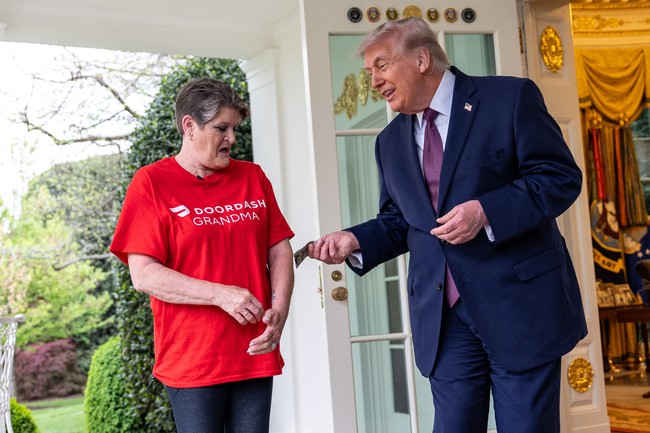
Sharon Simmons, a Dasher from Arkansas, marked her order complete at the doors of the Oval Office on the South Lawn of the White House—an unconventional drop-off to commemorate the first anniversary of the No Tax on Tips policy.
For Sharon, the moment was personal. A grandmother of ten, she started dashing in 2022 to earn income while keeping control of her schedule. Since then, she’s completed more than 14,000 deliveries, and like millions of Dashers, is now keeping more of what she earns in tips. Since No Tax on Tips was enacted, we estimate Dashers have saved hundreds of millions of dollars.
On the South Lawn, Simmons handed the McDonald’s order to staff at the outer doors of the Oval Office and spoke with President Trump about why she made this particular delivery. She told him that because of the simplified reporting she had “saved over $11,000 by not having to claim. It was very surprising,” Simmons said. That kind of savings changes retirement plans, medical bills, and the ability to help family.
President Trump answered with a line that captures the administration’s brand of bold, plainspoken policy talk: “We should call it the ‘Great Big Beautiful Tax Cut Bill!'” The president then invited Simmons to participate in an impromptu press moment, where she described what the policy meant for her household. Moments like these are what political messaging aims for—real people, real results, no spin.
WATCH:
Simmons made clear how much the No Tax on Tips policy has mattered. “I want to thank you for the No Tax on Tips,” she said. “It has helped my family out immensely, and I definitely appreciate it.” Her gratitude underscored how targeted tax relief can help working Americans without complicated bureaucratic strings attached.
Simmons also got a chance to plug a family project when the president asked about it, an oddball but human detail that made the encounter feel authentic. Small moments like that—grandparents delivering food, swapping stories with an elected leader—are what give policy a picture people can relate to. They matter in ways that charts and briefings never will.
WATCH:
“It was an incredible honor to represent Dashers from all over the country at the White House today. Thanks to DoorDash, I have been able to provide for my family while keeping the schedule that works best for me, something I never thought would be possible. Now No Tax on Tips has taken things to the next level, letting me keep more of the tips I earn and deserve. Today is a celebration of the advocacy of thousands of Dashers from around the country who fought to ensure we were included in this policy.”
One year after the policy change, the Working Families Tax Cut built into the broader One Big Beautiful Law is showing effects beyond headlines and press releases. For independent contractors, gig workers, and retirees who supplement income with tips, simplified reporting reduces paperwork and leaves more money where it belongs. Stories like Sharon Simmons’ are useful reminders that policy should be measured by what it does for actual lives, not just by how it reads in a bill.
The White House-Doordash moment also highlighted how public-private moments can amplify a message: a grassroots worker, a national platform, and a clear policy outcome. When voters see someone like Simmons benefiting, it makes the abstract concrete and the promise of economic common sense believable for many families. That kind of clarity is rare in politics, which is why this delivery made a mark.


Add comment