
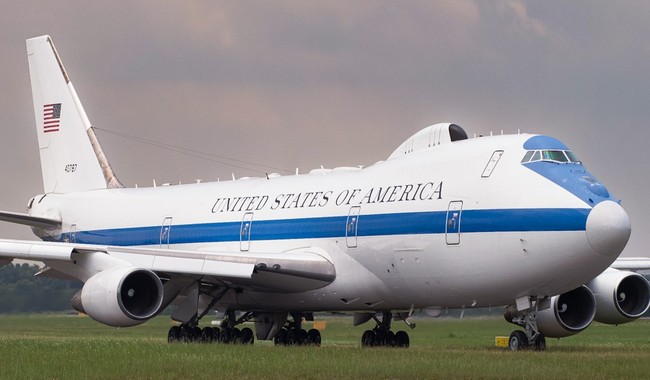
The sudden arrival of the U.S. Air Force’s E-4B Nightwatch at Los Angeles International Airport stirred online alarm, questions about purpose, and a flurry of speculation. Known as the “Doomsday plane,” the aircraft is built to keep national command and communications running during extreme crises. This article lays out what the plane is, what officials said about this stop, and why seeing it at a civilian airport mattered to a lot of people.
The E-4B Nightwatch is an unmistakable, heavily modified version of a 747 that serves as a flying command post in worst-case scenarios. Its design lets the president and top defense leaders sustain communications and operations if ground command centers are disabled, and it can survive serious threats, including nuclear and EMP effects. That capability is exactly why the plane’s appearance over LAX grabbed attention: it’s the kind of bird people picture only in doomsday fantasies.
The federal government’s Boeing E-4B Nightwatch — a military aircraft known, somewhat alarmingly, as the “Doomsday Plane” — touched down at Los Angeles International Airport this week, in what may be the famed aircraft’s first-ever LAX landing.
Aviation enthusiasts spotted the plane on Thursday on its approach to LAX. Billed by the U.S. Air Force as a “highly survivable command, control and communications center.”
The plane is equipped to serve as an airborne operations center for the president, the Defense Secretary and the Joint Chiefs of Staff in the event of a disaster that wipes out command centers on land.
Online reactions moved fast from curiosity to alarm, with many people asking whether its presence meant an imminent crisis. Social posts included blunt, panicked takes like “WAR IMMINENT?” . The internet’s instinct is to blow up a single event into immediate catastrophe, especially when tensions elsewhere feel high.
The Pentagon’s public explanation was straightforward: the E-4B was on official business transporting the Defense Secretary for scheduled engagements in Southern California as part of a tour of defense-related firms. Officials framed the visit as routine travel tied to outreach with military contractors and defense companies, not an emergency operation. That explanation calmed some observers but left others wanting more detail about why this platform, rather than another military transport, made the trip.
Aircraft buffs noted another oddity: this may be the E-4B’s first recorded landing at LAX in its more than 50-year history, making the sighting rare even if the mission was routine. The plane is optimized for extended airborne operations, able to stay aloft against substantial threats for long periods and to refuel in flight, and it can accommodate a large joint-service operations team. Those technical facts feed both respect for the machine and concern when it shows up at a major civilian hub instead of a secure military base.
That difference matters. Joint Base Andrews and other military installations regularly host high-security transports without raising eyebrows. When an aircraft built to function as a hardened, mobile Pentagon touches down at a busy civilian airport, it prompts practical questions about logistics, security, and signaling. Some observers argued the choice of LAX could be a message of deterrence to adversaries; others saw it as simply a matter of convenience tied to the Defense Secretary’s schedule.
Descriptions of the plane from official material underline why this platform attracts attention: “The E-4B, a militarized version of the Boeing 747-200, is a four-engine, swept-wing, long-range, high-altitude airplane capable of refueling in flight. The main deck is divided into six functional areas: a command work area, conference room, briefing room, an operations team work area, communications area and rest area. An E-4B may include seating for up to 111 people, including a joint-service operations team, Air Force flight crew, maintenance and security component, communications team and selected augmentees.”
While the Pentagon did not fully explain why the E-4B was chosen for this mission instead of other military transports, officials did emphasize routine travel and engagements as the purpose. Local journalists later reported possible long-term repositioning plans for at least one of the E-4Bs to a site closer to the capital, which would change deployment patterns going forward . For now, the sight of a Doomsday plane at a civilian airport remains an odd but explainable episode in a world where deterrence and readiness get attention from citizens and social feeds alike.
People curious to see the aircraft can still find images and footage from the day, and aircraft enthusiasts will keep tracking where these rare planes go next. The combination of powerful capability and rare public appearances is what keeps the E-4B in the spotlight whenever it shows up outside military installations. Check the clip below for a clear look at the machine in action.



Add comment