
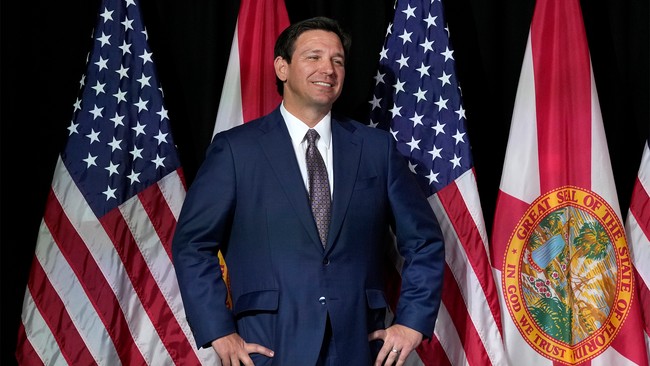
This piece covers the uproar over Florida’s new congressional map, a Democrat protest that turned into a “moral sit-in” at Governor DeSantis’ office, the House reprimand for Representative Angie Nixon, and the governor’s response after the sit-in led to her arrest.
Even as his final year in the governor’s mansion approaches because of term limits, Ron DeSantis remains a lightning rod for Florida Democrats who object to his conservative agenda and his effectiveness in office. The redistricting fight crystallized that tension when lawmakers approved a new congressional map during the session that coincided with the Louisiana v. Callais Supreme Court decision. DeSantis signed the map into law the same day, and Democrats responded with public protest.
Angie Nixon, who represents District 13 in the Florida House and is running for the U.S. Senate, became one of the loudest critics on the House floor. Observers reported she used a bullhorn to disrupt proceedings as lawmakers debated redistricting, drawing swift rebukes from colleagues who argued decorum and order were being undermined.
ICYMI, watch:
The House Ethics Committee has officially voted to reprimand Rep. Angie Nixon for “intentionally and repeatedly” breaking House rules during the April 29 session.
“When our rules become suggestions, the rights of every member of this House become less secure.”
The committee found that Nixon’s use of a megaphone on the House floor created an environment of “confusion and chaos.”
The House Rules and Ethics Committee moved formally to reprimand Nixon for violating House rules by using the megaphone, and the committee’s language stressed how breaches of procedure make the chamber less secure for every member. That reprimand echoed concerns from Republicans that orderly debate matters, and that procedural norms should not be tossed aside for attention-seeking theatrics.
Shortly after the legislative kerfuffle, Nixon staged what she called a “moral sit-in” at Governor DeSantis’ office to demand the map be undone and to shine a spotlight on her campaign. Protesters described the action as civil disobedience, while critics said it was a calculated move to raise money and attention for her Senate bid rather than a genuine policy fight.
The sit-in lasted only a few hours before staff asked participants to leave, and Governor DeSantis had Nixon arrested on trespassing charges after she refused to go. The arrest came after an on Nixon’s part to leave, and it triggered a quick response from the governor, who made clear he would not tolerate office occupations that disrupt operations.
When word spread on X of the arrest, DeSantis responded in crisp, unambiguous terms that matched his reputation for bluntness. Later he posted that she deserved to be arrested, and he slammed the action as performative: “Our office isn’t a platform for this performative nonsense.” That blunt reaction reflected a broader Republican argument that protests should not trample private space or official business.
Republicans currently hold 20 of Florida’s 28 congressional seats, and the new map could add as many as four more if it withstands court challenges. That potential gain has Democrats alarmed and energized, and it has made redistricting one of the defining political battles in Florida heading into the midterms.
Whoever wins the Democratic primary will face the GOP nominee expected to be Sen. Ashley Moody, who was appointed in January 2025 to finish Sen. Marco Rubio’s term after his confirmation as Secretary of State. The matchup promises to be a high-stakes contest, and the final shape of the congressional map will be a key factor in how competitive those races become.
The sequence of events — from the floor disruption and committee reprimand to the sit-in and arrest — highlights a clash over tactics and norms. Republicans argue the response was a necessary enforcement of rules and property rights, while Democrats cast their actions as principled protests against a map they call unfair.
As the legal challenges proceed, the political fight will move through courts and campaign cycles, with both sides sharpening arguments about representation, fairness, and the proper way to press grievances. Meanwhile, the immediate fallout shows how quickly a protest can become both a campaign moment and a legal matter in today’s polarized environment.



Add comment