
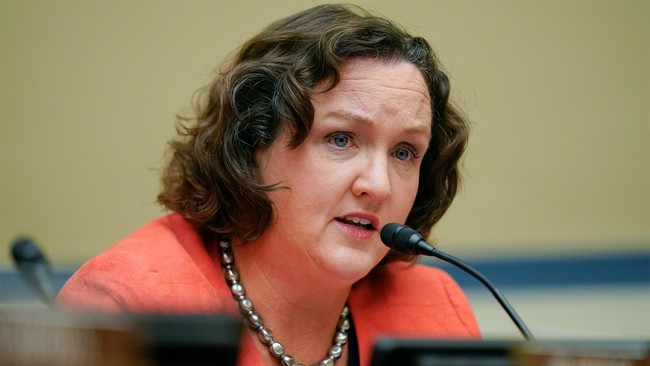
The California governor’s primary has turned into a demolition derby among Democrats, with former Rep. Katie Porter leveling sharp accusations at fellow candidates while the party struggles to present a coherent alternative to the Republican field.
Democratic infighting is now front and center in a race where voters are watching whether any candidate can rise above constant internal attacks. The back-and-forth exposes fractures and provides a clear narrative advantage to Republicans, who are casting themselves as steadier and more competent. Porter stepped into the spotlight and refused to back down during a tense cable-news interview, signaling the bitter tone the primary has taken.
On CNN, Porter accused billionaire Tom Steyer of leaking an old video that showed her shouting at a staffer, calling the move a deliberate attempt to undercut her. “Well, given that Tom Steyer is the person who leaked the video with me and the staffer from five years ago, he pretty clearly didn’t think that I, he pretty clearly wanted to be governor bad enough to knock me down to do it.” The claim landed in the middle of a campaign that already looks chaotic and attention-grabbing for the wrong reasons.
Porter also suggested the clip had ties to the Department of Energy and said people could follow that trail if they wanted to find answers. She has admitted to apologizing for the outburst caught on tape, and she even tried to frame it as a human moment in an ad that failed to win hearts. That mix of apology and deflection did little to soothe critics who see a pattern of temper and missteps.
Warning for graphic language:
Her campaign is attempting to reshape the narrative by owning the moment and moving on, but the strategy has risks when rivals and commentators keep the footage alive. Porter pointed fingers at rivals while struggling to provide independent proof of the leak, and that created a scene more about accusation than accountability. The episode also invited scrutiny from independent fact-checkers on the network where she made the claim.
CNN host Dana Bash pushed Porter for evidence and noted uncertainty about who actually leaked the video. “I should note that we don’t have evidence that Steyer leaked that video of you,” Bash said. “If you have it, please bring it.” That kind of on-air challenge left Porter without a clear trail to back her accusation, which weakened the claim even as it kept things headline-grabbing.
The Steyer campaign publicly denied involvement and characterized Porter’s accusation as a distraction from her own troubles, insisting the billionaire had no role in releasing the footage. Porter then pivoted to attack Xavier Becerra, raising questions about an unresolved probe tied to his former campaign account. She told the host, “The simple fact is Secretary Becerra cannot promise Californians that he will not be named as a co-conspirator in this corruption charge,” using the moment to push allegations that opponents say are unproven and politically motivated.
Bash reminded viewers that Becerra has consistently denied wrongdoing, pointing out the need for evidence before leaping to conclusions. The Becerra team said the FBI found no wrongdoing in its review and dismissed Porter’s comments as grasping at straws. That is the new normal in this Democratic primary: aggressive claims meet equally forceful denials, and voters get a steady diet of accusations instead of clear policy contrasts.
These clashes are more than political theater; they shape how voters perceive the party’s readiness to govern. When candidates spend their time litigating each other’s pasts, it creates a picture of a party preoccupied with internal warfare rather than presenting a forward-looking agenda. Republicans are capitalizing on the spectacle, arguing that the infighting shows Democrats are not prepared to run the state effectively.
Porter’s approach illustrates the hazard of mixing personal attacks with campaign strategy when there’s no smoking-gun evidence to support the charge. Making big allegations without clear proof invites pushback and fact-checks that keep the story alive for days, if not weeks. For a primary season already crowded with noise, the result is a prolonged fight that distracts from policy debates and hands momentum to opponents who promise stability.
The primary will keep unfolding in public, and each new claim or denial reshapes the competitive landscape. As the candidates trade barbs, voters are left sorting through competing narratives to decide who can lead California. Expect more sharp elbows and public sparring as the race tightens and stakes rise for everyone involved.


Add comment