
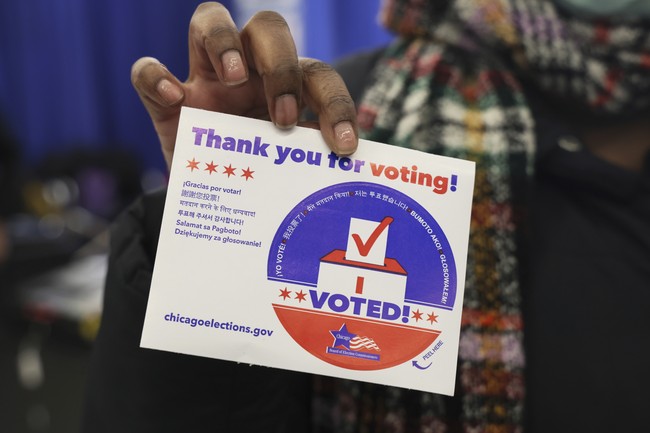
The Census Bureau’s initial review of 2020 voter records found over 24,000 instances where the voter was recorded as a noncitizen, a discovery that has reignited calls from Republicans for strict voter ID measures and renewed scrutiny of election integrity claims.
Move along, folks, move along; nothing to see here. Just a few noncitizens voting in our federal elections and plenty of people insisting that new safeguards like the SAVE America Act are unnecessary. The Bureau’s early numbers contradict the dismissive narrative and demand attention from lawmakers who claim to care about secure elections.
The Census Bureau reported Tuesday that they’re partially done poring through the 2020 election data, and they’ve so far identified 24,000 noncitizen voters. If the same rate holds as they analyze the remaining records, that count could rise to roughly 30,000 votes that should not have been included. That level of error, even if a small percentage, matters when our system depends on confidence in the count.
Wait, what?! That doesn’t sound safe, legal, or rare. The expectation from some quarters has been that voter fraud of this sort is virtually nonexistent, but these are real numbers coming from a federal statistical agency. Republicans see this as validation for ID requirements and tighter registration checks that would prevent ineligible individuals from casting ballots in the first place.
“The Census Bureau has begun checking the Voter Records from 2020 against their Citizenship Records. On the first 128,000,000 Voters, the Census Bureau proves that over 24,000 Noncitizens voted illegally! The Census Bureau is going to analyze the next 32,000,000 Voters, and this number will explode. I WON THE ELECTION! We must pass THE SAVE AMERICA ACT. Thank you for your attention to this matter!” – President DONALD J. TRUMP
The Bureau explained their methods and data sources in a concise statement, noting they matched voter lists against citizenship records and verified registrant information supplied by Secretaries of State. Their language made clear they treated over 128 million voter records with high confidence and flagged more than 24,000 records as representing noncitizens at the time of the election. Over 32 million voter records remain to be examined in the coming weeks.
https://x.com/WhiteHouse/status/2089824051233542582
Nearly 160 million voters cast ballots in the 2020 general election. The Census Bureau’s beginning analysis readily determined with high confidence that over 128 million of these voter records represented citizens, and that over 24,000 of these voter records represented noncitizens at the time of the election. Over 32 million voter records remain to be analyzed.
The headline percentage is small — roughly 0.02 percent of the reviewed records — but framing it as a fraction misses the practical consequence. Tens of thousands of misrecorded votes can tilt close contests in swing states, and the public deserves robust systems that keep ineligible ballots out of the count. That is exactly what Republicans mean when they push for voter ID and stronger verification laws.
I’ve checked these numbers in this tweet regarding three swing states, and they’re accurate: These state-level tallies highlight why even modest rates of ineligible voting are a problem when margins are tight. Listing the raw figures makes the risk obvious to anyone who cares about fair outcomes.
Here’s the breakdown that was referenced for three states: Arizona reported 10,457 votes, Wisconsin showed 20,682 votes, and Georgia recorded 11,779 votes, totaling 42,918 in those swing jurisdictions. Those are real vote counts tied to a small slice of the overall dataset, which means the national totals could be larger once the remaining records are processed. Critics who insist this is all hypothetical should wait for the full analysis before dismissing the findings.
Where did most of these noncitizen voters come from? The Census reporting provided country-of-origin percentages and Mexico led the list with 36.19 percent of the flagged records. Other countries represented included Canada at 9.05 percent, the Philippines at 8.57 percent, and Jamaica at 8.57 percent, followed by Germany 6.67 percent, the United Kingdom 6.19 percent, Cuba 4.29 percent, Vietnam 3.81 percent, Haiti 3.81 percent, and South Korea 3.33 percent.
Commerce Secretary Howard Lutnick commented on the release and urged transparency, pointing to the scale of the uncovered issue and the work still to be done. His statement emphasized that these were instances of illegal voting and that many more records are pending review, a point Republicans have seized on to argue for immediate reforms and plain accountability.
The Department of Commerce’s Census Bureau just released its analysis showing more than 24,000 noncitizens illegally voted in the 2020 election. Not just registered but literally illegally voted. And that is just the beginning. More than 32 million more voters’ records will be analyzed in the coming weeks, and these records will likely show tens of thousands of additional illegal voters.
The American people deserve transparency. We are making sure the facts are out for everyone to see.
It’s unconscionable to many conservatives that broad opposition to basic ID safeguards remains active in some political circles, especially when federal data exposes clear problems. Republicans argue that requiring verification at the polls is common sense and a straightforward way to rebuild trust. The push for the SAVE America Act and similar proposals is framed as a necessary fix to stop preventable errors and to keep elections beyond reproach.
Those who dismiss this evidence as trivial are ignoring the practical fallout from even a small number of ineligible votes in tight races. Lawmakers who care about election integrity need to respond to these findings with concrete policy, not platitudes. The coming weeks of analysis should sharpen the debate and make clear whether current systems are adequate or require the reforms many Republicans have long advocated.

Add comment