
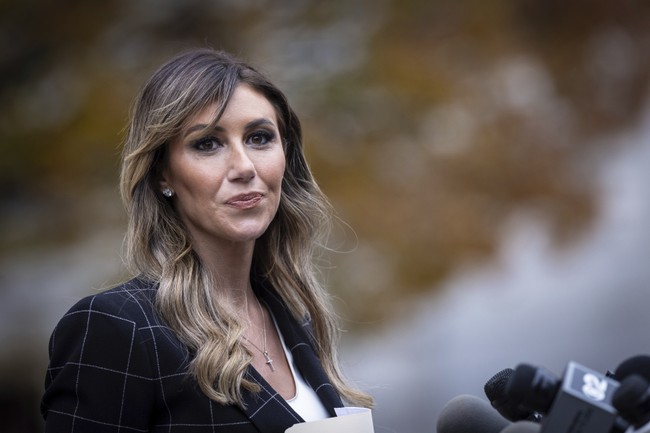
Alina Habba announced she is stepping away from serving as the federal prosecutor in New Jersey after courts blocked her appointment, and the Justice Department says it will seek further review while repositioning her to a national advisory role.
Alina Habba said Monday she was voluntarily stepping away from the job and warned, “Do not mistake compliance for surrender.” The decision follows a recent Third Circuit ruling that created new legal obstacles to her continuing as U.S. Attorney for the District of New Jersey. This has been a months-long confrontation between the White House and the courts over how presidential picks are placed into key federal roles.
The legal fight centers on the administration’s efforts to keep Habba in that top post after her Senate nomination stalled. Senators in New Jersey invoked long-standing senatorial privileges, and judges concluded that allowing Habba to stay would set a precedent that lets administrations bypass statutory appointment procedures. Critics in the judiciary warned such a result “should raise a red flag.”
A judicial panel expressed concern that the arrangement could “effectively [permit] anyone to fill the U.S. Attorney role indefinitely,” and the court’s decision made Habba’s continued tenure legally untenable. Republicans looking to restore presidential authority see this as another example of judges overruling the executive branch’s staffing choices. The administration disputes that reading and says the move undermines efforts to fight violent crime.
President Trump’s quest to install Alina Habba, his former personal defense lawyer, as U.S. Attorney for the District of New Jersey hit another legal roadblock Monday after an appeals court ruled Habba was unlawfully serving as the state’s top federal prosecutor. It’s the latest move in a months-long legal chess game in which the courts repeatedly undo the president’s effort to place Habba in the important blue state role.
The administration initially shifted Habba into an assistant role to the Attorney General after her nomination did not clear the Senate, a workaround that judges found impermissible. The courts said that arranging the appointment this way violated statutes and could taint prosecutions conducted while she held the position. That raises real questions for ongoing cases and for how future nominees are installed in politically contentious jurisdictions.
Attorney General Pam Bondi reacted sharply to the decision, calling the ruling “flawed” and saying she was “saddened to accept Alina’s resignation.” Bondi framed Habba’s departure as a judicial overreach that interferes with the Justice Department’s priorities. From a conservative perspective, that rings as yet another instance where judges substitute their judgment for the will of the voters and the prerogatives of the elected president.
Bondi pushed back on the idea that Habba’s removal would harm public safety, citing results the Justice Department credits to her time leading efforts in Newark and Camden. Officials claim Newark saw a 20 percent reduction in crime and that Camden experienced a murder-free summer, a milestone local leaders say had not happened in decades. Those outcomes became part of the administration’s argument that Habba produced tangible benefits on the ground.
Rather than vanish from the federal landscape, Habba will move into the role of Senior Advisor to the Attorney General for U.S. Attorneys, where she is slated to “help drive the fight against violent crime nationwide.” The Department of Justice expects to ask higher courts to revisit the Third Circuit’s decision, keeping the legal fight alive while she serves in an advisory capacity. If the decision is reversed on appeal, the DOJ says Habba would return to her prior post.
Conservative supporters say the broader issue is the erosion of presidential appointment power through informal senatorial privileges and judicial intervention. They argue that when unelected judges and procedural traditions prevent presidentially chosen, qualified people from serving, it weakens accountability and hampers law enforcement priorities. The dispute over Habba is likely to become a test case for how far courts can go in policing executive staffing choices.
Habba herself signaled she intends to remain engaged in New Jersey and in the fight against crime, writing, “You can take the girl out of New Jersey, but you cannot take the New Jersey out of the girl.” That line underscores her continued political profile and the way she has become a flashpoint in the clash between the administration and the judiciary. Expect more motions, appeals, and public statements as both sides press their cases in court and in the court of public opinion.



Add comment