
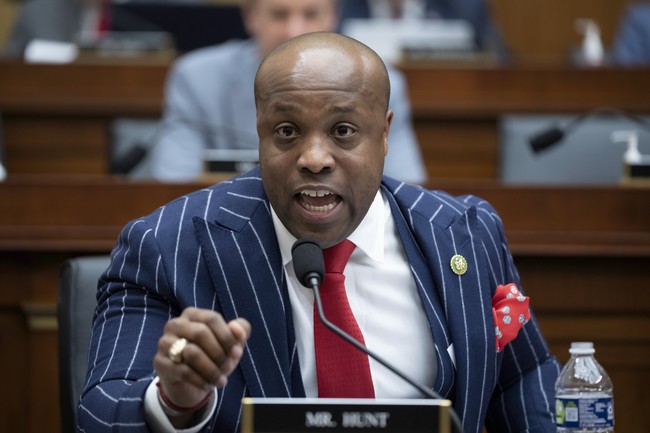
The Supreme Court’s recent ruling in Louisiana v. Callais stirred a fierce reaction from Democrats, but Rep. Wesley Hunt offered a grounded, direct rebuttal when a reporter tried to make the issue about race. He refused the bait, framed the debate around qualifications and representation, and challenged the media narrative that reduces political contests to identity politics. This piece recounts the fallout, highlights key reactions, and quotes the exact statements that shaped the exchange.
The Court’s decision in Louisiana v. Callais has reverberated across the political landscape and prompted sharp responses from prominent Democrats. Former President Barack Obama and House Minority Leader Hakeem Jeffries both voiced frustration, signaling how high the stakes felt to the left. Their responses made clear that the ruling could alter plans and strategies tied to congressional maps and voting rights frameworks.
Hakeem Jeffries did not mince words in his reaction, delivering a heated critique that reflected broader anger within his party. He warned of taking aggressive steps to counter what he called a “corrupt MAGA majority,” framing the Court’s move as political maneuvering rather than judicial interpretation. His full remark was stark and confrontational:
“Everything is on the table – everything – to deal with this corrupt MAGA majority that is issuing political opinions that are designed to bolster the prospects of the Republican Party, and we will not allow them to succeed.”
That sort of rhetoric revealed a partisan instinct to weaponize every ruling for political advantage, rather than to debate legal principles. It also underscored how Democrats often pivot from principle to power, supporting redistricting when it helps them and denouncing the same tactics when it does not. Observers saw a familiar pattern: outrage when the outcome cuts against them, selective outrage when it suits their aims.
Into that fraught moment stepped Representative Wesley Hunt, a Republican from Texas, who faced a reporter’s question about the hypothetical absence of black Republicans in the House. Hunt did not indulge the premise or turn the exchange into a performative grievance. Instead he dismissed the framing as irrelevant and focused on the core issue of qualification and representation.
Hunt’s reply was blunt and centered on merit. He said he was not in Congress because of race and emphasized the voters’ role in choosing their representatives, making his point without drama or diversion. He refused to play into what he called “race baiting,” insisting that the American people decide who best represents them.
Hunt put the choice back where it belongs: with constituents evaluating candidates on performance and ideas, not on identity. He explained that district outcomes and voter preferences drive representation, noting the practical electoral reality in his own district. His words made a clear contrast to the identity-focused language so often used by political opponents.
I represent a white majority district that President Trump would have won by over 20 points, and I won by over 25 points the last time I ran. I’m being judged not by the color of my skin, but the content of my character. I don’t care how many black people are here. I want the most qualified people.
That paragraph of Hunt’s remarks is notable because it rejects identity-based arguments while affirming a principle many conservatives hold: voters should prioritize competence and conviction. His stance suggests that expanding the Republican bench among minority communities is not only possible but likely, when the message and the messenger resonate. It also punctures the narrative that Republicans are indifferent to diversity or representation.
Critics on the left who rush to cast rulings as partisan wins or losses often forget that the Constitution and judiciary exist to apply law, not to serve political outcomes. When representatives emphasize qualifications and accountability, they shift the debate from grievance to governance. Voters respond to leaders who focus on results and who refuse to be reduced to talking points in a media-driven culture war.
The exchange with the media reflects a deeper divide over how political debates are framed and who gets to set the terms. Republicans like Hunt argue for a return to competition based on ideas and records, while many Democrats continue to center identity as the primary lens. That divergence will shape campaigns, messaging, and policy fights moving forward.
For those watching, the lesson was simple: questions designed to inflame rarely change outcomes, but answers rooted in principle and competence can. Representatives who stick to the substance and acknowledge voters’ judgment tend to fare better with constituents than those who chase headlines. The post-ruling skirmish over narrative control shows that how you answer matters as much as what the courts decide.



Add comment