
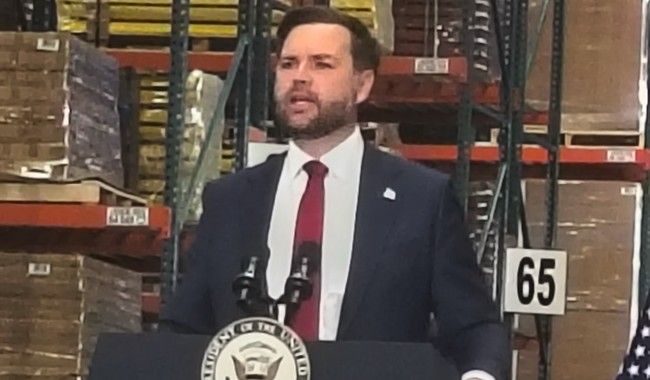
Vice President JD Vance spoke to roughly 500 people near Allentown, Pennsylvania, focusing on affordability, inflation, and who bears responsibility for higher prices; local officials and party figures joined him and the event highlighted competing narratives about the economy and political accountability.
Vice President JD Vance Campaigns on Affordability and Inflation in Allentown, Pennsylvania
Vice President JD Vance traveled to a suburb of Allentown to address issues that are dominating voter concerns: the rising cost of living, prescription drug prices, housing, and groceries. He framed the conversation around the idea that economic pain stems from the prior administration’s policies and positioned current leadership as the corrective force. Local and regional Republican officials were on hand to reinforce the message and outline steps being taken. The tone of the event was unapologetically political and focused on making the case for change at the ballot box.
Several elected officials spoke alongside the vice president, emphasizing both federal and state-level responses to affordability pressures. Attendees included the local GOP congressman, a cabinet-level official, and a statewide elected official who is being mentioned as a potential challenger for higher office. Their remarks centered on the administration’s record and policy priorities aimed at reducing costs for everyday families. The appearances were designed to show unity and a clear policy contrast with the opposition.
The central line delivered from the podium was direct and forceful: “If you look at every single affordability crisis that we talk about in the United States of America today, it’s because we inherited a nightmare of an economy from Joe Biden,” with campaign signage reinforcing themes of lower prices and bigger paychecks. That quote was presented behind the banner “LOWER PRICES, BIGGER PAYCHECKS,” which framed the event’s message. The blockquote encapsulated the event’s rhetorical strategy of placing blame for recent price shocks on prior policies. Supporters in the crowd reacted positively to the straightforward attribution.
Vice President JD Vance painted a rosy picture of America’s economy during a visit to a suburb southwest of Allentown, pinning the high costs of drugs, groceries and housing on the previous administration. “If you look at every single affordability crisis that we talk about in the United States of America today, it’s because we inherited a nightmare of an economy from Joe Biden,” Vance said at a podium behind a banner reading “LOWER PRICES, BIGGER PAYCHECKS.”
The event also functioned as a rallying point for grassroots organizers and veteran activists who have been building voter rolls and turnout infrastructure. The crowd included well-known local activists who have been active since the previous national campaign cycles, which underlines the coordination between national messaging and local organizing. That link between the ground game and top-level messaging is a key part of the strategy to turn economic arguments into votes. Observers noted the mix of seasoned operatives and rank-and-file supporters in attendance.
Discussion at the gathering moved quickly from rhetoric to numbers, with speakers pointing to current inflation figures and historical context to argue the case that recent price spikes were avoidable and the result of policy choices. The administration’s supporters stressed that the current trajectory shows improvement while reminding voters of the spike years. They argued that painting a contrast between painful past years and recent gains helps frame the upcoming elections. Critics will counter with different readings of those same statistics, so the messaging aims to be simple and memorable.
Part of the pitch was to trace causation back to specific fiscal decisions and claim that those policies led directly to higher costs across multiple categories. Speakers emphasized federal spending decisions and regulatory choices as drivers of inflation, saying those factors had immediate impacts on grocery bills, medicine, and housing costs. That argument is central to the broader effort to hold the previous administration politically accountable. It also serves to justify current policy shifts as corrective measures.
The crowd size and composition mattered politically because they signaled grassroots enthusiasm and a willingness to engage on economic issues. Local officials leveraged the event to highlight state-level political opportunities and to underscore competitive races where affordability is expected to be pivotal. The presence of potential statewide challengers suggested that the national message is being tied to down-ballot strategy. For voters focused on pocketbook issues, seeing both national and local leaders align on the same diagnosis can be persuasive.
https://x.com/PpollingNumbers/status/1999183874195132830
Speakers also referenced recent polling and commentary that treat inflation as a defining political issue for the coming election cycle, arguing that continued attention to affordability will decide many races. The line of attack is to keep the conversation anchored in relatively recent policy choices rather than distant history. That narrative intends to make voters connect personal financial pain with the opposition’s tenure in power. Maintaining that link will be a test of campaign discipline and messaging clarity.
Finally, the event highlighted how messaging about inflation and affordability is being woven into both campaign events and broader policy communications. Speakers combined emotional appeals about household struggles with factual appeals about economic trends to make their case. The focus was steady: blame where it’s believed to belong, show that improvements are happening, and argue that continued implementation of current policies will make life more affordable. The day’s speeches were as much about accountability as they were about future plans, aiming to convert concern into electoral momentum.

Add comment