
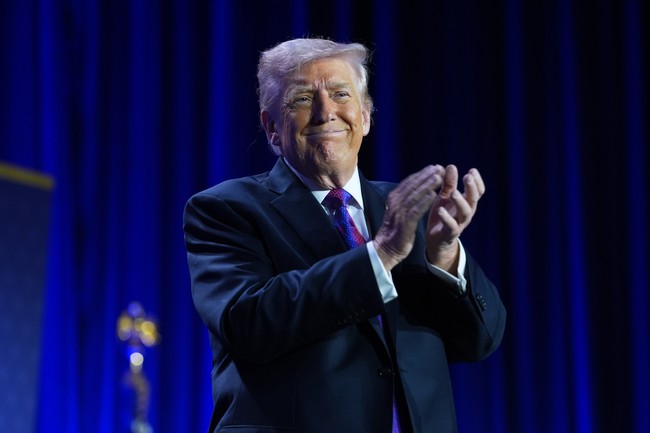
President Trump, Dr. Mehmet Oz, and Joe Gebbia unveiled TrumpRX.gov, a federal portal that connects consumers with deep discounts from drug manufacturers, promising lower out-of-pocket prices and a new route around insurance and pharmacy middlemen.
The launch event featured live demonstrations and bold claims that the site will deliver the biggest cut to prescription prices in decades. Officials said major drugmakers signed on and that the platform will point customers to manufacturer-run direct-to-consumer offers, including printable or digital coupon credits. The idea is to give Americans a straightforward place to comparison-shop and buy medicines without unnecessary intermediaries.
At the launch, President Trump framed the new site as transformative for American health costs. He said, “We’re here this evening to celebrate the launch of one of the most transformative healthcare initiatives of all time. There’s never been anything like it. Starting tonight, dozens of the most commonly used prescription drugs will be available at dramatic discounts for all consumers throughout a new website, it’s called, ‘Trump RX dot gov,’ that’s ‘TrumpRX.gov.'”
Trump did not shy away from attacking the status quo, noting decades of promises from politicians who failed to lower drug prices. He insisted this program is different and finished, saying, “For years, politicians from both parties have promised to bring down prescription drug prices and make healthcare more affordable. But they all failed. It was all words, as usual. They failed, and they failed badly. They tried doing this. some of them, most of them didn’t even try, because they never really had a shot at it. But I’m actually getting it done. And It is done, actually.”
The demonstration showcased a responsive search for conditions like diabetes that immediately returned GLP-1 medicines such as Monjauro, Ozempic, and Wegovy at prices reportedly around 10 percent or less of standard retail. Officials emphasized that dozens of commonly prescribed drugs will be available at steep discounts and that the catalog will expand as more agreements are finalized. Joe Gebbia walked through the site interface, showing how a user could search by condition or drug name, print coupons, or transfer credits to a smartphone wallet.
Trump touted industry participation, asserting that 16 of the 17 largest pharmaceutical companies had agreed to take part. He also highlighted commitments to bring manufacturing back to the United States, telling listeners that “Eli Lilly is on board to build six new plants.”
Officials say the platform targets consumers who opt to pay cash and bypass insurance co-pays and PBM-driven pricing. That strategy could especially help people with high deductibles, limited coverage, or no insurance at all. Administrators framed the choice as restoring market pressure and transparency so Americans can see and compare prices themselves.
Gebbia explained the logistics of the site and the goal of keeping it simple for everyday users. He said the initial roll-out includes more than 40 commonly used medications and that new drugs will be added week after week as partnerships expand. The site does not sell medicines directly but acts as a central hub linking customers to manufacturer offers.
Dr. Oz chimed in with a lighter moment during the demo, remarking, “We’re gonna have a lot of Trump babies with these costs,” when infertility drugs appeared among the discounted options. That line underscored how the administration pitched the program as benefiting a broad range of needs, from chronic disease management to family-building treatments.
Critics and media outlets warned that direct-to-consumer deals could leave some consumers worse off if manufacturer prices don’t consistently beat insurance-negotiated rates. Supporters counter that removing opaque middlemen restores choice and power to buyers who want to comparison-shop in a large market. The administration framed the approach as a corrective to an insurance-dominated system that often hides true cost signals from patients.
The Trump team also tied this effort to a favored-nations pricing push that seeks to align some U.S. prices with the lowest in other developed countries. Negotiated manufacturer deals were described as part of that broader strategy to rein in prices that the Rand Corporation and other analysts have shown tend to be higher in the U.S. than abroad.
Beyond price headlines, the administration emphasized manufacturing investment and economic benefits, presenting supply-chain reshoring as a companion goal to affordability. If manufacturers follow through on announced domestic investments, the project could reshape parts of the industry while creating new U.S. capacity for drug production.
For Republicans and conservatives who favor market-driven solutions, TrumpRX.gov is being pitched as a win for personal freedom, transparency, and consumer choice in healthcare. The coming weeks will show whether the platform sustains deep discounts, scales access, and undercuts the dominant role of pharmacy benefit managers and opaque insurance arrangements.



Add comment