
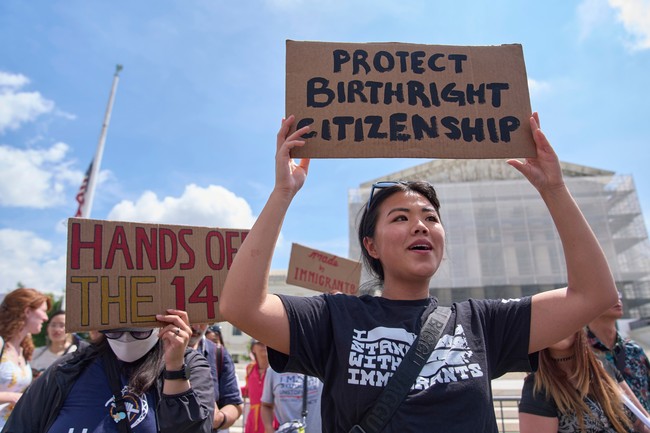
The Supreme Court’s 5-4 decision on birthright citizenship this week struck down an executive order that tried to redefine the Fourteenth Amendment, reaffirming long-standing precedent while exposing deep splits on the bench and in the country. The ruling upholds the principle that most children born on U.S. soil acquire citizenship at birth, rejects the administration’s attempt to rewrite doctrine by executive fiat, and lays bare sharp ideological divisions among justices about history, original intent, and the role of the courts.
The Court’s majority found that children born in the United States to parents who are unlawfully or temporarily present are citizens at birth, and it blocked Executive Order 14160, which sought to have federal agencies stop recognizing such births as conferring citizenship. The decision rests heavily on United States v. Wong Kim Ark from 1898, which the Court treated as controlling precedent on the Citizenship Clause and the “right of the soil” doctrine. Chief Justice John Roberts authored the opinion, joined by Justices Sotomayor, Kagan, Barrett, and Jackson, and he rejected the administration’s historical argument that “subject to the jurisdiction” meant a parent’s domicile in the United States.
That analysis was decisive: the majority said the ratification-era record does not support narrowing the Clause to exclude children of nonpermanent residents, and it emphasized the narrow historical exception for children of foreign diplomats. The legal result is straightforward, but the court’s reasoning exposes constitutional tensions about how to interpret 19th-century texts in 21st-century contexts. For Republicans who sought change through policy or legislation, the ruling is a reminder that significant legal shifts still require broad political consensus, not unilateral executive orders.
Justice Ketanji Brown Jackson wrote a separate opinion, joined in part by Justice Sotomayor, advancing a broader reading of the Amendment’s purpose and the scope of citizenship protections. Justice Brett Kavanaugh concurred in the judgment while reserving parts of his reasoning, showing how even in narrow outcomes there can be varied constitutional approaches. Those separate writings matter because they map alternative paths the Court could take in future cases that touch on immigration, federal power, and the reach of constitutional text.
The dissent, led by Justice Clarence Thomas and joined by Justice Neil Gorsuch, argued the Fourteenth Amendment was chiefly aimed at securing citizenship for former slaves and did not automatically confer birthright citizenship on children of those unlawfully present. That position underscores a stricter historical reading and a willingness to limit modern interpretations of the Amendment’s scope. Justices Alito and Gorsuch also filed additional dissents, signaling deep skepticism among conservative jurists about the majority’s reliance on Wong Kim Ark and the broader implications for national sovereignty and immigration control.
This decision closed a term marked by major rulings that reshaped multiple areas of law, including voting rights and executive authority over trade. The Court’s action here stops an executive attempt to alter citizenship rules from taking effect and returns the debate to the political branches for any lasting policy changes. For Republicans frustrated with the outcome, the path forward is clear: legislative fixes, not executive proclamations, are the constitutional route to revise birthright rules.
Beyond the immediate legal holding, the case puts pressure on Congress and state policymakers to address immigration and citizenship concerns through statutes rather than relying on contested constitutional reinterpretations. The majority opinion reaffirms a long-standing reading of the Citizenship Clause while leaving open the possibility that future cases could probe its limits in different fact patterns. Meanwhile, the dissents offer a roadmap for conservative legal arguments that could resurface if the Court’s composition shifts or if narrower cases arrive that test specific elements of the Clause.
The practical effect is that children born on U.S. soil to parents without permanent status remain citizens at birth under current law, and federal agencies will continue to treat such births as conferring citizenship. The ruling removes a short-term administrative change and directs political actors back to Congress and the states for durable solutions. In the larger sense, the decision highlights how contentious constitutional questions collide with immigration politics, and how the Supreme Court’s answers can shape policy debates for years to come.
Add comment