
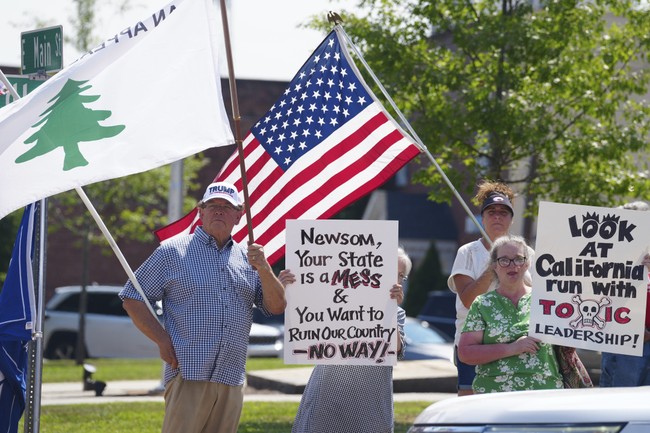
Gavin Newsom’s press office posted an inflammatory line calling an ICE-related shooting “STATE. SPONSORED. TERRORISM.” and then the governor walked back that characterization during a podcast exchange with Ben Shapiro, admitting Shapiro’s point that ICE officers are “not terrorists” was fair. This episode exposes a mismatch between a governor’s public posture and the messages his taxpayer-funded communications shop pushes, while also fitting a pattern of performative rhetoric followed by selective follow-through on policy and culture fights.
Gavin Newsom Sells Out His Own Communications Team, Backpedals on Their Vile ICE Statement
California’s governor has a press office that treats X like a playground for barbs and grand statements, often aimed at political opponents. Those posts have leaned hard into provocative language, sometimes comparing public figures to historical villains, and they read less like official communications and more like cheap stunts.
When his press shop tweeted “STATE. SPONSORED. TERRORISM.” after the ICE shooting of Renee Good, the line landed as an official office position coming from a taxpayer-funded account. That kind of rhetoric escalates tensions instead of calming them, and it invited immediate pushback from conservative commentators who challenged the governor directly.
California Gov. Gavin Newsom walked back a social media post from his press office under pressure from Ben Shapiro on Thursday, agreeing with Shapiro that it was “fair” to say ICE officers are “not terrorists.”
During a conversation between Newsom and Shapiro on the This is Gavin Newsom podcast, Shapiro grilled the governor about a his press office made following the ICE shooting of Renee Good, which simply read, “STATE. SPONSORED. TERRORISM.”
On the podcast, Ben Shapiro pressed Newsom to take responsibility for that tweet and to clarify whether his office meant to call federal ICE agents terrorists. Faced with the question, Newsom did not stand behind the wording of his communications team and instead conceded that calling ICE officers “terrorists” was unfair and inaccurate.
“Your press office tweeted out that it was state-sponsored terrorism, which, I mean governor, I just have to ask you about that. That sort of thing makes our politics worse, and it does,” said Shapiro, to which Newsom responded, “Yeah.”
Shapiro continued, “Our ICE officers obviously are not terrorists. A tragic situation is not state-sponsored terrorism.”
“Yeah, I think that’s fair,” agreed Newsom.
That the governor publicly disowned his press office’s framing shows a tolerance for extreme messaging until it’s convenient to retreat. It’s not just about a single tweet; it’s about an environment where officials toss incendiary phrases into public debate and then let the fallout land on others.
At the same time, there are examples where Newsom has acknowledged conservative concerns but then taken no meaningful action, such as his comments about fairness in sports. His words can sound principled in one setting and absent of consequence in the next, leaving critics to question whether his positions are sincere or situational.
I think it’s an issue of fairness, I completely agree with you on that. It is an issue of fairness — it’s deeply unfair.
Meanwhile, his office maintained the offending tweet even after he agreed it was “fair” to say ICE officers are not terrorists, highlighting a disconnect between the governor’s on-air posture and his communications operation’s willingness to escalate rhetoric. That discrepancy matters when a governor’s account frames public servants as existential threats.
The pattern is familiar: grand gestures, dramatic language, and press-shop theatrics followed by equivocation when the political heat intensifies. Californians and observers elsewhere notice when a leader’s public statements and the official messaging machine are out of sync.
These episodes feed a narrative Republicans have long advanced: coastal leadership that prefers virtue signaling and media moments over steady governance and accountability. When a governor’s team can throw incendiary phrases into the debate, and the governor later distances himself, it erodes trust and underscores a leadership style built on posture.
That’s the political reality being tested here: voters and officials should expect consistency between what an office broadcasts and what the elected official actually believes and will defend. When that link breaks, it becomes fair game for scrutiny from across the aisle and from the public at large.

Add comment