
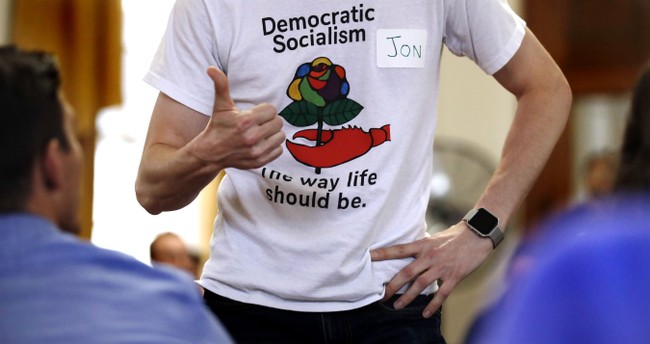
The headline poll and commentary below argue that the modern Democratic Party has shifted sharply away from older traditions and toward collectivist ideas, with a new survey showing a majority of Democratic respondents saying they would rather live outside the United States and follow-on polls and commentary highlighting growing comfort with socialism among Democratic voters.
My mother always said the last Democrat she voted for was John F. Kennedy, and she would recognize little of today’s party. Kennedy famously said, “Ask not what your country can do for you — ask what you can do for your country.” That contrast frames the argument here: a party that once celebrated civic duty now seems to embrace attitudes that question the basic virtues of American capitalism.
https://x.com/PollTracker2024/status/2063673790614175807
Recent polling is driving the point home. The Elon University/YouGov America 250 National Survey polled 1,000 U.S. adults between April 30 and May 4 and found that 55 percent of Democrats responded “yes” to the question “Is there any other country on Earth you would rather live in than the United States today?” Independents answered yes at 38 percent, and Republicans at 10 percent. Those numbers matter because they suggest not just dissatisfaction but a deeper ideological tilt among Democratic voters.
The survey result is not an isolated finding. A September 2025 Gallup poll similarly showed Democrats were the only partisan group that viewed socialism more favorably than capitalism, a data point that helps explain why far-left candidates can win in strong-blue enclaves while struggling elsewhere. The Gallup analysis noted, “Unsurprisingly, the survey found that socialism is largely toxic to Republicans and many independents, explaining why far-left Democrats have had more success in places like New York City but have struggled in red and battleground areas…” That observation pinpoints the geographic and demographic limits of this ideological shift.
Democratic leaders and activists have, over the years, softened or hidden more radical labels, but the elections of figures like Alexandria Ocasio-Cortez and New York City Mayor Zohran Mamdani make the underlying orientation harder to deny. The rise of elected officials who openly champion Democratic Socialist branding signals a party increasingly comfortable with collectivist language and policy prescriptions, and that trend shows up in public opinion.
Those who watch media and culture see the same drift. Performers who walked away from national events and outspoken commentators criticizing displays of patriotism add fuel to perceptions that some on the left view America as flawed to the point of preferring other systems. Comedian Bill Maher said performers quitting the “America 250” concert “don’t really love America,” and that blunt assessment resonates with voters who prize national pride.
Political consequences follow. As midterm campaigns approach, conventional wisdom holds that the party out of power tends to gain ground, and Democrats looking like they favor collectivist solutions may find that image costly outside liberal strongholds. A May CNN poll showed Democrats and Republicans nearly tied, which underscores how fragile the Democrats’ standing can be when questions of national loyalty and economic philosophy become wedge issues.
Part of the problem is generational and educational. Many young Americans have limited firsthand exposure to the historical and human costs of socialism, and public schools often downplay those lessons. When curricula omit the failures and tragedies tied to collectivist regimes, new voters can be more receptive to abstract variations of the idea without understanding real-world consequences.
That disconnect between abstract sympathy and lived reality helps explain survey results showing a substantial share of Democrats willing to consider moving abroad. But the practical follow-through is another matter. Saying you would rather live somewhere else is different from actually leaving family, community, and career behind to move overseas. The poll gauges sentiment and identity as much as intent.
There is also a cultural layer: politics and tribal identity now shape how people define love of country. For some on the left, critique equals love, a belief that reforming America requires distancing from certain traditions. For many conservatives and independents, critique that suggests abandoning core institutions or economic foundations looks like rejection, not reform. That clash is why these poll numbers matter beyond partisan scorekeeping.
Ultimately, the data points and public remarks combine into a clear signal for Republican readers: Democrats are trending toward policies and rhetoric that elevate collectivist approaches and skepticism of American capitalism. Whether that proves decisive in elections or continues to be a regional phenomenon will depend on how effectively conservative and independent voters press the case for prosperity, liberty, and national pride.



they want to leave and we want them to leave.