
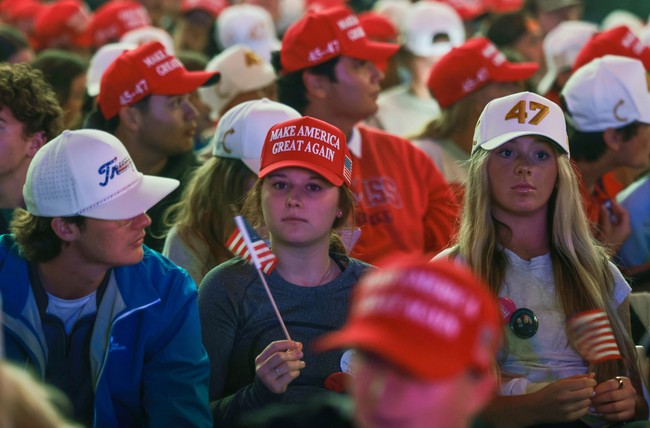
The press has latched onto a single story line for 2025: endless coverage of internal fights inside the Trump coalition framed as a “MAGA civil war,” while the Democrats’ far more consequential breakdowns get far less attention. This piece explains how that double standard plays out across leadership failures, ideological splits, and public clashes, and why it matters for the country and upcoming elections. The critique is direct: the media treats Republican disputes as proof of collapse but treats Democratic dysfunction as minor noise. Expect clear examples and plain talk about the political stakes ahead.
The dominant media narrative in 2025 treats every quarrel within Trump’s coalition like a crisis. Cable panels, political newsletters, and headline news feed into the idea that MAGA is tearing itself apart over issues such as visas, foreign policy, and who qualifies as a loyal foot soldier. That coverage is relentless and it shapes public perception, turning every disagreement into proof of systemic failure. The result is a cycle that amplifies partisan drama at the expense of deeper context.
At the same time, the Democratic Party is experiencing real chaos that rarely gets the same intense scrutiny. Leadership mistakes, public floor fights, and an existential debate over the party’s direction are playing out in the open. Those are not minor skirmishes; they speak to whether Democrats have a coherent strategy beyond opposing one man. Yet much of that turmoil is aired briefly and then buried in the news cycle.
Look at the shutdown episode this November: a planned strategy led to a backfire when eight Democratic senators broke ranks and voted with Republicans, producing furious backlash inside the caucus. The incident left Senate leaders scrambling as activists and local politicians questioned who should lead them forward. Internal sources described one senior leader as “angry at how much he’s being blamed” as party discipline unraveled. That level of internal revolt would usually command sustained national coverage, but it largely passed without the fanfare reserved for Republican fights.
The ideological split inside the Democratic coalition is another example of high stakes getting low attention. A center-left report concluded progressive rhetoric has “badly weakened” the party and urged a return to older, more centrist positions on immigration and crime. Progressive groups pushed back, insisting the party should double down on left-wing framing, not retreat. That disagreement is not a minor policy spat; it is a debate over core identity and electoral strategy ahead of 2026 and 2028.
At the party apparatus level, the Democratic National Committee’s summer meeting in Minneapolis saw public clashes over Israel policy and competing resolutions that forced the chair to pull his own proposal and form a task force. Delegates openly argued over whether their tactics were adequate or whether the party needed to abandon long-standing rules entirely. It was formal institutional conflict that revealed leadership uncertainty, yet it hardly received the repeated prime-time dissection that Republican disputes do.
When a moderate Democrat forced a floor vote that exposed tensions with progressives, the episode was described as “a rare moment of public infighting” and a “heated exchange,” but then it vanished from the headlines. Progressives attacked the move as “going after a strong progressive Latino leader,” and the incident highlighted real pressure points between the party’s wings. That kind of public fracture, involving senior figures and principle, should prompt sustained analysis—but reporters moved on quickly.
The selective spotlight reflects narratives that journalists already hold. MAGA infighting fits a familiar storyline: the movement is unstable, built on personality rather than principle, and destined to cannibalize itself. Each spat becomes evidence for that preexisting belief. By contrast, acknowledging Democratic dysfunction would force a more uncomfortable reckoning about whether the opposition has a governing vision of its own or is primarily an anti-Trump coalition.
Journalism in 2025 often amplifies Republican conflicts while downplaying comparable or worse problems on the left. That uneven treatment matters because it distorts public understanding of which party is cohesive and which is in disarray. Voters deserve reporting that treats institutional failure and strategic incoherence the same, no matter which side they happen to come from. The current imbalance fuels partisan narratives rather than illuminating the underlying political reality.
The stakes of this media double standard are real: Democrats face a fundamental question about identity and electability, not just tactical disagreements. Should they embrace progressive priorities that alienate certain voters, or revert to centrist policies that once helped them win? Can leadership navigate the split without splintering the coalition? Those questions deserve more honest national attention than they have received so far.
Editor’s Note: The Democrat Party has never been less popular as voters reject its globalist agenda.


I’m getting 230 D0llars consistently to deal with net. Q I’ve never accepted like it tends to be reachable anyway one of my most noteworthy buddy got D0llars 15,000 D0llars in three weeks working this basic task and she impacted me to avail…Take A Look Here…..
.
More Details For ≻≻≻≻≻≻≻≻≻≻≻ EarnApp1.Com