
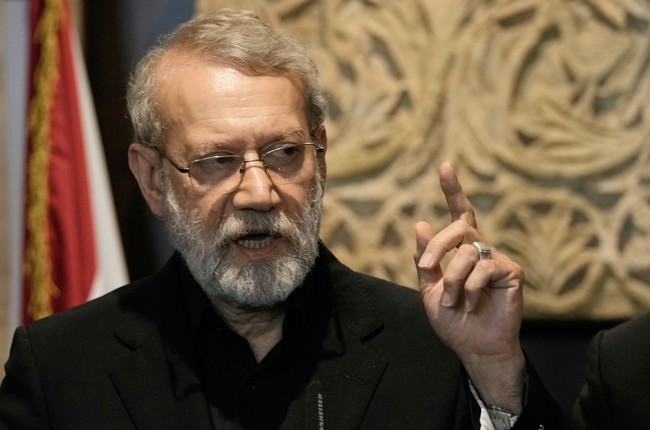
The recent strikes that removed Iran’s acting security chief and a top Basij commander mark a stark shift in the campaign against Tehran’s violent regime. This article reviews who was hit, the context of their roles, and what those losses mean for the regime and the region. It focuses on the military results and the propaganda posture that preceded the strikes. Embedded media and primary visuals are left in place for direct reference.
The headline development is the killing of Ali Larijani, identified as the secretary of Iran’s Supreme National Security Council, in an airstrike attributed to Israeli forces. Larijani had been acting as the regime’s de facto leader amid confusion over the supreme leader’s condition, and he had taken on a public face during the crisis. His visibility included provocative online behavior that tried to mask weakness with bluster.
Larijani’s public profile included mocking the United States online and posting inflammatory content during sensitive moments, which only underscored his willingness to trade in propaganda. Those online taunts did not translate into protection when precision strikes targeted high-value figures. The contrast between virtual bravado and kinetic reality is central to how observers are interpreting the strike’s message.
Reports link Larijani to the harsh suppression of dissent in early 2026, when protests were crushed with extreme force. Some estimates cited in reporting placed the death toll in the tens of thousands, a grim number that framed Larijani as a key architect of repression. That track record made him a symbolic and operational target for those seeking to degrade the regime’s internal control mechanisms.
Alongside Larijani, the Basij’s senior leadership, including commander Gholamreza Soleimani, was struck and eliminated, according to multiple accounts. The Basij is a paramilitary apparatus responsible for street-level enforcement and suppression of protests, and its leadership plays a critical role in maintaining the regime’s grip. Removing that command structure erodes the state’s immediate capacity to intimidate and violently suppress dissenters.
The Basij’s composition, which at times has included non-Iranian militia elements, made it especially dangerous as the primary tool for internal repression. January’s crackdown, which relied heavily on Basij units, showed how those forces could be turned into an engine of mass violence. Degrading the Basij disrupts the regime’s enforcement pipeline and complicates its ability to react to renewed unrest.
Strategically, these strikes showcase the effectiveness of high-end intelligence and precision munitions when used against leadership nodes rather than merely punitive or symbolic targets. The outcome reinforces a reality that loud rhetoric and social media posturing do not substitute for battlefield capability or counterintelligence. In this case, the side with superior targeting and willpower appears to have translated information into decisive action.
The strikes also carry political messaging. For domestic audiences inside Iran, the removal of senior figures sends a signal about vulnerability within the power structure. For regional actors, it demonstrates that external coalition partners can project force and knock out critical nodes of command and control. That combination changes calculations for both supporters of the regime and those waiting for an opening to act.
What follows will matter: if Basij capacity to terrorize the population is significantly reduced, space for civic action could widen, though the path to any systemic change is unpredictable and risky. The immediate military objective—degrading the regime’s ability to wage repression—appears to have been met in these strikes. Still, the longer-term political consequences will unfold unevenly and could include new cycles of violence or consolidation by surviving hardliners.
From a national security standpoint, the operation underscores a core lesson: decisive action paired with reliable intelligence can alter adversaries’ behavior and shape the battlefield faster than words ever could. Those who relied on online theatrics to project strength found that virtual posturing provided little protection against precision operations. The practical advantage remains with whichever side can turn information into timely, targeted strikes.
Editor’s Note: For decades, former presidents have been all talk and no action. Now, Donald Trump is eliminating the threat from Iran once and for all.


Add comment