
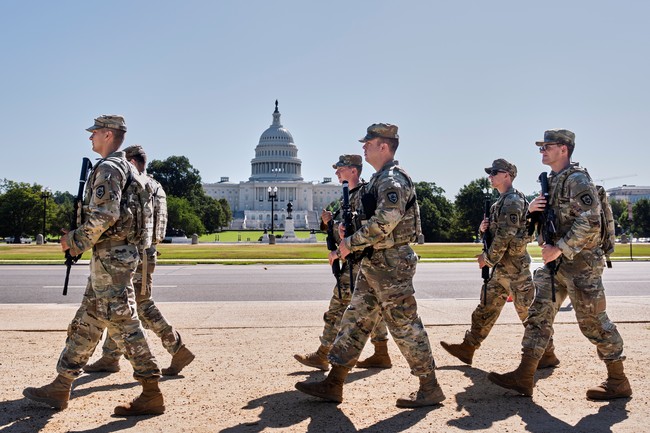
The Trump administration’s year-long law-and-order push in Washington, D.C., has delivered headline numbers and visible results, from thousands of arrests to weapons and narcotics taken off the streets, and it shows a clear approach: surge resources where crime spikes and hold people accountable.
President Trump walked into his second term determined to stop the capital from sliding into a state of disorder, and the response was straightforward and unapologetic. The Make D.C. Safe and Beautiful Task Force was created to flood high-crime neighborhoods with federal law enforcement, and the administration now points to tangible results. That direct, focused approach is what voters expect when they hear the phrase law and order.
The administration reports, and law enforcement counts confirm, a dramatic enforcement footprint that produced a long list of measurable outcomes. In its first year the task force made more than 16,000 arrests and seized large quantities of illegal drugs and firearms. Those are not just statistics; they represent people taken off the streets who were threatening residents and workers in the city.
The Make D.C. Safe and Beautiful Task Force will mark its first anniversary Tuesday after making more than 16,000 arrests since its launch, Fox News Digital has learned exclusively, as the Trump administration points to the results of its sweeping crackdown on violent crime in the nation’s capital.
“Under President Trump’s leadership, the Department of Justice and our law enforcement partners have delivered extraordinary results in our nation’s capital. More than 16,000 arrests, thousands of illegal drugs and firearms taken off the streets, and dangerous violent offenders brought to justice mean safer neighborhoods and lives protected,” said Acting Attorney General Todd Blanche. “We will not relent until every community in Washington, D.C., is safe.”
Beyond the headline total, the breakdown is stark and revealing: arrests of homicide suspects, gang members, narcotics offenders, and the recovery of missing children. Those figures read like a crime-fighting ledger and they tell a story of aggressive, targeted enforcement. When officers are visible, criminals think twice, and residents get to live without looking over their shoulders every day.
The operation has led to the arrests of 35 homicide suspects and more than 100 known gang members, along with more than 3,200 narcotics arrests, nearly 2,000 illegal guns seized, and 25 missing children located and returned home, according to a White House official.
What pushed the administration to act was a string of brutal, high-profile incidents that made it clear federal intervention was necessary. A series of violent crimes, including the killing of a young congressional intern, exposed the urgent need for a decisive response. Those tragic events underscored that the capital cannot be allowed to normalize violence under any political theory.
The operation followed the June 2025 killing of 21-year-old congressional intern Eric Tarpinian and a series of high-profile violent crimes, including the beating of a former DOGE staffer and the shooting death of a 14-year-old boy in a case involving MS-13 gang members.
If the capital city is supposed to represent the best of America, it has to be safe and orderly. That is not a partisan nostalgia trip; it is a core expectation of public life. People who work in government, live in neighborhoods near the monuments, and visit our national institutions deserve protection from violent crime and open-air narcotics markets.
The D.C. surge also reinforces a broader principle: visible, sustained enforcement works. Putting more boots on the ground, increasing patrols, and taking the fight to gang networks produces results quickly. It is not complicated policy; it is basic public safety practice, and the administration’s experience in the District is a case study for other jurisdictions struggling with spikes in violence.
Yes, enforcement sometimes pushes criminal activity into neighboring areas, and that displacement is a real management challenge. But having an operational model matters: once you demonstrate success in one place, you can adapt, coordinate with other agencies, and extend proven tactics rather than starting from scratch. That pragmatic, results-oriented mindset is what will drive broader improvements.
This is more than a political talking point; it is a practical demonstration of how prioritizing safety changes daily life for citizens. The numbers — arrests, seizures, and children returned to families — are not abstract. They are the immediate payoff of a policy choice to stop tolerating mayhem in the nation’s capital and to demand accountability from criminals who prey on the public.



Add comment