
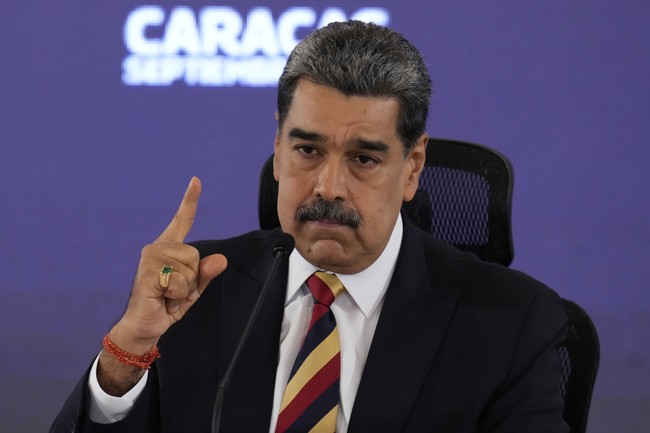
I will explain President Trump’s ultimatum to Nicolás Maduro, outline the U.S. military posture in the region, examine Venezuela’s military capabilities, report on the negotiations and their sticking points, and describe the likely political aftermath for Venezuela.
President Trump reportedly gave Nicolás Maduro a stark choice: surrender the presidency, leave Venezuela, and take his family with him. The message was framed as an opportunity to step aside peacefully before Washington escalated pressure. From the Republican perspective, this is a tough but sensible approach: offer a clear exit to avoid bloodshed while preparing to act if Caracas refuses.
President Donald Trump delivered a stern ultimatum to Nicolás Maduro to leave Venezuela immediately before announcing the country’s airspace should be closed, according to a report.
Per the Miami Herald, Washington’s warning was delivered in a phone call with Caracas and offered guaranteed evacuation for Maduro, his wife Cilia Flores, and their son, but only if the dictator agreed to resign on the spot.
The conversation stalled, U.S. officials said, and within hours Washington escalated dramatically.
U.S. forces have been visibly repositioned in response, with a sizable deployment in the region. Reports describe roughly 10,000 to 15,000 troops nearby, an aircraft carrier task group centered on the USS Gerald R. Ford, the USS Iwo Jima Amphibious Ready Group, several destroyers, and at least one attack submarine. That kind of posture signals readiness for a range of operations short of full-scale invasion, and it sends a clear deterrent message to Maduro and his allies.
The ensuing impasse, a source told the outlet, was over Maduro asking for “global amnesty for any crimes he and his group had committed, and that was rejected.”
“Second, they asked to retain control of the armed forces — similar to what happened in Nicaragua in ’91 with Violeta Chamorro. In return, they would allow free elections.”
The final issue was timing, according to the outlet, as Washington demanded that Maduro resign immediately – but Caracas refused.
According to the reporting, Maduro’s team pushed for sweeping guarantees in exchange for any departure, including amnesty and continued influence over the military. Those demands were unacceptable to the U.S. negotiators, who insisted on immediate resignation and a clean break. The dispute over timing and conditions appears to be the main reason talks broke down and the crisis intensified.
Assessing Venezuela’s military balance, the aerial side looks especially weak. The Venezuelan air force reportedly has only a handful of operational fighters: three or four aging American F-16 A/Bs and 15 to 18 Russian-made Sukhoi Su-30MK2 fighters, many of which face maintenance and logistic issues. Those numbers, combined with limited sustainment, make Venezuelan air defenses vulnerable against a coordinated regional or U.S. effort to control airspace.
Ground forces are larger in headcount but limited in modern capability. Estimates put the Venezuelan army between 63,000 and 100,000 soldiers, with perhaps up to half a million reservists, and a fleet of mostly obsolete or second-hand armor. Tanks and armored vehicles are largely Soviet-era or foreign imports with varying readiness, so while numbers could complicate any operation, they do not match the training, logistics, and firepower of U.S. expeditionary forces.
From a strategic angle, the U.S. approach combines maximum pressure with an offered out for Maduro, which aligns with classic coercive diplomacy. The public posture of military readiness increases leverage in talks, and the evacuation guarantee for the dictator’s family was meant to reduce his incentive to fight to the bitter end. That gambit depends on convincing Maduro that his options will shrink rapidly if he refuses to step aside.
Politically, removing Maduro would not leave Venezuela without organized leadership. The Plataforma Unitaria Democrática and opposition figures such as María Corina Machado present a ready alternative that could move toward representative government. The existence of a political opposition capable of forming a transitional authority reduces the chaos risk that often follows a dictator’s departure, making intervention seem more manageable to policymakers.
The bottom line is that Washington appears to be laying down a clear timeline: leave now or face increasing pressure from American forces in the region. President Trump’s warning frames this as an opportunity for a peaceful exit that Maduro has reportedly declined. If Maduro holds fast, the next phase could be a rapid tightening of military and diplomatic options to force a resolution.

Add comment