

President Donald Trump directly challenged Representative Marjorie Taylor Greene’s claim that international matters aren’t part of the MAGA agenda, arguing that America’s global role affects domestic security and pointing to past decisions that led to costly foreign entanglements.
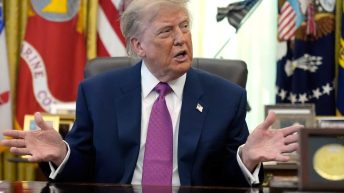
At an unplanned Oval Office exchange, Trump pushed back on the idea that the president should avoid foreign policy and focus only on domestic meetings. He argued that failing to maintain influence abroad leaves the country vulnerable to being dragged into conflicts after the fact. The former president framed global involvement as a practical necessity for protecting American interests at home.
Journalist Kaitlan Collins pressed Trump about Greene’s comments, which urged colleagues to prioritize “America first policies” and to limit “non-stop foreign policy meetings.” Trump responded by questioning what had changed with Greene and insisting that the presidency must be viewed through a global lens. He said, “I don’t know what happened to Marjorie. She’s a nice woman, but I don’t know what happened.”
Trump added that the stakes are high when the United States cedes influence and fails to monitor global flashpoints. He warned that a lack of attention can let wars spread and even reach our shores in extreme scenarios. That was his justification for treating foreign policy as part of the broader MAGA mission.
He then connected this approach to recent history, blaming prior leadership for leaving America exposed to fallout. “We had a horrible president, and we ended up with Russia-Ukraine. And we ended up with other disasters, too. Don’t forget, I put out eight wars, nine to come…and look at the damage that Russia-Ukraine has done to us as a country,” he said exactly as quoted.
Trump emphasized the monetary and strategic costs he associates with those developments, arguing that U.S. resources were strained and that the country lost leverage. “We spent three hundred and fifty billion. We’re not spending any money anymore. They completely pay us through NATO,” he said, repeating his point about burden-sharing and financial exposure. He framed active engagement as a way to deter escalation and avoid being pulled into larger conflicts.
At one moment Trump made a stark claim about how close the country came to a larger war, asserting that the Russia-Ukraine situation might have spiraled toward World War III if he had not been in office. “It’s not going to anymore,” he declared, offering reassurance that his approach would prevent similar escalations in the future. That line underscores his central message: strong leadership abroad protects Americans at home.
Collins later shared Representative Greene’s response to Trump’s remark that she had “lost her way,” and Greene’s team issued a short statement defending her stance. It read: “After President Trump told me in the Oval that she had “lost her way,” Rep. Marjorie Taylor Greene responds, telling us in a statement provided by her team: “I haven’t lost my way. I’m 100% America first and only!””
The exchange highlighted a fault line in conservative thinking about foreign policy: whether America should retrench or remain assertive abroad. Trump framed assertiveness as essential to the America First project, arguing that influence at the table prevents worse outcomes later. His remarks suggested that isolationism risks inviting chaos that eventually spills into U.S. interests.
An editorial note included in the original coverage voiced sharp criticism of Democratic tactics on domestic funding and labeled the shutdown as punitive rather than principled. It stated, “After more than 40 days of screwing Americans, a few Dems have finally caved. The Schumer Shutdown was never about principle—just inflicting pain for political points.” That sentence appears here exactly as it was printed.
The debate between Greene and Trump reflects broader questions about the balance between domestic priorities and international engagement. Trump insists his brand of MAGA requires a global posture to shield American prosperity and security, while Greene’s comments push for slowing the pace of foreign involvement. Both positions claim to serve American interests, but they offer very different paths forward.


Add comment