
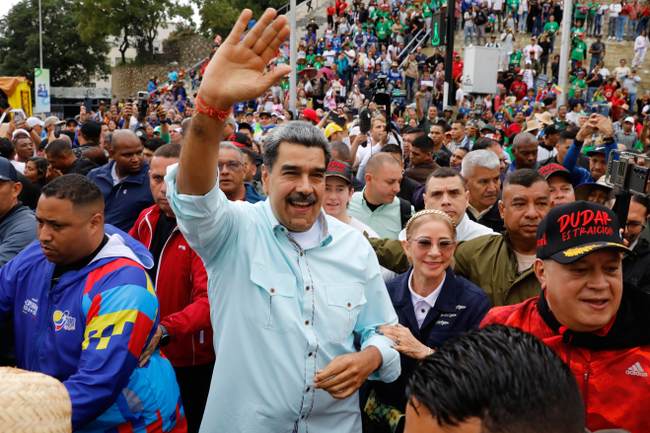
U.S. forces captured Nicolás Maduro and Cilia Flores and flew them to New York to face federal charges, but removing two people from power won’t dismantle the entrenched Chavismo network. This article looks at the arrests, courtroom scenes, the remaining power players—Delcy Rodríguez, Jorge Rodríguez, Vladimir Padrino López, and Diosdado Cabello—and why Venezuelans fear a dangerous vacuum unless more of the regime is rooted out.
Maduro and Flores were brought to the Southern District of New York to face a sweeping indictment: Narco-Terrorism Conspiracy, Cocaine Importation Conspiracy, possession of machineguns and destructive devices, and related counts. The operation to detain them in Venezuela and transfer them to the United States was described by observers as a near-flawless military and law enforcement effort. The arraignment unfolded quickly, and federal authorities moved to process and incarcerate both pending trial.
At the arraignment Maduro erupted, insisting in Spanish that he was the rightful ruler and calling himself a “prisoner of war” and “a Man of God.” The judge cut him off and pressed the proceeding forward while Flores entered a plea of being “completely innocent.” The spectacle offered a stark contrast: a man used to running a country now facing American justice in custody, and a wife who was no passive bystander but a powerful operator in her own right.
Far more than a first lady, Ms. Flores is one of Venezuela’s most powerful political figures. She built extraordinary influence over decades while largely operating from the shadows. Ms. Flores shaped a judicial system in which nearly every major decision ran through her and embedded state institutions with relatives and loyalists, according to journalists, analysts and former officials. At the same time, they noted, her family amassed vast, unexplained wealth.
A lawyer from a lower middle class background, Ms. Flores began her political rise in the 1990s, becoming close to Hugo Chávez — the former president who was Mr. Maduro’s mentor and predecessor — while he was imprisoned after a failed coup attempt in 1992. She steadily climbed the ranks of Chávez’s socialist movement, known as chavismo, becoming a central figure in Venezuela’s legislature.
Ms. Flores and Mr. Maduro have been partners since at least the late 1990s, when both were lawmakers. They married in 2013, the year he became president. After Mr. Chávez’s death, she was widely seen as critical to consolidating and sustaining Mr. Maduro’s hold on power, bringing a loyal political base and deep institutional influence.
Even with Maduro and Flores detained, immediate control in Venezuela did not automatically transfer to reformers. Maduro loyalists remain embedded in the state, and Delcy Rodríguez, long seen as a senior power broker, emerged as the acting president. Analysts and Venezuelan voices argue that unless key Chavismo figures are removed, a simple decapitation of the regime could create a violent scramble for power rather than a democratic transition.
Journalists who follow Venezuela stress that Delcy and others must go for Venezuelans to taste real freedom and institutional repair. Rodríguez issued a public message—posted in both English and Spanish—pledging peace and cooperation while calling for respectful international relations. That public pitch looks like damage control meant to reassure foreign governments, but many Venezuelans remain skeptical because the inner circle’s actions tell a different story.
WATCH:
Trump administration officials signaled they expect cooperation from Martínez’s successors, but rhetoric from Washington warned that noncooperation would carry heavy consequences. Commentators point out that removing a single kingpin does not dissolve a decades-deep network of military and economic interests that Chavismo built. The regime is armored by loyalists across security services, the judiciary, and the state bureaucracy.
Rodríguez’s public shift—or apparent softening—may be tactical. She posted a long statement about peace, sovereignty, and cooperation, framing Venezuela as a nation seeking dialogue. That message did not convince critics who recalled her role inside the administration; for many Venezuelans, her words ring hollow when family members and allies are still maneuvering to retain control.
People who lived through the worst of Chavismo warn that cornered regimes become unpredictable and dangerous. Delcy’s brother, Jorge Rodríguez, immediately pledged legal and political actions to free Maduro and Flores, positioning himself as a rallying figure within the legislature. That pledge underscores how family networks and institutional capture can produce immediate resistance to any outside intervention.
Vladimir Padrino López, the long-serving defense minister, oversees the military apparatus and is widely credited with enforcing the regime’s brutal policies. Padrino’s name comes up repeatedly when analysts discuss who could lead a violent counterstrike or block efforts toward transition. Meanwhile, Diosdado Cabello Rondón, with influence over intelligence and security, is painted as the most ideological and unpredictable element of Chavismo.
Observers warn that figures like Cabello and Padrino are ready to fill any vacuum left by Maduro’s removal, perhaps with a ferocity surpassing the old guard. “Chavismo is an armored structure of military and economic interests,” one analyst translated, and without a sovereign transition plan the capture risks opening space for more radical actors. That concern explains why some experts argue the U.S. action must be followed by a credible, multilateral strategy to dismantle the regime’s pillars.
Certain commentators call the operation a miscalculation in the absence of a clear plan for what comes next, and critics are amplifying that worry. Yet for many Venezuelans who suffered under authoritarian rule and economic collapse, the sight of Maduro in custody is a moment of accountability. The critical question now is whether the international community moves fast enough to prevent a chaotic power grab by the remaining Chavismo elite.
As the region watches, the coming days will reveal whether the stated commitments to peace and cooperation are sincere or merely rhetorical cover for those who hope to keep the old system intact. The stakes are high: a rushed exit without a plan could trade one dictator for a more dangerous stalemate.
Add comment