
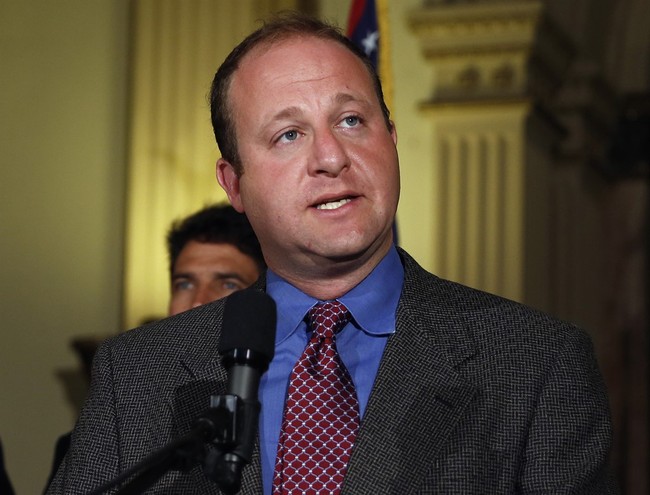
I’ll examine Jared Polis’ commutation of Tina Peters’ sentence, contrast it with other Colorado cases, lay out Polis’ public defense of his decision, report reactions from Democrats and media, and include the key quoted exchanges and videos tied to the story.
Colorado Governor Jared Polis reduced Tina Peters’ nearly nine-year sentence to four-and-a-half years, a move that set off a firestorm from Democratic officials and much of the legacy press. From a Republican viewpoint, Polis’ action reads like a rare instance of a Democrat governor recognizing an overreach by prosecutors and judges and stepping in to restore a measure of fairness. The controversy centers on whether Peters’ punishment matched similar cases and whether her conviction punished speech rather than criminal conduct.
Peters’ 2024 conviction involved exposing certain voting machine data and being found guilty of election interference and attempting to influence a public official. Critics on the Left framed the commutation as dangerous leniency that undermines confidence in elections, while many on the Right saw Polis’ move as correcting an unusually harsh sentence. The governor pointed to comparable cases that received far lighter treatment as evidence of inconsistency in Colorado’s criminal penalties.
Polis highlighted Sonja Jaquez Lewis, a former state senator and Democrat, as a contrast in outcomes; her case resulted in probation, community service, and a fine despite facing felony indictments tied to false statements. That discrepancy formed the core of Polis’ argument that Peters’ original sentence was atypically severe for a nonviolent, first-time offender. From a Republican angle, that inconsistency underlines concerns about selective punishment when political sympathies are involved.
However, this is an extremely unusual and lengthy sentence for a first time offender who committed nonviolent crimes.
I agree with the principle highlighted by the Colorado Court of Appeals in your case that, “…the First Amendment generally prohibits punishing someone for their protected speech. ‘[A] court may not punish an individual by imposing a heavier sentence for the exercise of [F]irst [A]mendment rights. . . . A sentence based to any degree on activity or beliefs protected by the [F]irst [A]mendment is constitutionally invalid.’”
Further I agree, in this case, “[T]he trial court’s comments about Peters’s belief in the existence of 2020 election fraud went beyond relevant considerations for her sentencing. Her offense was not her belief, however misguided the trial court deemed it to be, in the existence of such election fraud; it was her deceitful actions in her attempt to gather evidence of such fraud.
Indeed, under these circumstances, just as her purported beliefs underlying her motive for her actions were not relevant to her defense, the trial court should not have considered those beliefs relevant when imposing sentence.”
Polis recorded a video and sat for interviews explaining why he cut the sentence nearly in half, repeatedly stressing that Peters’ crimes were not federal and had nothing to do with the 2020 presidential result. That point matter-of-factly undercuts liberal attempts to tie the commutation to a broader narrative about 2020 election denialism. The governor framed his decision as addressing proportionality, not pardoning wrongdoing.
When pressed on CNN by Kaitlan Collins about whether the events in Mesa County flowed from the 2020 election atmosphere, Polis refused to accept simplistic links. He acknowledged that outside actors might have encouraged Peters, but emphasized that the convictions were about specific actions in a municipal election, not a federal conspiracy. His tone in those interviews was measured and centered on law, not partisan theater.
POLIS: Thousands of people, of course, have weighed in, people called my office, some incorrectly thought she didn’t commit a crime, as the president did, thought she should be pardoned — we’re going to fight the president’s illegal pardon in court. Some like me thought she was guilty, should have had a slightly lower sentence. Others wanted her to stay there for a long time and fundamentally misunderstood the crime. Thought it had something to do with the 2020 election or election conspiracy around Trump and Biden, when the crime had zero to do with that.
COLLINS: You don’t think its.. its.. had Trump not disputed the 2020 election, had Mike Lindell not become this famous figure on TV disputing the election results in 2020, that what happened in 2021 in Mesa County would have happened?
POLIS: Well, to be clear: this was the clerk that certified the 2020 election results. There was not an issue there. There were some issues around her competency [COLLINS interrupts] This was a municipal election —
COLLINS: I’m just asking, if you don’t think that what happened in 2020… you don’t think this would have happened? You just think that those are totally separate? That this would have occurred even if the president, if that never happened in 2020 with a major election dispute, pressure on the Vice President, and on state election officials, from Georgia to Colorado to wherever, on that. You don’t think that would have happened?
POLIS: You’d have to have her on to talk about her motivation. Do I think that she was egged on or encouraged in her illegal acts by people like Mike Lindell, or perhaps, even, the President of the United States, it’s certainly conjecture, but it’s certainly possible. I don’t know how she came to hold her beliefs. I certainly believe that there are incorrect, dangerous beliefs that are held in certain circles in our country.
Ultimately it’s a matter of free speech until you cross the line and violate the law, which she did. And that’s why she committed the crime and she should do the crime with a sentence that’s tough and fair. That’s why she’ll… her sentence has been adjusted to four-and-a-half years, which is a very severe sentence for what she did. When again, another public official in Colorado got probation only for one of these acts of felony and three other felonies.
Polis’ stance exposed the media’s tendency to turn nuance into headlines that sell. Democrats and some elected officials reacted as if clemency equaled endorsement, but Polis framed his move as a narrow correction of sentencing excess. From a conservative view, the louder accusations often looked like political self-preservation and attempt to weaponize every legal decision into a partisan rallying cry.
Courtroom footage from Peters’ sentencing shows a judge excoriating her in florid terms, language many on the Right argue crossed into punishing belief rather than conduct. That judge called her a charlatan and warned her words were as damaging as violence, a depiction Republicans see as a dangerous erosion of free expression when wielded by an activist bench. Polis seized on that narrative to argue the sentence had improperly factored beliefs into punishment.
Yes, you are a charlatan. And you cannot help but lie as easy it is as you to breathe.
And this is what makes Ms. Peters such a danger to our community. It’s the position she held that has provided her the pulpit from which she can preach these lies. The undermining of our democratic process. The undermining of the belief and confidence in our election systems. It’s not about questioning it, no one says you can’t question, you can’t ask, it’s completely different. And if you don’t understand, nothing I can say or do here today that will change your mind. So, the damage that is caused and continue to be caused, is just as bad, if not worse, than the physical violence that this court sees on an all too regular basis. And it’s particularly damaging when those words comes from someone who holds a position of influence like you.
Democratic Secretary of State Jena Griswold and other critics insisted the commutation sent the wrong signal amid concerns about election security, and they used the media to amplify that view. Republicans counter that protecting liberty means guarding against judicial overreach and selective punishment, even when the defendant’s politics are unpalatable to the bipartisan establishment. Polis’ commutation, controversial as it is, will be debated in courts and politics for months to come.


Add comment